Hunt Martin, Bradley Phelim, Lapierre Simon Grandjean, Heys Simon, Thomsit Mark, Hall Michael B, Malone Kerri M, Wintringer Penelope, Walker Timothy M, Cirillo Daniela M, Comas Iñaki, Farhat Maha R, Fowler Phillip, Gardy Jennifer, Ismail Nazir, Kohl Thomas A, Mathys Vanessa, Merker Matthias, Niemann Stefan, Omar Shaheed Vally, Sintchenko Vitali, Smith Grace, van Soolingen Dick, Supply Philip, Tahseen Sabira, Wilcox Mark, Arandjelovic Irena, Peto Tim E A, Crook Derrick W, Iqbal Zamin
European Bioinformatics Institute, Cambridge, UK.
Nuffield Department of Medicine, University of Oxford, Oxford, UK.
Wellcome Open Res. 2019 Dec 2;4:191. doi: 10.12688/wellcomeopenres.15603.1. eCollection 2019.
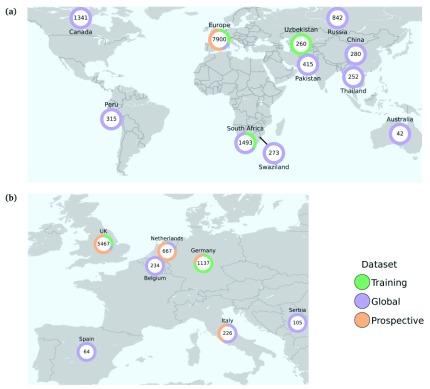
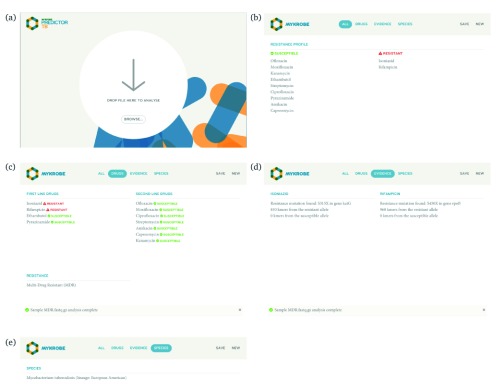
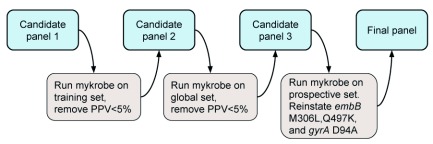
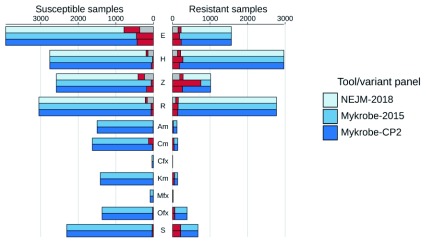
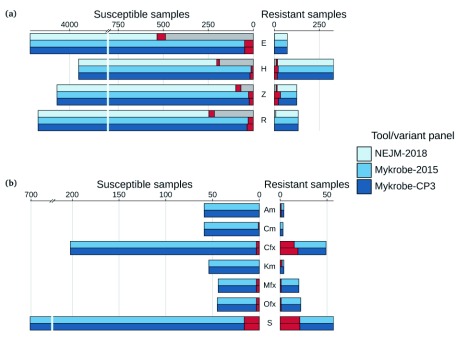
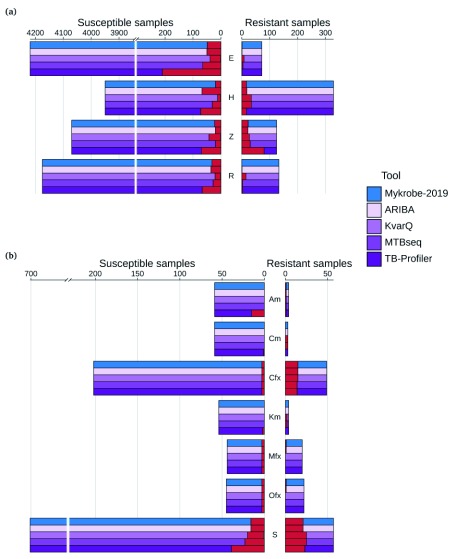
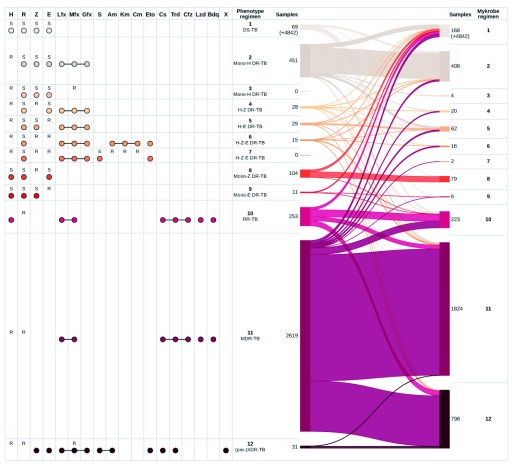
Two billion people are infected with , leading to 10 million new cases of active tuberculosis and 1.5 million deaths annually. Universal access to drug susceptibility testing (DST) has become a World Health Organization priority. We previously developed a software tool, , which provided offline species identification and drug resistance predictions for from whole genome sequencing (WGS) data. Performance was insufficient to support the use of WGS as an alternative to conventional phenotype-based DST, due to mutation catalogue limitations. Here we present a new tool, , which provides the same functionality based on a new software implementation. Improvements include i) an updated mutation catalogue giving greater sensitivity to detect pyrazinamide resistance, ii) support for user-defined resistance catalogues, iii) improved identification of non-tuberculous mycobacterial species, and iv) an updated statistical model for Oxford Nanopore Technologies sequencing data. is released under MIT license at https://github.com/mykrobe-tools/mykrobe. We incorporate mutation catalogues from the CRyPTIC consortium et al. (2018) and from Walker et al. (2015), and make improvements based on performance on an initial set of 3206 and an independent set of 5845 Illumina sequences. To give estimates of error rates, we use a prospectively collected dataset of 4362 . Using culture based DST as the reference, we estimate to be 100%, 95%, 82%, 99% sensitive and 99%, 100%, 99%, 99% specific for rifampicin, isoniazid, pyrazinamide and ethambutol resistance prediction respectively. We benchmark against four other tools on 10207 (=5845+4362) samples, and also show that gives concordant results with nanopore data. We measure the ability of -based DST to guide personalized therapeutic regimen design in the context of complex drug susceptibility profiles, showing 94% concordance of implied regimen with that driven by phenotypic DST, higher than all other benchmarked tools.
全球有20亿人感染结核分枝杆菌,每年导致1000万例新的活动性肺结核病例和150万人死亡。普及药敏试验(DST)已成为世界卫生组织的一项优先事项。我们之前开发了一个软件工具Mykrobe,它能根据全基因组测序(WGS)数据对结核分枝杆菌进行离线菌种鉴定和耐药性预测。由于突变目录的局限性,其性能不足以支持将WGS用作基于传统表型的DST的替代方法。在此,我们展示了一个新工具Mykrobe 2.0,它基于新的软件实现提供相同的功能。改进之处包括:i)更新的突变目录,对检测吡嗪酰胺耐药性具有更高的敏感性;ii)支持用户定义的耐药目录;iii)改进了非结核分枝杆菌菌种的鉴定;iv)更新了针对牛津纳米孔技术测序数据的统计模型。Mykrobe 2.0根据麻省理工学院许可在https://github.com/mykrobe-tools/mykrobe上发布。我们纳入了来自CRyPTIC联盟等(2018年)以及Walker等人(2015年)的突变目录,并根据最初的3206个和独立的5845个Illumina序列集的性能进行改进。为了估计错误率,我们使用了一个前瞻性收集的4362个结核分枝杆菌数据集。以基于培养的DST作为参考,我们估计Mykrobe 2.0对利福平、异烟肼、吡嗪酰胺和乙胺丁醇耐药性预测的敏感性分别为100%、95%、82%、99%,特异性分别为99%、100%、99%、99%。我们在10207个(=5845 + 4362)样本上与其他四个工具进行基准测试,并且还表明Mykrobe 2.0与纳米孔数据给出的结果一致。我们衡量了基于Mykrobe 2.0的DST在复杂药敏谱背景下指导个性化治疗方案设计的能力,结果表明其隐含方案与表型DST驱动的方案的一致性为94%,高于所有其他基准测试工具。