Department of Biomedical Informatics, Harvard Medical School, Boston, MA, USA.
Department of Systems Biology, Harvard Medical School, Boston, MA, USA.
Genome Med. 2021 Aug 30;13(1):138. doi: 10.1186/s13073-021-00953-4.
Multidrug-resistant Mycobacterium tuberculosis (Mtb) is a significant global public health threat. Genotypic resistance prediction from Mtb DNA sequences offers an alternative to laboratory-based drug-susceptibility testing. User-friendly and accurate resistance prediction tools are needed to enable public health and clinical practitioners to rapidly diagnose resistance and inform treatment regimens.
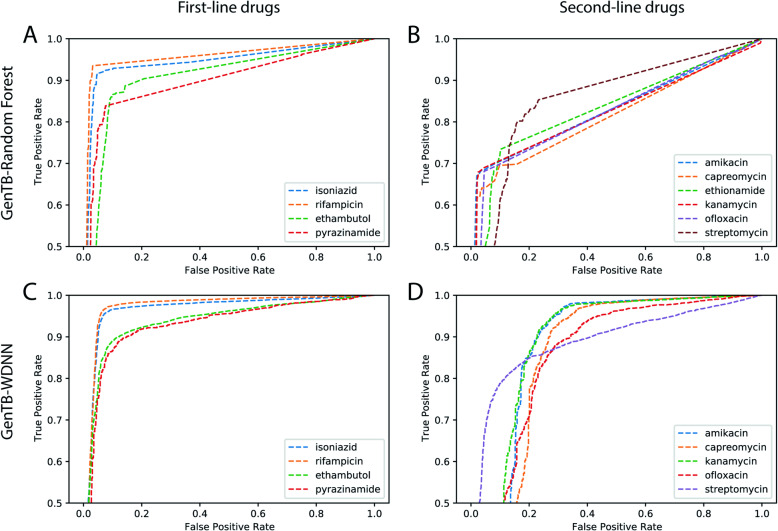
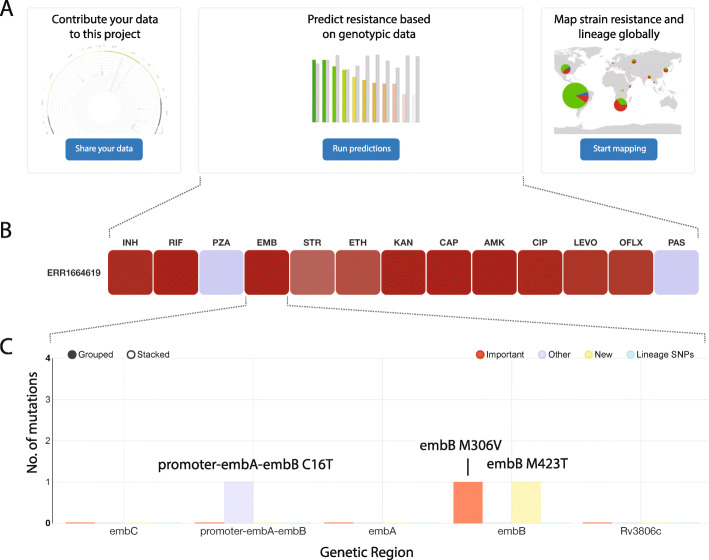
We present Translational Genomics platform for Tuberculosis (GenTB), a free and open web-based application to predict antibiotic resistance from next-generation sequence data. The user can choose between two potential predictors, a Random Forest (RF) classifier and a Wide and Deep Neural Network (WDNN) to predict phenotypic resistance to 13 and 10 anti-tuberculosis drugs, respectively. We benchmark GenTB's predictive performance along with leading TB resistance prediction tools (Mykrobe and TB-Profiler) using a ground truth dataset of 20,408 isolates with laboratory-based drug susceptibility data. All four tools reliably predicted resistance to first-line tuberculosis drugs but had varying performance for second-line drugs. The mean sensitivities for GenTB-RF and GenTB-WDNN across the nine shared drugs were 77.6% (95% CI 76.6-78.5%) and 75.4% (95% CI 74.5-76.4%), respectively, and marginally higher than the sensitivities of TB-Profiler at 74.4% (95% CI 73.4-75.3%) and Mykrobe at 71.9% (95% CI 70.9-72.9%). The higher sensitivities were at an expense of ≤ 1.5% lower specificity: Mykrobe 97.6% (95% CI 97.5-97.7%), TB-Profiler 96.9% (95% CI 96.7 to 97.0%), GenTB-WDNN 96.2% (95% CI 96.0 to 96.4%), and GenTB-RF 96.1% (95% CI 96.0 to 96.3%). Averaged across the four tools, genotypic resistance sensitivity was 11% and 9% lower for isoniazid and rifampicin respectively, on isolates sequenced at low depth (< 10× across 95% of the genome) emphasizing the need to quality control input sequence data before prediction. We discuss differences between tools in reporting results to the user including variants underlying the resistance calls and any novel or indeterminate variants CONCLUSIONS: GenTB is an easy-to-use online tool to rapidly and accurately predict resistance to anti-tuberculosis drugs. GenTB can be accessed online at https://gentb.hms.harvard.edu , and the source code is available at https://github.com/farhat-lab/gentb-site .
耐多药结核分枝杆菌(Mtb)是一个重大的全球公共卫生威胁。从 Mtb DNA 序列预测基因型耐药性为实验室药物敏感性测试提供了替代方法。需要用户友好且准确的耐药性预测工具,使公共卫生和临床医生能够快速诊断耐药性并告知治疗方案。
我们提出了结核病转化基因组学平台(GenTB),这是一个免费的开源基于网络的应用程序,用于从下一代测序数据预测抗生素耐药性。用户可以在随机森林(RF)分类器和宽深神经网络(WDNN)之间进行选择,分别预测对 13 种和 10 种抗结核药物的表型耐药性。我们使用具有实验室药物敏感性数据的 20,408 个分离株的真实数据集,与领先的结核耐药预测工具(Mykrobe 和 TB-Profiler)一起对 GenTB 的预测性能进行了基准测试。所有四种工具都可靠地预测了一线抗结核药物的耐药性,但二线药物的性能存在差异。GenTB-RF 和 GenTB-WDNN 在九种共享药物中的平均敏感性分别为 77.6%(95%CI 76.6-78.5%)和 75.4%(95%CI 74.5-76.4%),略高于 TB-Profiler 的 74.4%(95%CI 73.4-75.3%)和 Mykrobe 的 71.9%(95%CI 70.9-72.9%)。较高的敏感性是以≤1.5%的特异性降低为代价的:Mykrobe 为 97.6%(95%CI 97.5-97.7%),TB-Profiler 为 96.9%(95%CI 96.7 至 97.0%),GenTB-WDNN 为 96.2%(95%CI 96.0 至 96.4%),GenTB-RF 为 96.1%(95%CI 96.0 至 96.3%)。在四种工具的平均值中,异烟肼和利福平的基因型耐药性敏感性分别低 11%和 9%,这是由于对低深度(95%基因组的<10×)测序的分离物进行测序所致,强调在预测之前需要对输入序列数据进行质量控制。我们讨论了工具在向用户报告结果方面的差异,包括耐药性检测结果背后的变异以及任何新的或不确定的变异。
GenTB 是一种易于使用的在线工具,可快速准确地预测抗结核药物的耐药性。GenTB 可在 https://gentb.hms.harvard.edu 在线访问,源代码可在 https://github.com/farhat-lab/gentb-site 获得。