Hunan Provincial Key Laboratory of Protein Engineering in Animal Vaccines, College of Veterinary Medicine, Hunan Agricultural University (HUNAU), No. 1 Nongda road, Furong District, Changsha, 410128, People's Republic of China.
Institute of Innovation and Applied Research in Chinese Medicine, Hunan University of Chinese Medicine, Changsha, 410208, People's Republic of China.
Arch Virol. 2020 Apr;165(4):877-889. doi: 10.1007/s00705-020-04532-7. Epub 2020 Feb 13.
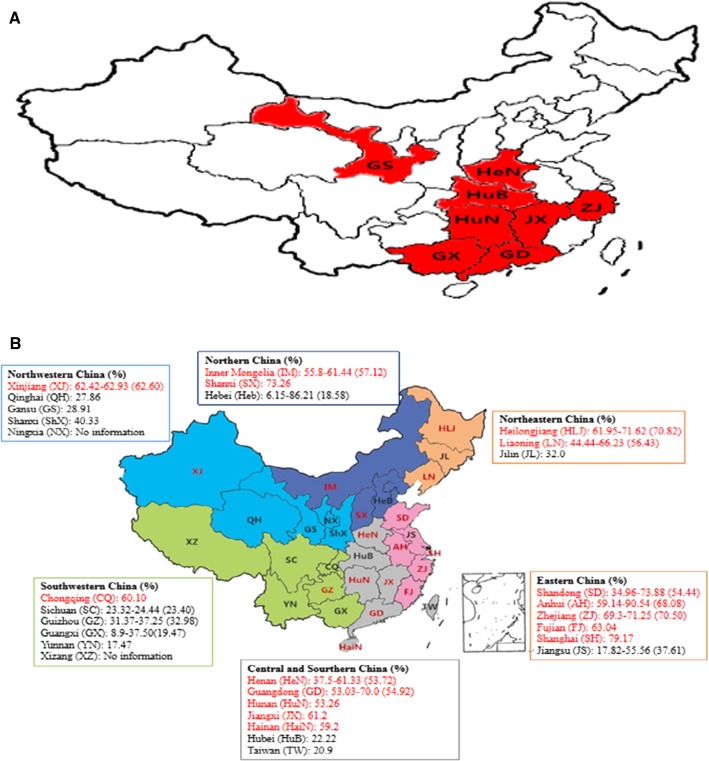
Outbreaks of porcine epidemic diarrhea (PED) caused by porcine epidemic diarrhea virus (PEDV) infection have caused high mortality of piglets and significant economic losses to the Chinese swine industry. In the current study, 184 specimens from pigs with or without signs of diarrhea were collected from 39 farms across eight provinces, mainly around Hunan, People's Republic of China, in 2017 to 2018 in order to obtain epidemiological information on PEDV infections in these regions. The results indicated an average PEDV-positive rate of 38.04% (70/184) and more-pronounced disease severity in diarrheic pigs (48.76%; 59/121) than in non-diarrheic pigs (17.46%; 11/63). Phylogenetic and sequence analysis demonstrated that 14 representative PEDV strains from 14 swine farms belonged to the G2 group (G2-a and G2-b subgroups) and displayed a high degree of genetic variation. In particular, two out of the 14 PEDV strains were found to have unique indels in the S1 gene. The strain HN-SY-2017-Oct had a 9-nucleotide (TGAAGCCAATT) insertion, and the strain ZJ-2018-May had a 3-nucleotide (AAA) deletion at position 1126 in the S1 gene. A three-dimensional structural prediction revealed that these unique insertions might lengthen the loop on the surface or increase the likelihood of the surface protein being phosphorylated at Y, thereby affecting the virulence or pathogenicity of PEDV. Collectively, the data show that PED remains a severe threat to the pig industry and that variant PEDV stains are circulating in China. The updated PEDV epidemiological data will facilitate the design of PEDV vaccines and the application of effective measures for PED prevention.
2017 年至 2018 年期间,从中国 8 个省份的 39 个农场中采集了 184 份有或无症状腹泻猪的样本,这些农场主要集中在湖南省周边,以获得这些地区猪流行性腹泻病毒(PEDV)感染的流行病学信息。结果显示,PEDV 阳性率平均为 38.04%(70/184),腹泻猪(48.76%;59/121)比非腹泻猪(17.46%;11/63)的疾病严重程度更高。系统进化和序列分析表明,来自 14 个猪场的 14 株代表性 PEDV 属于 G2 组(G2-a 和 G2-b 亚群),具有高度的遗传变异。特别是,在 14 株 PEDV 株中,有两株在 S1 基因中发现了独特的缺失。菌株 HN-SY-2017-Oct 在 S1 基因中有一个 9 个核苷酸(TGAAGCCAATT)的插入,而菌株 ZJ-2018-May 在位置 1126 有一个 3 个核苷酸(AAA)的缺失。三维结构预测显示,这些独特的插入可能会使表面的环变长或增加表面蛋白在 Y 位被磷酸化的可能性,从而影响 PEDV 的毒力或致病性。总之,数据表明 PED 仍然是养猪业的严重威胁,并且在中国流行的变异 PEDV 株。更新的 PEDV 流行病学数据将有助于设计 PEDV 疫苗和应用有效的 PED 预防措施。