Division of Cancer Metastasis and Recurrence, CRUK Beatson Institute, Glasgow, UK.
Institute of Cancer Sciences, University of Glasgow, Glasgow, UK.
J Pathol. 2020 Apr;250(5):612-623. doi: 10.1002/path.5395. Epub 2020 Mar 14.
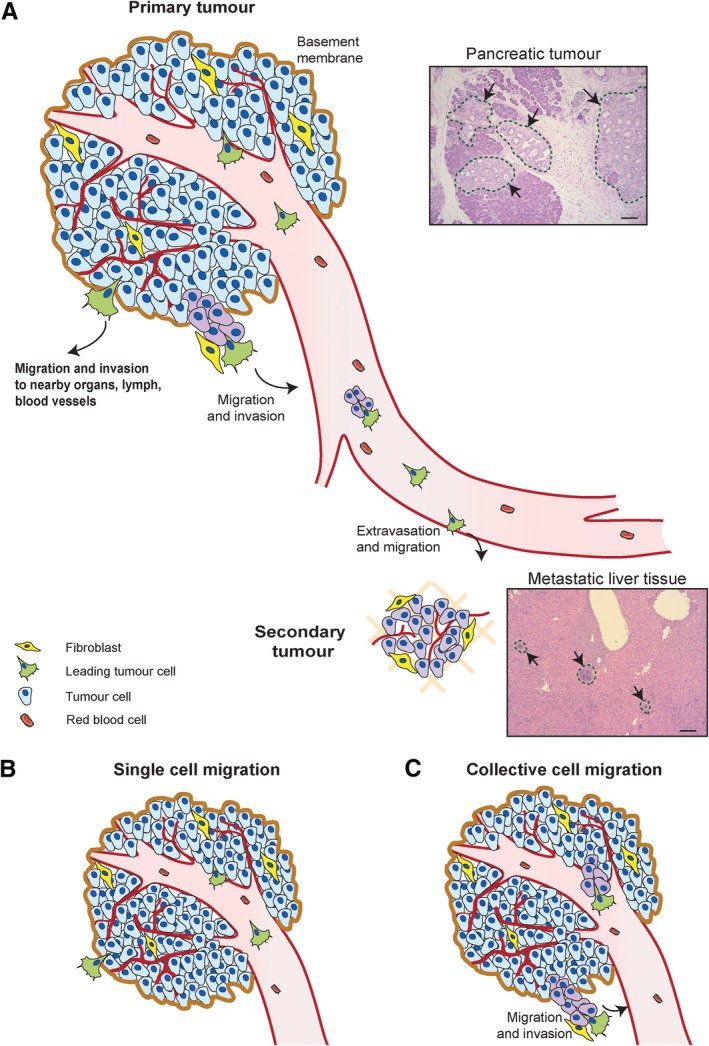
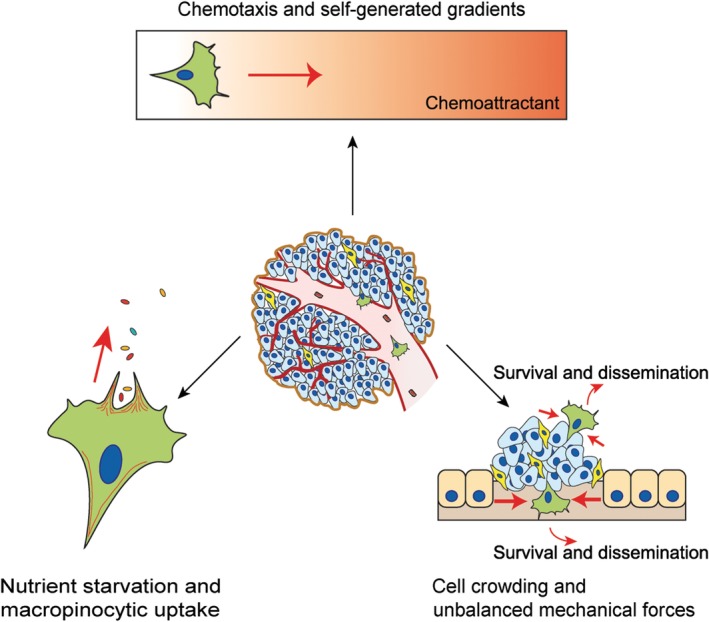
Tumours evolve to cope with environmental stresses or challenges such as nutrient starvation, depletion of survival factors, and unbalanced mechanical forces. The uncontrolled growth and aberrant deregulation of core cell homeostatic pathways induced by genetic mutations create an environment of stress. Here, we explore how the adaptations of tumours to the changing environment can drive changes in the motility machinery of cells, affecting migration, invasion, and metastasis. Tumour cells can invade individually or collectively, or they can be extruded out of the surrounding epithelium. These mechanisms are thought to be modifications of normal processes occurring during development or tissue repair. Therefore, tumours may activate these pathways in response to environmental stresses, enabling them to survive in hostile environments and spread to distant sites. © 2020 The Authors. The Journal of Pathology published by John Wiley & Sons Ltd on behalf of Pathological Society of Great Britain and Ireland.
肿瘤为了应对环境压力或挑战而进化,如营养饥饿、生存因子枯竭以及机械力失衡。遗传突变引起的核心细胞内稳态途径的不受控制的生长和异常失调,会产生压力环境。在这里,我们探讨了肿瘤对不断变化的环境的适应如何驱动细胞运动机制的变化,从而影响迁移、侵袭和转移。肿瘤细胞可以单独或集体侵袭,或者可以从周围上皮细胞中挤出。这些机制被认为是在发育或组织修复过程中发生的正常过程的修饰。因此,肿瘤可能会激活这些途径以应对环境压力,使它们能够在恶劣环境中存活并扩散到远处。© 2020 作者。病理学杂志由 John Wiley & Sons Ltd 代表英国和爱尔兰的病理学学会出版。