Department of Psychological Sciences, Purdue University, West Lafayette, IN.
Department of Psychology, University of North Carolina at Greensboro, Greensboro, NC.
J Pediatr. 2020 Apr;219:180-187. doi: 10.1016/j.jpeds.2019.12.002. Epub 2020 Feb 11.
To examine the cross-sectional associations between young adolescents' access, use, and perceived impairments related to digital technologies and their academic, psychological, and physical well-being.
There were 2104 adolescents (ages 10-15 years), representative of the North Carolina Public School population, who completed questionnaires in 2015. Administrative educational records were linked with parental consent.
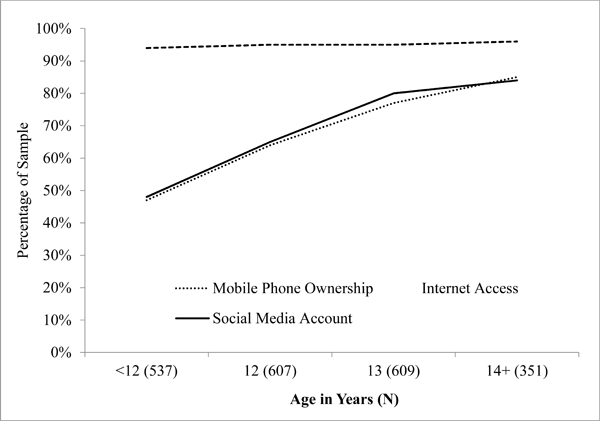
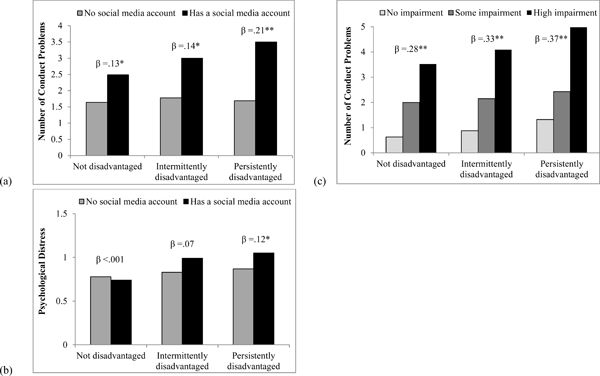
Nearly all young adolescents (95%) had Internet access, 67% owned a mobile phone, and 68% had a social media account. Mobile phone ownership was not associated with any indicators of well-being (math and reading test scores, school belonging, psychological distress, conduct problems, or physical health) after controlling for demographic factors. Having a social media account and frequency of social media use were only robustly associated with conduct problems (explaining ∼3% of the variation in conduct problems). Despite the lack of strong associations, 91% of adolescents reported at least 1 perceived technology-related impairment and 29% of adolescents reported online-to-offline spillover of negative experiences. Economically disadvantaged adolescents reported similar access, but greater online-to-offline spillover and stronger associations between social media account ownership and poor psychological well-being compared with their more affluent peers.
At the population level, there was little evidence that digital technology access and use is negatively associated with young adolescents' well-being. Youth from economically disadvantaged families were equally likely to have access to digital technologies, but were more likely than their more affluent peers to report negative online experiences. Closing the digital divide requires prioritizing equity in experiences and opportunities, as well as in access.
探讨青少年获取、使用数字技术以及感知数字技术对其学业、心理和身体健康造成的损害与他们的学术、心理和身体健康之间的横断面关联。
共有 2104 名青少年(年龄在 10-15 岁之间)参与了 2015 年的问卷调查,这些青少年代表了北卡罗来纳州公立学校的学生群体。行政教育记录与父母同意相关联。
几乎所有的青少年(95%)都可以上网,67%的青少年拥有手机,68%的青少年拥有社交媒体账户。在控制了人口因素后,手机拥有量与任何幸福指标(数学和阅读考试成绩、学校归属感、心理困扰、行为问题或身体健康)均无关联。拥有社交媒体账户和使用社交媒体的频率仅与行为问题显著相关(解释行为问题变化的约 3%)。尽管没有很强的关联,但 91%的青少年报告至少有 1 项感知与技术相关的损害,29%的青少年报告了负面在线体验向线下的溢出。与经济条件较好的同龄人相比,经济条件较差的青少年报告了类似的获取情况,但他们的负面在线体验向线下溢出的情况更多,并且拥有社交媒体账户与较差的心理健康之间的关联更强。
在人群层面上,几乎没有证据表明数字技术的获取和使用与青少年的幸福感呈负相关。来自经济条件较差家庭的青少年同样有可能接触到数字技术,但他们比经济条件较好的同龄人更有可能报告负面的在线体验。缩小数字鸿沟需要优先考虑公平的体验和机会,以及公平的获取途径。