Opt Lett. 2020 Feb 15;45(4):828-831. doi: 10.1364/OL.382898.
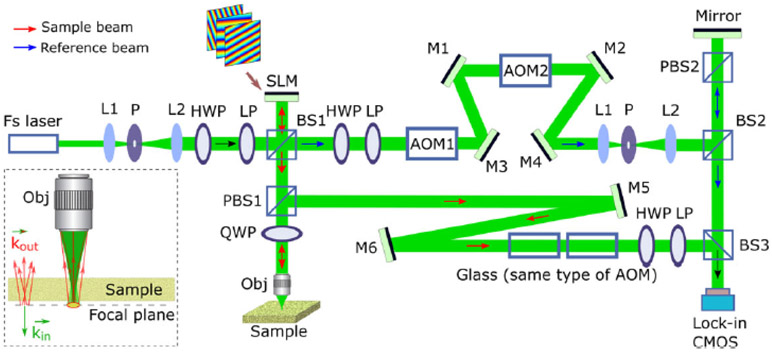
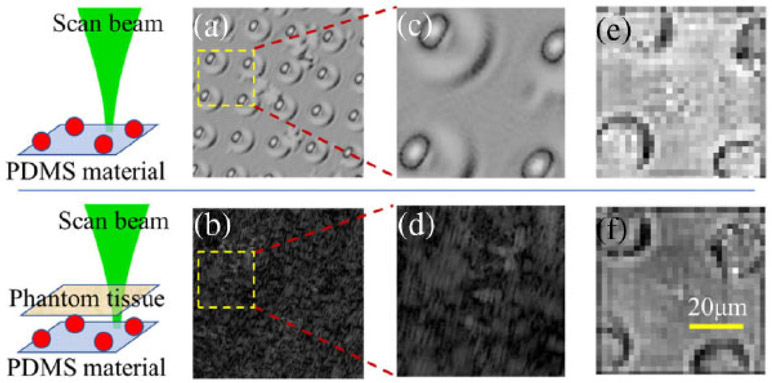
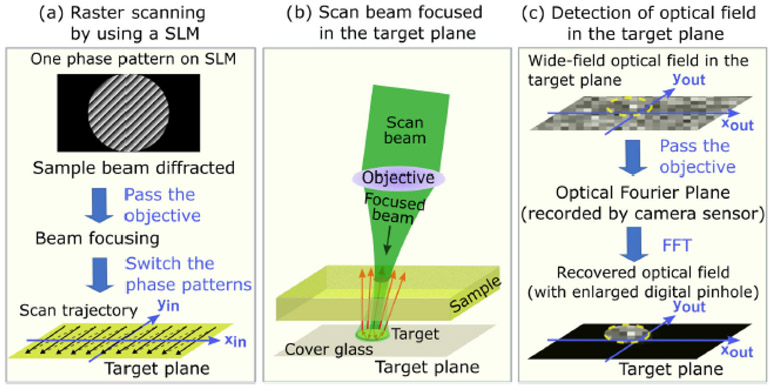
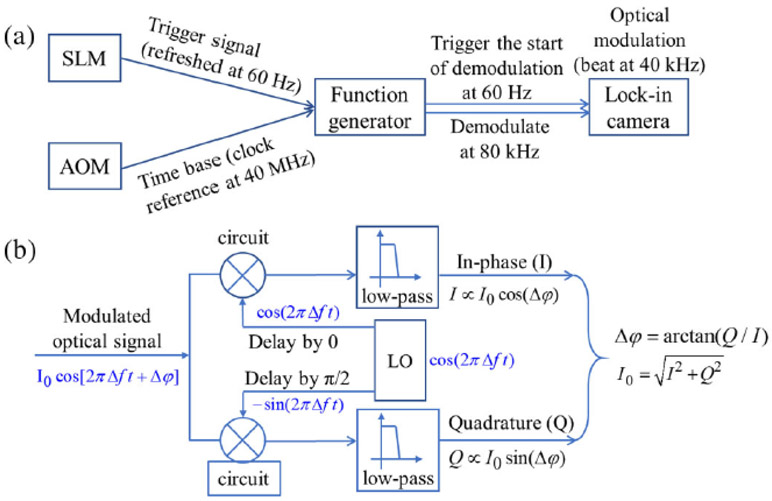
Multiple light scattering in biomedical tissue limits the penetration depth of optical imaging systems such as optical coherence tomography. To increase the imaging depth in scattering media, a computational method based on coherent reflection matrix measurement has been developed using low coherence interferometry. The complex reflection matrix is obtained via point-by-point scanning followed by a phase-shifting method; then singular value decomposition is used to retrieve the singly back-scattered light. However, the in vivo application of the current reported method is limited due to the slow acquisition speed of the matrix. In this Letter, a wide-field heterodyne-detection method is adopted to speed up the complex matrix measurement at a deep tissue layer. Compared to the phase-shifting method, the heterodyne-detection scheme retrieves depth-resolved complex amplitudes faster and is more stable without mechanical movement of the reference mirror. As a result, the matrix measurement speed is increased by more than one order of magnitude.
生物医学组织中的多次光散射限制了光学相干层析成像等光学成像系统的穿透深度。为了增加散射介质中的成像深度,已经开发出一种基于相干反射矩阵测量的计算方法,该方法使用低相干干涉测量法。通过逐点扫描和相移法获得复反射矩阵,然后使用奇异值分解来恢复单次背向散射光。然而,由于矩阵的采集速度较慢,目前报道的方法在体内的应用受到限制。在本研究中,采用宽场外差探测方法来提高深层组织中复矩阵的测量速度。与相移法相比,外差探测方案更快地恢复了深度分辨的复振幅,并且不需要参考镜的机械运动,因此更加稳定。结果,矩阵测量速度提高了一个数量级以上。