National Institute for Communicable Diseases of the National Health Laboratory Service, Johannesburg, South Africa.
Department of Pathology, Division of Medical Virology, University of Cape Town, South Africa.
Influenza Other Respir Viruses. 2020 May;14(3):266-273. doi: 10.1111/irv.12724. Epub 2020 Feb 14.
In June 2017, an outbreak of the highly pathogenic avian influenza A(H5N8) was detected in commercial poultry farms in South Africa, which rapidly spread to all nine South African provinces.
We conducted active surveillance for the transmission of influenza A(H5N8) to humans working with infected birds during the South African outbreak.
Influenza A(H5N8)-positive veterinary specimens were used to evaluate the ability of real-time PCR-based assays to detect contemporary avian influenza A(H5N8) strains. Whole genome sequences were generated from these specimens by next-generation sequencing for phylogenetic characterization and screening for mammalian-adaptive mutations.
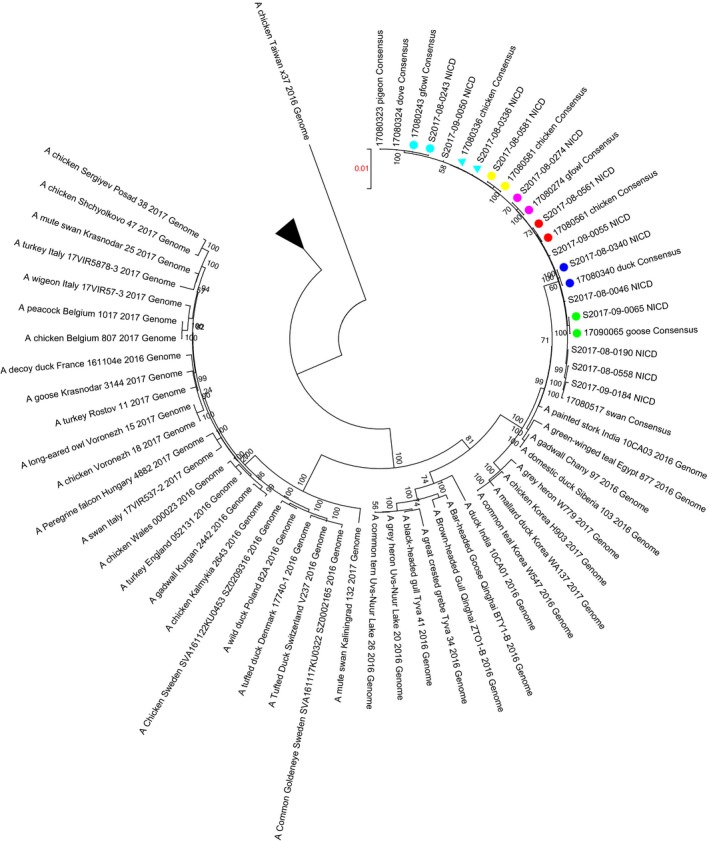
Human respiratory samples from 74 individuals meeting our case definition, all tested negative for avian influenza A(H5) by real-time PCR, but 2 (3%) were positive for human influenza A(H3N2). 54% (40/74) reported wearing personal protective equipment including overalls, boots, gloves, masks, and goggles. 94% (59/63) of veterinary specimens positive for H5N8 were detected on an influenza A(H5) assay for human diagnostics. A commercial H5N8 assay detected H5 in only 6% (3/48) and N8 in 92% (44/48). Thirteen (13/25; 52%) A(H5N8) genomes generated from veterinary specimens clustered in a single monophyletic clade. These sequences contained the NS (P42S) and PB2 (L89V) mutations noted as markers of mammalian adaptation.
Diagnostic assays were able to detect and characterize influenza A(H5N8) viruses, but poor performance is reported for a commercial assay. Absence of influenza A(H5N8) in humans with occupational exposure and no clear impression of molecular adaptation for mammalian infection suggest that this avian pathogen continues to be low-risk human pathogen.
2017 年 6 月,南非商业家禽养殖场爆发高致病性禽流感 A(H5N8)疫情,疫情迅速蔓延至南非所有 9 个省份。
我们对南非疫情期间接触感染鸟类的人群中流感 A(H5N8)的传播进行了主动监测。
使用禽流感 A(H5N8)阳性兽医标本评估基于实时 PCR 的检测方法检测当代禽流感 A(H5N8)毒株的能力。通过下一代测序从这些标本中生成全基因组序列,用于系统发育特征分析和筛选哺乳动物适应性突变。
符合我们病例定义的 74 个人的呼吸道样本,实时 PCR 均检测为禽流感 A(H5)阴性,但 2 例(3%)为人类流感 A(H3N2)阳性。54%(40/74)报告佩戴个人防护装备,包括工作服、靴子、手套、口罩和护目镜。94%(59/63)兽医标本中检测到的 H5N8 经流感 A(H5)人诊断检测呈阳性。商业 H5N8 检测仅在 6%(3/48)的样本中检测到 H5,在 92%(44/48)的样本中检测到 N8。从兽医标本中生成的 13 个(13/25;52%)A(H5N8)基因组聚类为单个单系枝。这些序列包含作为哺乳动物适应性标记的 NS(P42S)和 PB2(L89V)突变。
诊断检测能够检测和鉴定流感 A(H5N8)病毒,但商业检测的性能较差。在有职业接触的人群中未发现流感 A(H5N8),且没有明显的哺乳动物感染分子适应印象,这表明这种禽流感病原体仍然是低风险的人类病原体。