Faculty of Veterinary Medicine, Universida Nacional Autónoma de Mexico, FES Cuatitlan, Guelph, Ontario, Canada.
Department of Clinical Studies, Ontario Veterinary College, University of Guelph, Guelph, Ontario, Canada.
PLoS One. 2020 Feb 14;15(2):e0223697. doi: 10.1371/journal.pone.0223697. eCollection 2020.
In veterinary medicine, the administration of nonsteroidal anti-inflammatory analgesics (NSAIDs) for the control of postsurgical pain in dogs and cats is common given the anti-inflammatory, analgesic, and antipyretic effects of these drugs. This study compared the serum biochemical changes and postoperative analgesic effects of paracetamol, meloxicam, and carprofen in bitches submitted to an ovariohysterectomy using the Dynamic Interactive Visual Analog Scale (DIVAS) and Pain Scale of the University of Melbourne (UMPS) scoring systems.
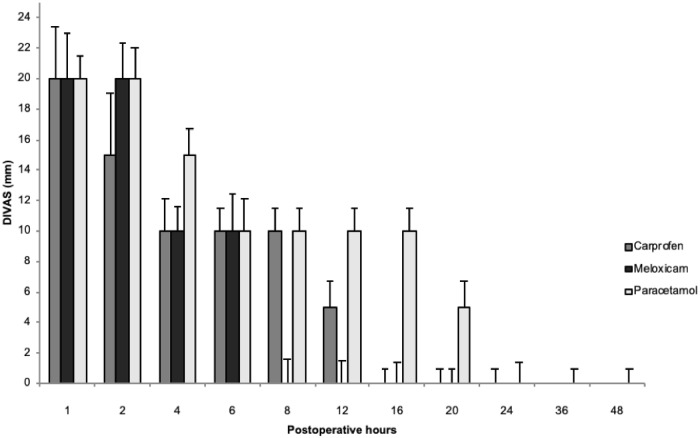
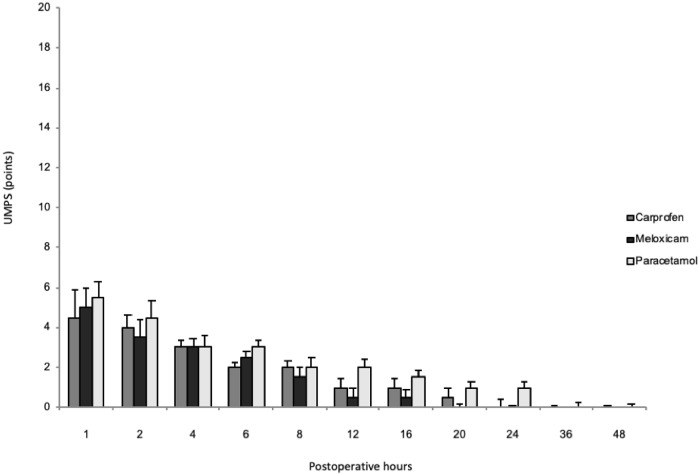
Thirty bitches of different breeds underwent elective ovariohysterectomies and were randomly assigned to one of three treatment groups: a paracetamol group [15 mg kg-1 intravenous (IV)], a carprofen group (4 mg kg-1 IV), and a meloxicam group (0.2 mg kg-1 IV). All treatments were administered 30 minutes prior to surgery. Paracetamol was administered every 8 hours postoperatively for 48 hours total, while carprofen and meloxicam were intravenously administered every 24 hours. An evaluation of post-surgical pain was done with the DIVAS and the UMPS. The first post-surgical pain measurement was performed 1 hour after surgery and then 2, 4, 6, 8, 12, 16, 20, 24, 36, and 48 hours after surgery.
All groups exhibited a gradual reduction in pain throughout the postoperative period in both scales; however, neither scale significantly differed between the three treatment groups (P > 0.05) during the 48 postoperative hours.
Paracetamol was as effective as meloxicam and carprofen for post-surgical analgesia in bitches subjected to elective ovariohysterectomy. The present study demonstrates that paracetamol may be considered a tool for the effective treatment of acute perioperative pain in dogs. Furthermore, this drug led to no adverse reactions or changes in the parameters assessed in the present study, indicating its safety.
在兽医领域,由于这些药物具有抗炎、镇痛和解热作用,非甾体抗炎镇痛药物(NSAIDs)被广泛用于控制犬猫手术后的疼痛。本研究使用动态互动视觉模拟量表(DIVAS)和墨尔本大学疼痛量表(UMPS)评分系统比较了对接受卵巢子宫切除术的母犬给予扑热息痛、美洛昔康和卡洛芬后血清生化变化和术后镇痛效果。
30 只不同品种的母犬接受了选择性卵巢子宫切除术,并随机分为 3 个治疗组之一:扑热息痛组(15 mg/kg 静脉内[IV])、卡洛芬组(4 mg/kg IV)和美洛昔康组(0.2 mg/kg IV)。所有治疗均在手术前 30 分钟给药。扑热息痛术后每 8 小时给药一次,共 48 小时,而卡洛芬和美洛昔康则每 24 小时静脉内给药一次。使用 DIVAS 和 UMPS 评估术后疼痛。手术后 1 小时进行第一次术后疼痛测量,然后在手术后 2、4、6、8、12、16、20、24、36 和 48 小时进行测量。
在两个量表中,所有组在整个术后期间疼痛均逐渐减轻;然而,在 48 小时的术后期间,三个治疗组之间在任何量表上均无显著差异(P > 0.05)。
在接受选择性卵巢子宫切除术的母犬中,扑热息痛与美洛昔康和卡洛芬一样有效用于术后镇痛。本研究表明,扑热息痛可被视为治疗犬急性围手术期疼痛的有效工具。此外,该药在本研究中未引起任何不良反应或评估参数的变化,表明其安全性。