Graduate Institute of Injury Prevention and Control, College of Public Health, Taipei Medical University, Taipei, Taiwan.
Department of Urology, Taipei Medical University Hospital, Taipei, Taiwan.
BMC Public Health. 2020 Feb 14;20(1):234. doi: 10.1186/s12889-020-8286-8.
Falls represent a global health issue among older adults and cause a considerable burden on medical systems. In this study, a fall-risk assessment profile was developed for community-dwelling older adults.
The data of survey participants aged > 65 years were obtained from three rounds (2005, 2009, and 2013) of the National Health Interview Survey in Taiwan. In total, 8356 older participants were included in this study. Logistic regression analyses were used to determine potential predictors associated with falls. The regression coefficients of the predictors in the final model were translated into scores (by multiplying by 5) and then summed to obtain a total risk-score for falls. A receiver operating characteristic (ROC) curve was used to evaluate the discriminative performance of the risk assessment profile.
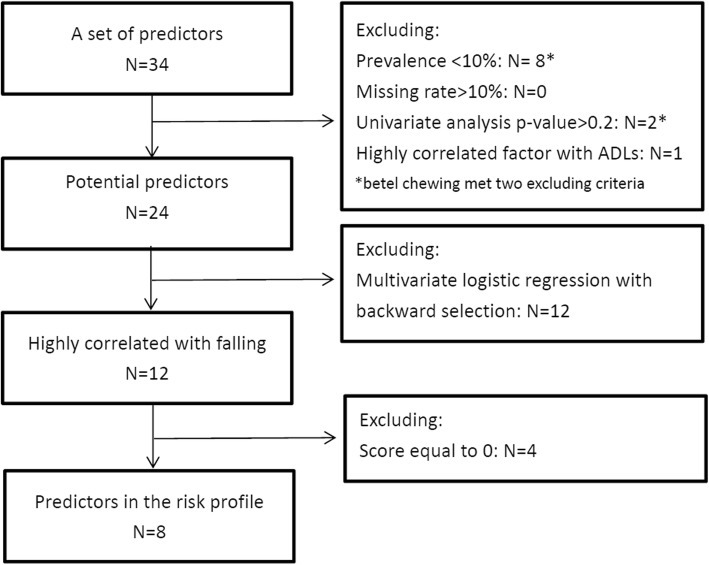
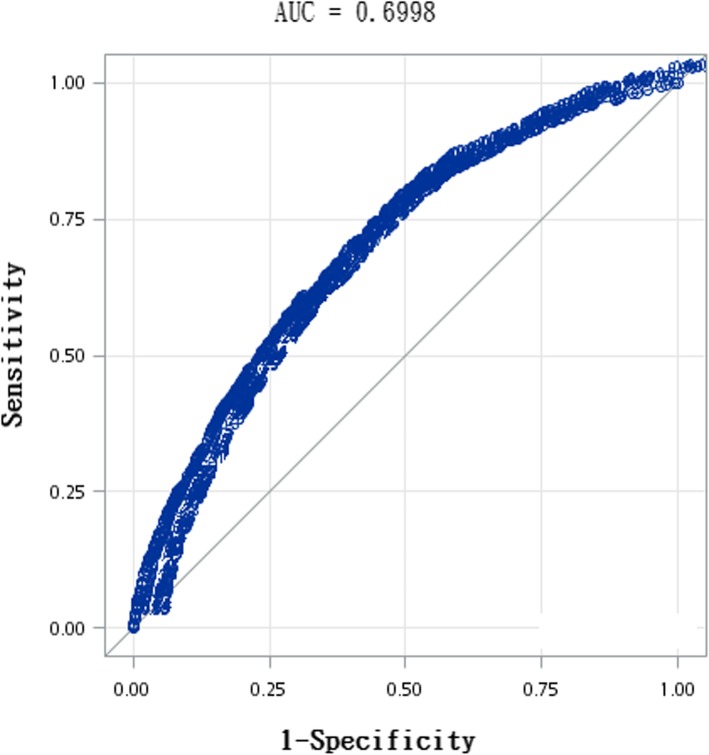
Self-reported falls within 1 year accounted for 19.1% of the total falls. The predictors that were included in the risk profile according to the logistic regression analysis results were as follows: female sex (adjusted odds ratio = 1.57; risk-score = 2), living alone (adjusted odds ratio = 1.56; risk-score = 2), urinary incontinence (adjusted odds ratio = 1.36; risk-score = 2), perceived unhealthiness (adjusted odds ratio = 1.32; risk-score = 1), perceived pain (adjusted odds ratio = 1.51; risk-score = 2), hospital admission in the past year (adjusted odds ratio = 2.42; risk-score = 4), low activity of daily living (ADL) scores (adjusted odds ratio = 1.29; risk-score = 1), and low mobility function scores (adjusted odds ratio = 1.68; risk-score = 3). At a total risk-score cutoff point of 6 (range 0-17), the model predicted falls with a sensitivity and specificity of 75.16 and 52.75%, respectively (area under the ROC curve = 0.70).
The fall-risk assessment profile comprising eight predictors-female sex, living alone, incontinence, perceived unhealthiness, perceived pain, hospital admission in the past year, low ADL scores, and low mobility function scores-may serve as an assessment tool for identification of older adults with a high risk of falling, and assessment results can be used to facilitate community-based intervention.
跌倒在老年人中是一个全球性的健康问题,给医疗系统造成了相当大的负担。本研究旨在为社区居住的老年人开发一种跌倒风险评估表。
从台湾 3 轮全国健康访谈调查(2005 年、2009 年和 2013 年)中获取年龄>65 岁的调查参与者数据。共纳入 8356 名老年人。采用 logistic 回归分析确定与跌倒相关的潜在预测因素。将最终模型中预测因素的回归系数转换为分数(乘以 5),然后相加得到跌倒总风险评分。使用受试者工作特征(ROC)曲线评估风险评估表的区分性能。
1 年内报告的跌倒占总跌倒的 19.1%。根据 logistic 回归分析结果,纳入风险表的预测因素如下:女性(调整优势比=1.57;风险评分=2)、独居(调整优势比=1.56;风险评分=2)、尿失禁(调整优势比=1.36;风险评分=2)、自我感觉不健康(调整优势比=1.32;风险评分=1)、自我感觉疼痛(调整优势比=1.51;风险评分=2)、过去 1 年内住院(调整优势比=2.42;风险评分=4)、日常生活活动(ADL)评分低(调整优势比=1.29;风险评分=1)和移动功能评分低(调整优势比=1.68;风险评分=3)。在总分风险评分截断点为 6 分(0-17 分)时,该模型预测跌倒的敏感度和特异度分别为 75.16%和 52.75%(ROC 曲线下面积=0.70)。
包括 8 个预测因素(女性、独居、尿失禁、自我感觉不健康、自我感觉疼痛、过去 1 年内住院、ADL 评分低和移动功能评分低)的跌倒风险评估表可作为识别有较高跌倒风险的老年人的评估工具,评估结果可用于促进社区干预。