Institute for Health Research, University of Notre Dame Australia, Perth, WA, Australia.
Emerald Clinics, Perth, WA, Australia.
Trials. 2020 Feb 14;21(1):188. doi: 10.1186/s13063-020-4085-x.
Dementia is a neurological condition that affects the cognitive and functional ability of the brain and is the leading cause of disability among those aged 65 years and above. More effective ways to manage dementia symptoms are needed because current treatment options (antidepressants and antipsychotics) can be ineffective and are associated with substantial side effects, including increased rate of mortality. Cannabinoid-based medicine (CBM) has shown an ability to inhibit some symptoms associated with dementia, and the adverse effects are often minimal; yet, little research has explored the use of CBM among this population.
To monitor the safety of a purified dose of CBM oil (3:2 delta-9-tetrahydrocannabinol:cannabidiol) on behaviour symptoms, quality of life and discomfort caused by pain.
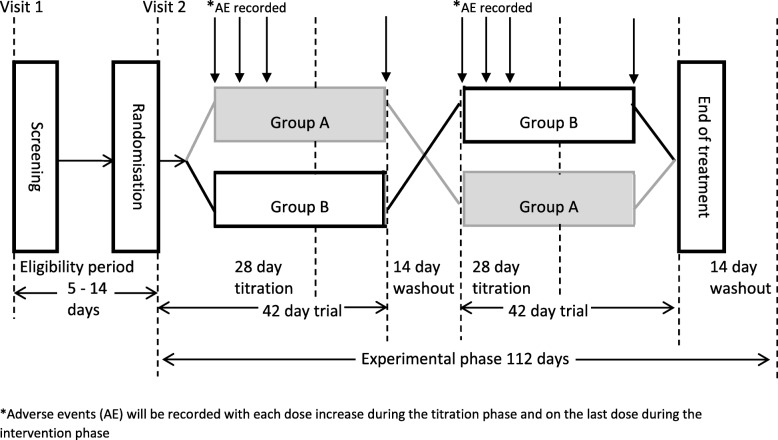
METHODS/DESIGN: We will carry out an 18-week, randomised, double-blind crossover trial that consists of a 2-week eligibility period, two 6-week treatment cycles, and two 2-week washout periods (between both cycles and after the second treatment cycle). We aim to recruit 50 participants with dementia who are living in residential aged-care facilities. The participants will be randomised into two groups and will receive a dose of either CBM oil or placebo for the first treatment cycle and the opposite medication for the second. Data will be collected using the Neuropsychiatric Inventory Questionnaire, the Cohen-Mansfield Agitation Inventory, the Quality of Life in Alzheimer's Disease questionnaire, and the Abbey Pain Scale on seven occasions. These will be completed by the participants, aged-care staff, and nominated next of kin or family members. The participants' heart rate and blood pressure will be monitored weekly, and their body composition and weight will be monitored fortnightly by a research nurse, to assess individual dose response and frailty. In addition, pre- and post-surveys will be administered to aged-care staff and family members to understand their perceptions of CBM and to inform proposed focus groups consisting of the aged-care staff and next of kin.
The study design has been informed by medical professionals and key stakeholders, including those working in the residential aged-care industry to ensure patient safety, collection of non-invasive measures, and methodological rigor and study feasibility.
Australian New Zealand Clinical Trials Registry, ACTRN12619000474156. Registered on 21 March 2019.
痴呆症是一种影响大脑认知和功能能力的神经疾病,是 65 岁及以上人群残疾的主要原因。需要更有效的方法来管理痴呆症症状,因为目前的治疗选择(抗抑郁药和抗精神病药)可能无效,并伴有严重的副作用,包括死亡率增加。基于大麻素的药物(CBM)已显示出抑制与痴呆症相关的一些症状的能力,且其副作用通常很小;然而,很少有研究探索这种药物在该人群中的应用。
监测纯化剂量的 CBM 油(3:2 位-9-四氢大麻酚:大麻二酚)对行为症状、生活质量和疼痛引起的不适的安全性。
方法/设计:我们将进行一项为期 18 周的随机、双盲交叉试验,包括 2 周的资格期、两个 6 周的治疗周期和两个 2 周的洗脱期(在两个周期之间和第二个治疗周期后)。我们旨在招募 50 名居住在养老院的痴呆症患者。参与者将被随机分为两组,第一治疗周期接受 CBM 油或安慰剂治疗,第二周期接受相反的药物治疗。将在七次就诊时使用神经精神病学问卷、科恩-曼斯菲尔德激惹量表、阿尔茨海默病生活质量问卷和 Abbey 疼痛量表收集数据。这些将由参与者、老年护理人员和指定的近亲或家庭成员完成。每周将监测参与者的心率和血压,研究护士将每两周监测一次他们的身体成分和体重,以评估个体剂量反应和脆弱性。此外,将在老年护理人员和家庭成员中进行预调查和后调查,以了解他们对 CBM 的看法,并为包括老年护理人员和近亲的焦点小组提供信息。
该研究设计得到了医疗专业人员和主要利益相关者的支持,包括在养老院工作的人员,以确保患者安全、收集非侵入性措施以及方法学严谨性和研究可行性。
澳大利亚新西兰临床试验注册处,ACTRN12619000474156。于 2019 年 3 月 21 日注册。