Institute of Orthopaedics and Musculoskeletal Science, University College London and the Royal National Orthopaedic Hospital, Stanmore, Middlesex, London, HA7 4LP, UK.
Department of Radiology and Nuclear Medicine, University Hospital Basel, Basel, Switzerland.
Skeletal Radiol. 2020 Jul;49(7):1099-1107. doi: 10.1007/s00256-020-03394-z. Epub 2020 Feb 14.
To identify abnormalities in asymptomatic sedentary individuals using 3.0 Tesla high-resolution MRI.
The cohort comprised of 230 knees of 115 uninjured sedentary adults (51 males, 64 females; median age: 44 years). All participants had bilateral knee 3.0 T MRIs. Two senior musculoskeletal radiologists graded all intraarticular knee structures using validated scoring systems. Participants completed Knee Injury and Osteoarthritis Outcome Score questionnaires at the time of the MRI scan.
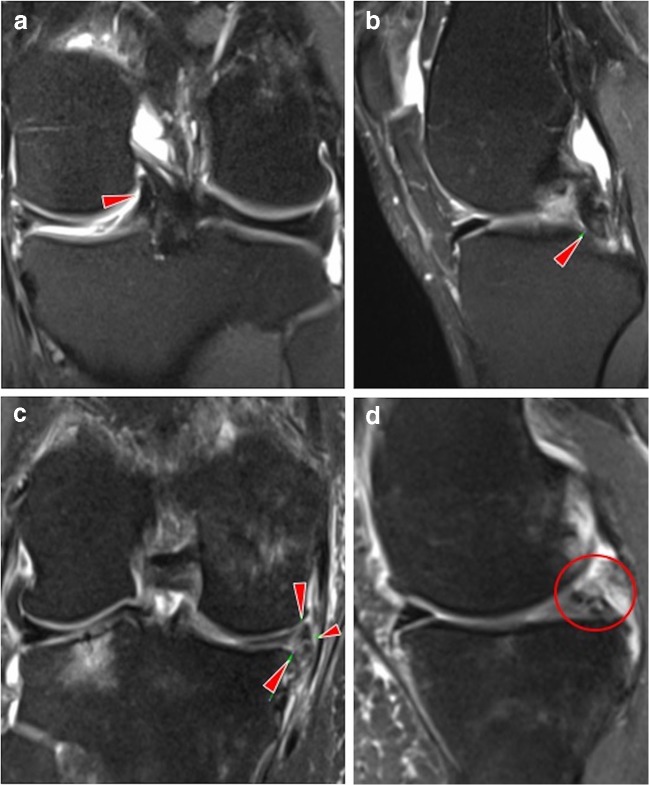
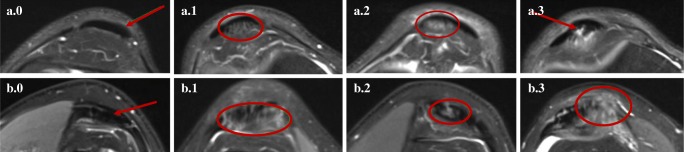
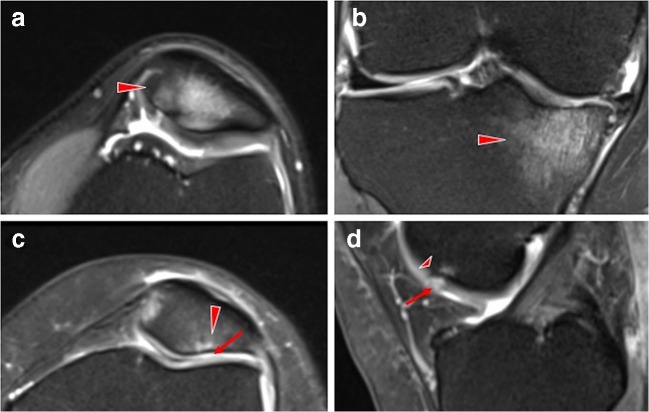
MRI showed abnormalities in the majority (97%) of knees. Thirty percent knees had meniscal tears: horizontal (23%), complex (3%), vertical (2%), radial (2%) and bucket handle (1%). Cartilage and bone marrow abnormalities were prevalent at the patellofemoral joint (57% knees and 48% knees, respectively). Moderate and severe cartilage lesions were common, in 19% and 31% knees, respectively, while moderate and severe bone marrow oedema in 19% and 31% knees, respectively. Moderate-intensity lesion in tendons was found in 21% knees and high-grade tendonitis in 6% knees-the patellar (11% and 2%, respectively) and quadriceps (7% and 2%, respectively) tendons being most affected. Three percent partial ligamentous ruptures were found, especially of the anterior cruciate ligament (2%).
Nearly all knees of asymptomatic adults showed abnormalities in at least one knee structure on MRI. Meniscal tears, cartilage and bone marrow lesions of the patellofemoral joint were the most common pathological findings. Bucket handle and complex meniscal tears were reported for the first time in asymptomatic knees.
使用 3.0T 高分辨率 MRI 识别无症状久坐个体的异常。
该队列包括 115 名无损伤久坐成年人的 230 个膝关节(51 名男性,64 名女性;中位数年龄:44 岁)。所有参与者均行双侧膝关节 3.0T MRI。两位资深肌肉骨骼放射科医生使用经过验证的评分系统对所有关节内膝关节结构进行分级。参与者在进行 MRI 扫描时完成膝关节损伤和骨关节炎结果评分问卷。
MRI 显示大多数(97%)膝关节存在异常。30%的膝关节存在半月板撕裂:水平(23%)、复杂(3%)、垂直(2%)、放射状(2%)和桶柄状(1%)。髌股关节软骨和骨髓异常较为常见(分别为 57%和 48%的膝关节)。中等和重度软骨病变在 19%和 31%的膝关节中较为常见,而中等和重度骨髓水肿在 19%和 31%的膝关节中较为常见。21%的膝关节存在中等强度的肌腱病变,6%的膝关节存在高级腱炎-髌腱(分别为 11%和 2%)和股四头肌肌腱(分别为 7%和 2%)受影响最严重。发现 3%的部分韧带撕裂,尤其是前交叉韧带(2%)。
无症状成年人的几乎所有膝关节在 MRI 上至少有一个膝关节结构存在异常。半月板撕裂、髌股关节软骨和骨髓病变是最常见的病理发现。在无症状膝关节中首次报道了桶柄状和复杂半月板撕裂。