Department of Neurosurgery, University Medical Center, Mainz, Germany.
Division of Neuro-Oncology, University Medical Center Tubingen, Tübingen, Germany.
Support Care Cancer. 2020 Nov;28(11):5165-5175. doi: 10.1007/s00520-020-05354-8. Epub 2020 Feb 14.
Half of all newly diagnosed patients with glioblastoma are > 65 years still with a poor prognosis. Preserving quality of life is of high importance. However, patient reported outcome (PRO) data in this patient group is rare. The aim was to compare health-related quality of life (HRQoL) and distress between elderly and younger patients with high-grade glioma (HGG).
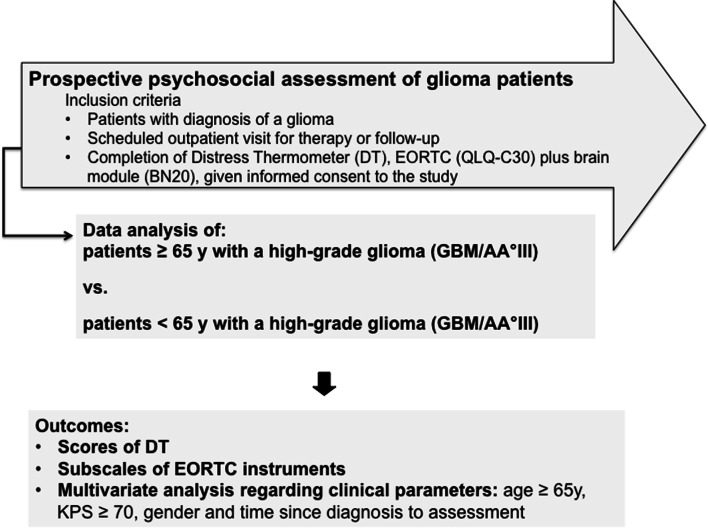
We used baseline data of a prospective study where HGG patients were enrolled from 4 hospitals. Distress was measured using the distress thermometer (DT), HRQoL using the European Organization for Research and Treatment of Cancer (EORTC) Quality of Life Core Questionnaire (QLQ-C30) plus brain module (BN20). We compared distress and HRQoL by age (≥ 65 vs. < 65 years), gender, performance score, and time since diagnosis using multivariate linear and logistic regressions.
A total of n = 93 (30%) out of n = 309 patients were ≥ 65 years (mean 70 years, range 65-86 years). Mean DT score of elderly patients (5.2, SD 2.6) was comparable with younger patients (4.9, SD 2.6). Elderly patients reported significantly lower global health (GHS, mean elderly vs. younger; 50.8 vs. 60.5, p = 0.003), worse physical (56.8 vs. 73.3, p < 0.001) and lower cognitive functioning (51.1 vs. 63.2, p = 0.002), worse fatigue (52.5 vs. 43.5, p = 0.042), and worse motor dysfunction (34.9 vs. 23.6, p = 0.030). KPS and not age was consistently associated with HRQoL.
Physical functioning was significantly reduced in the elderly compared with younger HGG patients, and at the same time, emotional functioning and DT scores were comparable. KPS shows a greater association with HRQoL than with calendric age in HGG patients reflecting the particular importance for adequate assessment of HRQoL and general condition in elderly patients.
一半的新诊断为胶质母细胞瘤的患者年龄在 65 岁以上,预后仍然较差。保持生活质量非常重要。然而,该患者群体的患者报告结局(PRO)数据很少。本研究旨在比较老年和年轻的高级别胶质瘤(HGG)患者的健康相关生活质量(HRQoL)和痛苦程度。
我们使用了一项前瞻性研究的基线数据,该研究在 4 家医院招募了 HGG 患者。使用痛苦温度计(DT)测量痛苦,使用欧洲癌症研究与治疗组织(EORTC)生活质量核心问卷(QLQ-C30)加脑模块(BN20)测量 HRQoL。我们通过年龄(≥65 岁与<65 岁)、性别、表现评分和诊断后时间,使用多变量线性和逻辑回归比较了痛苦和 HRQoL。
309 名患者中有 93 名(30%)年龄≥65 岁(平均 70 岁,范围 65-86 岁)。老年患者的 DT 评分(5.2,标准差 2.6)与年轻患者(4.9,标准差 2.6)相当。老年患者报告的总体健康状况(GHS,老年 vs. 年轻患者的平均值;50.8 与 60.5,p=0.003)、身体功能(56.8 与 73.3,p<0.001)和认知功能(51.1 与 63.2,p=0.002)明显更差,疲劳(52.5 与 43.5,p=0.042)和运动功能障碍(34.9 与 23.6,p=0.030)更差。KPS 而非年龄与 HRQoL 始终相关。
与年轻的 HGG 患者相比,老年患者的身体功能明显下降,而同时,情绪功能和 DT 评分相当。在 HGG 患者中,KPS 与 HRQoL 的关联大于与年龄的关联,反映了在老年患者中对 HRQoL 和一般状况进行充分评估的特殊重要性。