Bresesti Ilia, Bruckner Marlies, Mattersberger Christian, Baik-Schneditz Nariae, Schwaberger Bernhard, Mileder Lukas, Avian Alexander, Urlesberger Berndt, Pichler Gerhard
Research Unit for Neonatal Micro- and Macrocirculation, Department of Pediatrics, Medical University of Graz, Graz, Austria.
Division of Neonatology, Department of Pediatrics, Medical University of Graz, Graz, Austria.
Front Pediatr. 2020 Jan 29;8:11. doi: 10.3389/fped.2020.00011. eCollection 2020.
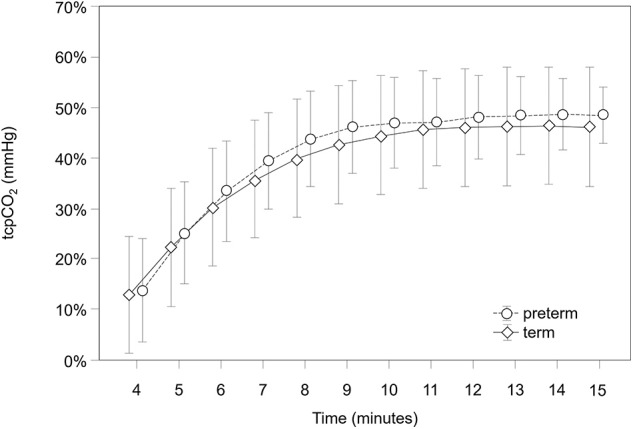
According to recommendations, non-invasive monitoring during neonatal resuscitation after birth includes heart rate (HR) and oxygen saturation (SpO). Continuous transcutaneous monitoring of carbon dioxide partial pressure (tcpCO) may further offer quantitative information on neonatal respiratory status. We aimed to investigate feasibility of tcpCO measurements in the delivery room during immediate neonatal transition and to compare the course of tcpCO between stable term and preterm infants. Neonates without need for cardio-respiratory intervention during immediate transition after birth were enrolled in a prospective observational study. In these term and preterm neonates, we measured HR and SpO by pulse oximetry on the right wrist and tcpCO with the sensor applied on the left hemithorax during the first 15 min after birth. Courses of tcpCO were analyzed in term and preterm neonates and groups were compared. Fifty-three term (gestational age: 38.8 ± 0.9 weeks) and 13 preterm neonates (gestational age: 34.1 ± 1.5 weeks) were included. First tcpCO values were achieved in both groups at minute 4 after birth, which reached a stable plateau after the equilibration phase at minute 9. Mean tcpCO values 15 min after birth were 46.2 (95% CI 34.5-57.8) mmHg in term neonates and 48.5 (95%CI 43.0-54.1) mmHg in preterm neonates. Preterm and term infants did not show significant differences in the tcpCO values at any time point. This study demonstrates that tcpCO measurement is feasible during immediate neonatal transition after birth and that tcpCO values were comparable in stable term and preterm neonates.
根据建议,出生后新生儿复苏期间的无创监测包括心率(HR)和血氧饱和度(SpO)。持续经皮监测二氧化碳分压(tcpCO)可能会进一步提供有关新生儿呼吸状态的定量信息。我们旨在研究在新生儿即刻过渡期间在产房进行tcpCO测量的可行性,并比较足月儿和早产儿之间tcpCO的变化过程。出生后即刻过渡期间无需心肺干预的新生儿被纳入一项前瞻性观察性研究。在这些足月儿和早产儿中,我们在出生后的前15分钟内通过右腕脉搏血氧饱和度仪测量HR和SpO,并将传感器应用于左半胸测量tcpCO。分析足月儿和早产儿tcpCO的变化过程并比较两组。纳入了53名足月儿(胎龄:38.8±0.9周)和13名早产儿(胎龄:34.1±1.5周)。两组在出生后第4分钟均首次获得tcpCO值,在第9分钟平衡期后达到稳定平台期。足月儿出生后15分钟的平均tcpCO值为46.2(95%CI 34.5-57.8)mmHg,早产儿为48.5(95%CI 43.0-54.1)mmHg。在任何时间点,早产儿和足月儿的tcpCO值均无显著差异。本研究表明,出生后新生儿即刻过渡期间进行tcpCO测量是可行的,并且足月儿和早产儿的tcpCO值相当。