Department of Pediatric Surgery, Erasmus MC - Sophia Children's Hospital, University Medical Center Rotterdam, Rotterdam, The Netherlands.
Division of Neonatology, Department of Pediatrics, Erasmus MC - Sophia Children's Hospital, University Medical Center Rotterdam, Rotterdam, The Netherlands.
Med Biol Eng Comput. 2020 Feb;58(2):239-247. doi: 10.1007/s11517-019-02067-x. Epub 2019 Nov 18.
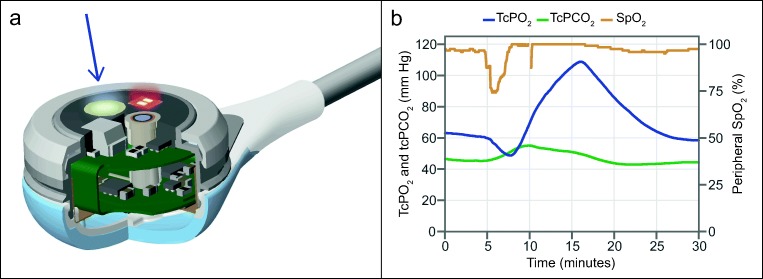
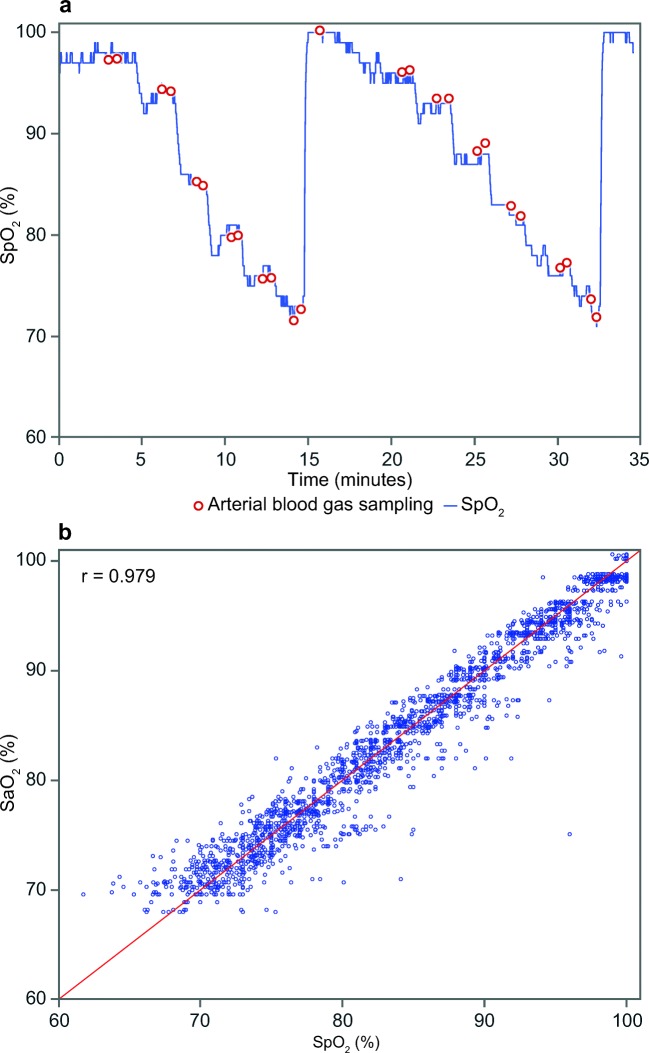
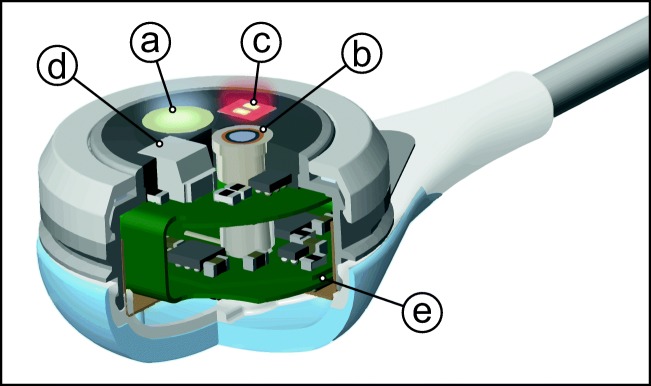
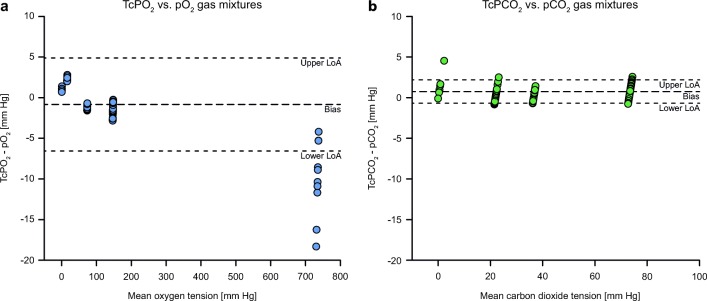
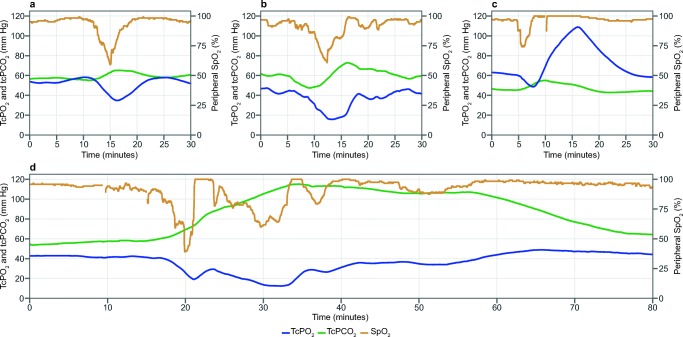
This study investigated the accuracy, drift, and clinical usefulness of a new optical transcutaneous oxygen tension (tcPO) measuring technique, combined with a conventional electrochemical transcutaneous carbon dioxide (tcPCO) measurement and reflectance pulse oximetry in the novel transcutaneous OxiVenT™ Sensor. In vitro gas studies were performed to measure accuracy and drift of tcPO and tcPCO. Clinical usefulness for tcPO and tcPCO monitoring was assessed in neonates. In healthy adult volunteers, measured oxygen saturation values (SpO) were compared with arterially sampled oxygen saturation values (SaO) during controlled hypoxemia. In vitro correlation and agreement with gas mixtures of tcPO (r = 0.999, bias 3.0 mm Hg, limits of agreement - 6.6 to 4.9 mm Hg) and tcPCO (r = 0.999, bias 0.8 mm Hg, limits of agreement - 0.7 to 2.2 mm Hg) were excellent. In vitro drift was negligible for tcPO (0.30 (0.63 SD) mm Hg/24 h) and highly acceptable for tcPCO (- 2.53 (1.04 SD) mm Hg/12 h). Clinical use in neonates showed good usability and feasibility. SpO-SaO correlation (r = 0.979) and agreement (bias 0.13%, limits of agreement - 3.95 to 4.21%) in healthy adult volunteers were excellent. The investigated combined tcPO, tcPCO, and SpO sensor with a new oxygen fluorescence quenching technique is clinically usable and provides good overall accuracy and negligible tcPO drift. Accurate and low-drift tcPO monitoring offers improved measurement validity for long-term monitoring of blood and tissue oxygenation. Graphical abstract.
本研究旨在评估新型经皮氧分压(tcPO)测量仪结合传统电化学经皮二氧化碳分压(tcPCO)测量和反射式脉搏血氧饱和度测量的准确性、漂移和临床实用性。我们进行了体外气体研究以测量 tcPO 和 tcPCO 的准确性和漂移。在新生儿中评估 tcPO 和 tcPCO 监测的临床实用性。在健康成年志愿者中,通过控制性低氧血症比较了测量的氧饱和度值(SpO)与动脉取样的氧饱和度值(SaO)。体外相关性和与 tcPO(r = 0.999,偏差 3.0 mm Hg,一致性界限-6.6 至 4.9 mm Hg)和 tcPCO(r = 0.999,偏差 0.8 mm Hg,一致性界限-0.7 至 2.2 mm Hg)的气体混合物具有极好的一致性。tcPO 的体外漂移可以忽略不计(0.30(0.63 SD)mm Hg/24 h),而 tcPCO 的漂移高度可接受(-2.53(1.04 SD)mm Hg/12 h)。在新生儿中的临床应用表明该仪器具有良好的可用性和可行性。在健康成年志愿者中,SpO-SaO 相关性(r = 0.979)和一致性(偏差 0.13%,一致性界限-3.95 至 4.21%)均非常出色。这项研究中,我们所调查的组合式 tcPO、tcPCO 和 SpO 传感器采用了新型氧荧光猝灭技术,具有良好的临床可用性,提供了良好的整体准确性和可忽略的 tcPO 漂移。准确且漂移较小的 tcPO 监测可提高血液和组织氧合的长期监测的测量有效性。