Leibniz University Hannover, Institute of Organic Chemistry and Center for Biomolecular Drug Research, Schneiderberg 38, 30167 Hannover, Germany.
European Molecular Biology Laboratory, Structural and Computational Biology Unit, Meyerhofstrasse 1, 69117 Heidelberg, Germany.
Sci Adv. 2020 Jan 31;6(5):eaay4458. doi: 10.1126/sciadv.aay4458. eCollection 2020 Jan.
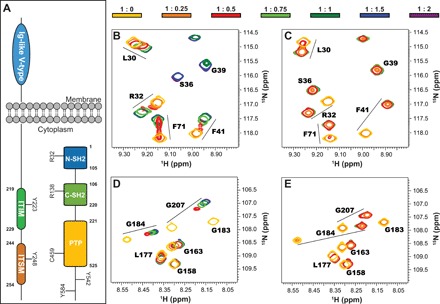
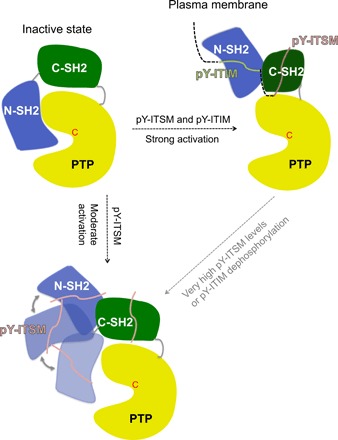
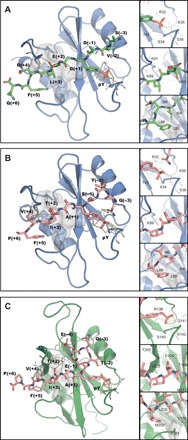
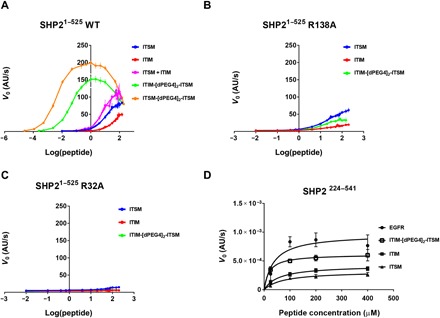
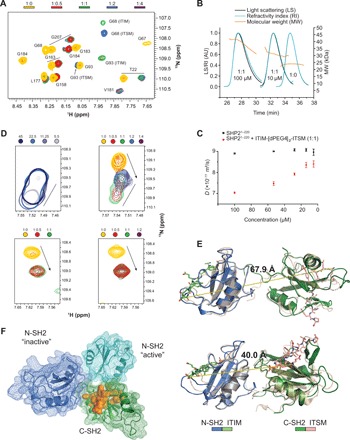
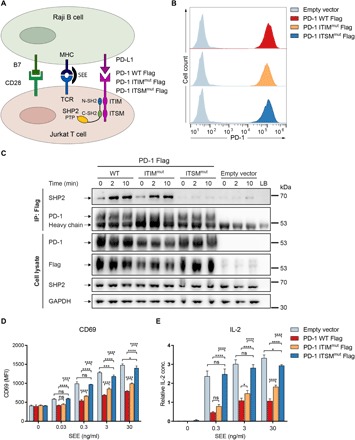
In cancer, the programmed death-1 (PD-1) pathway suppresses T cell stimulation and mediates immune escape. Upon stimulation, PD-1 becomes phosphorylated at its immune receptor tyrosine-based inhibitory motif (ITIM) and immune receptor tyrosine-based switch motif (ITSM), which then bind the Src homology 2 (SH2) domains of SH2-containing phosphatase 2 (SHP2), initiating T cell inactivation. The SHP2-PD-1 complex structure and the exact functions of the two SH2 domains and phosphorylated motifs remain unknown. Here, we explain the structural basis and provide functional evidence for the mechanism of PD-1-mediated SHP2 activation. We demonstrate that full activation is obtained only upon phosphorylation of both ITIM and ITSM: ITSM binds C-SH2 with strong affinity, recruiting SHP2 to PD-1, while ITIM binds N-SH2, displacing it from the catalytic pocket and activating SHP2. This binding event requires the formation of a new inter-domain interface, offering opportunities for the development of novel immunotherapeutic approaches.
在癌症中,程序性死亡受体 1 (PD-1) 途径抑制 T 细胞的刺激并介导免疫逃逸。在受到刺激后,PD-1 在其免疫受体酪氨酸基抑制基序 (ITIM) 和免疫受体酪氨酸基开关基序 (ITSM) 上发生磷酸化,然后与含 SH2 结构域的磷酸酶 2 (SHP2) 的 SH2 结构域结合,启动 T 细胞失活。PD-1 介导的 SHP2 激活的 SHP2-PD-1 复合物结构和两个 SH2 结构域和磷酸化基序的确切功能仍不清楚。在这里,我们解释了 PD-1 介导的 SHP2 激活的结构基础,并提供了功能证据。我们证明,只有在 ITIM 和 ITSM 都磷酸化时才能获得完全激活:ITSM 与 C-SH2 具有很强的亲和力结合,将 SHP2 招募到 PD-1 上,而 ITIM 与 N-SH2 结合,将其从催化口袋中置换出来并激活 SHP2。这种结合事件需要形成一个新的域间界面,为开发新型免疫治疗方法提供了机会。