Department of Pediatric Dentistry, School of Dentistry of Ribeirão Preto, University of São Paulo, Avenida do Café S/N, Ribeirão Preto, SP, 14040-904, Brazil.
Department of Oral and Maxillofacial Surgery and Periodontology, School of Dentistry of Ribeirao Preto, University of São Paulo, Avenida do Café S/N, Ribeirão Preto, SP, 14040-904, Brazil.
Prog Orthod. 2020 Feb 17;21(1):6. doi: 10.1186/s40510-020-00307-7.
The objective was to analyze clinical, microbiological, and immunological periodontal parameters in patients in corrective orthodontic treatment.
Twenty-eight patients were selected. Plaque index (PI), bleeding on probing (BOP), width of keratinized gingiva, levels of 40 bacterial species, and of 3 cytokines (IL-1β, MMP-8, and TNF-α) in gingival crevicular fluid (GCF) were evaluated at T0, before orthodontic treatment; T1, 6 months; and T2, 12 months post-treatment. Non-parametric, Friedman, Wilcoxon, ANOVA, and Spearman correlation coefficient tests were used for statistical analyses, with the significance level of 5%.
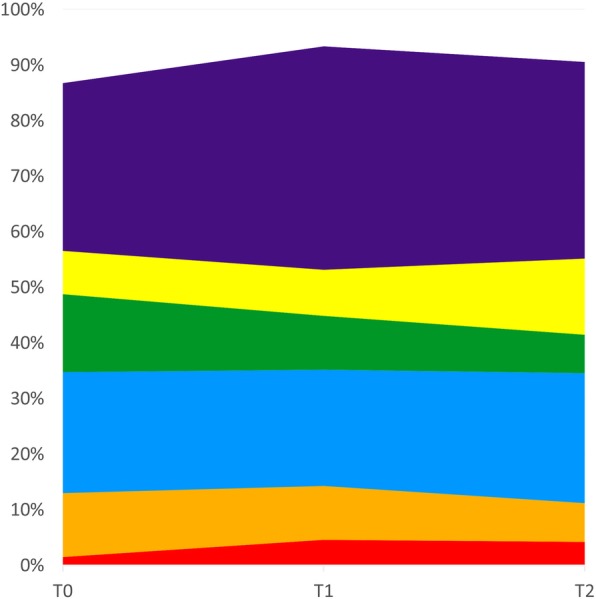
No significant difference was found for the width of keratinized gingiva, but PI presented a significant increase at T1 and T2 (p < 0.05) when compared with T0. The percentage of sites with BOP increased significantly from T0 to T1 (p < 0.05); however, at T2, the values decreased and did not differ anymore from T0 (p > 0.05). In the microbiological analysis, red complex pathogens were in significantly greater proportions in T2 compared with T0 (p < 0.05). There was no statistically significant difference in the cytokine levels between the periods but there was a positive correlation between BOP and IL-1β (r = 0.49 p = .01) and TNF-α (r = 0.39 and p = .05).
In conclusion, corrective orthodontic treatment caused clinical periodontal alterations regarding biofilm accumulation and gingival bleeding, with alteration of periodontopathogens.
本研究旨在分析接受正畸矫正治疗患者的临床、微生物学和免疫学牙周参数。
选择 28 名患者。在 T0(正畸治疗前)、T1(治疗后 6 个月)和 T2(治疗后 12 个月)时评估菌斑指数(PI)、探诊出血(BOP)、角化龈宽度、龈沟液(GCF)中 40 种细菌和 3 种细胞因子(IL-1β、MMP-8 和 TNF-α)的水平。采用非参数、Friedman、Wilcoxon、ANOVA 和 Spearman 相关系数检验进行统计学分析,显著性水平为 5%。
角化龈宽度无显著差异,但 PI 在 T1 和 T2 时均显著增加(p<0.05),与 T0 相比。BOP 位点百分比从 T0 到 T1 显著增加(p<0.05);然而,在 T2 时,值下降,与 T0 无差异(p>0.05)。在微生物分析中,与 T0 相比,T2 时红色复合体病原体的比例显著增加(p<0.05)。各期细胞因子水平无统计学差异,但 BOP 与 IL-1β(r=0.49,p=0.01)和 TNF-α(r=0.39,p=0.05)呈正相关。
综上所述,正畸矫正治疗导致生物膜积聚和牙龈出血的临床牙周改变,牙周病病原体发生改变。