Departament de Genètica, Universitat de València, Burjassot, Valencia, Spain.
Departamento de Biotecnología de los Alimentos, Instituto de Agroquímica y Tecnología de los Alimentos (IATA), CSIC, Paterna, Valencia, Spain.
Microb Genom. 2020 Mar;6(3). doi: 10.1099/mgen.0.000333.
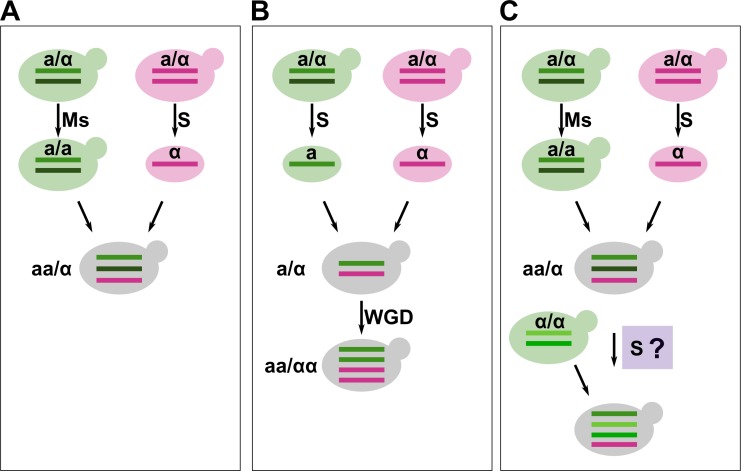
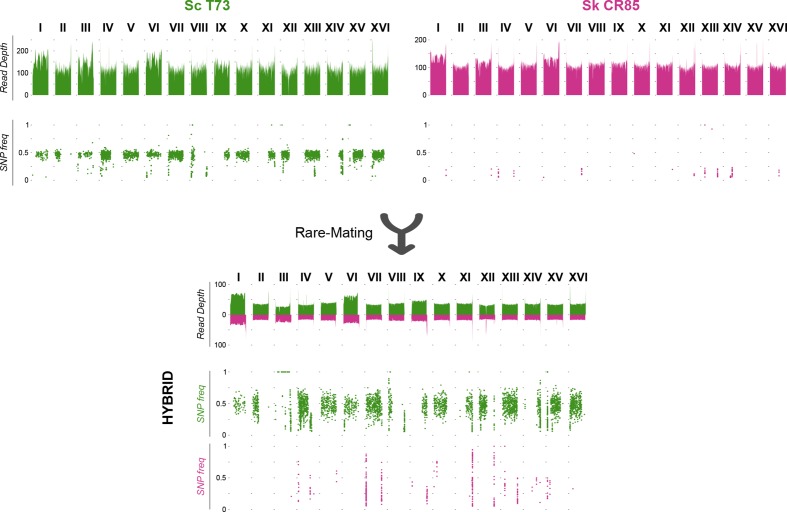
Interspecific hybridization has played an important role in the evolution of eukaryotic organisms by favouring genetic interchange between divergent lineages to generate new phenotypic diversity involved in the adaptation to new environments. This way, hybridization between species, involving the fusion between their metabolic capabilities, is a recurrent adaptive strategy in industrial environments. In the present study, whole-genome sequences of natural hybrids between and were obtained to unveil the mechanisms involved in the origin and evolution of hybrids, as well as the ecological and geographic contexts in which spontaneous hybridization and hybrid persistence take place. Although species can mate using different mechanisms, we concluded that rare-mating is the most commonly used, but other mechanisms were also observed in specific hybrids. The preponderance of rare-mating was confirmed by performing artificial hybridization experiments. The mechanism used to mate determines the genomic structure of the hybrid and its final evolutionary outcome. The evolution and adaptability of the hybrids are triggered by genomic instability, resulting in a wide diversity of genomic rearrangements. Some of these rearrangements could be adaptive under the stressful conditions of the industrial environment.
种间杂交通过促进不同谱系之间的基因交流,产生新的表型多样性,从而有助于真核生物的进化,使它们能够适应新的环境。这种种间杂交,涉及代谢能力的融合,是工业环境中一种经常出现的适应性策略。在本研究中,获得了 和 之间自然杂种的全基因组序列,以揭示杂种起源和进化过程中的机制,以及自发杂交和杂种持续存在的生态和地理背景。尽管 物种可以通过不同的机制进行交配,但我们得出结论,稀交配是最常用的,但在特定的杂种中也观察到了其他机制。通过进行人工杂交实验,证实了稀交配的主导地位。交配所使用的机制决定了杂种的基因组结构及其最终的进化结果。杂种的进化和适应性是由基因组不稳定性引发的,导致了广泛的基因组重排多样性。其中一些重排可能在工业环境的压力条件下具有适应性。