Applied Neuroscience Laboratory, Department of Physical Therapy, Universidade Federal de Pernambuco, Recife, Pernambuco, Brazil.
Postgraduate Program in Neuropsychiatry and Behavioral Sciences, Universidade Federal de Pernambuco, Recife, Pernambuco, Brazil.
J Parkinsons Dis. 2020;10(2):455-470. doi: 10.3233/JPD-191840.
Individualized treatment guided by biomarkers certainly will play a crucial role in the more effective treatment of various neurological diseases in the near future. Identifying the electroencephalographic biomarkers in the brain of patients with Parkinson's disease (PD) may help in the decision-making process of health professionals regarding the non-invasive brain stimulation (NIBS) protocols.
To summarize quantitative electroencephalographic (qEEG) characteristics of patients with PD with motor symptoms at rest or during movement to identify potential biomarker associated with motor impairment in PD.
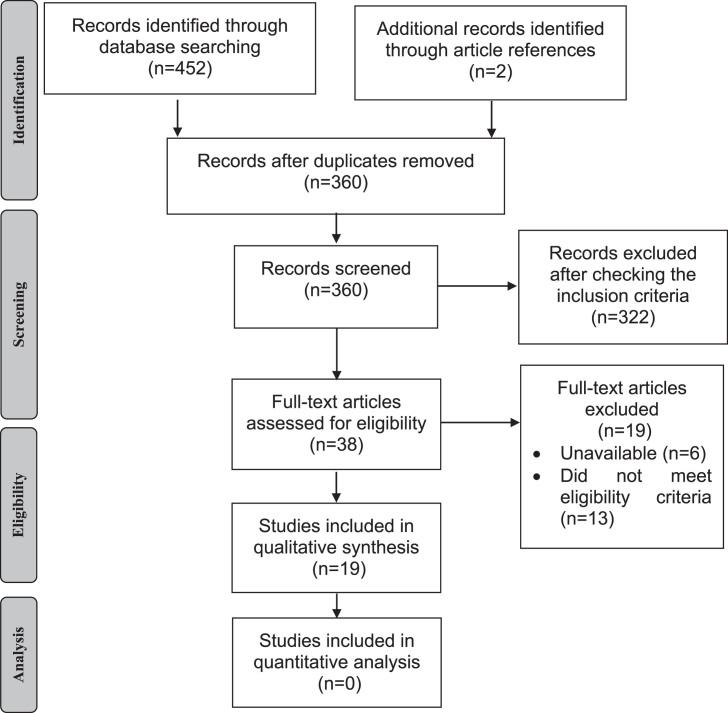
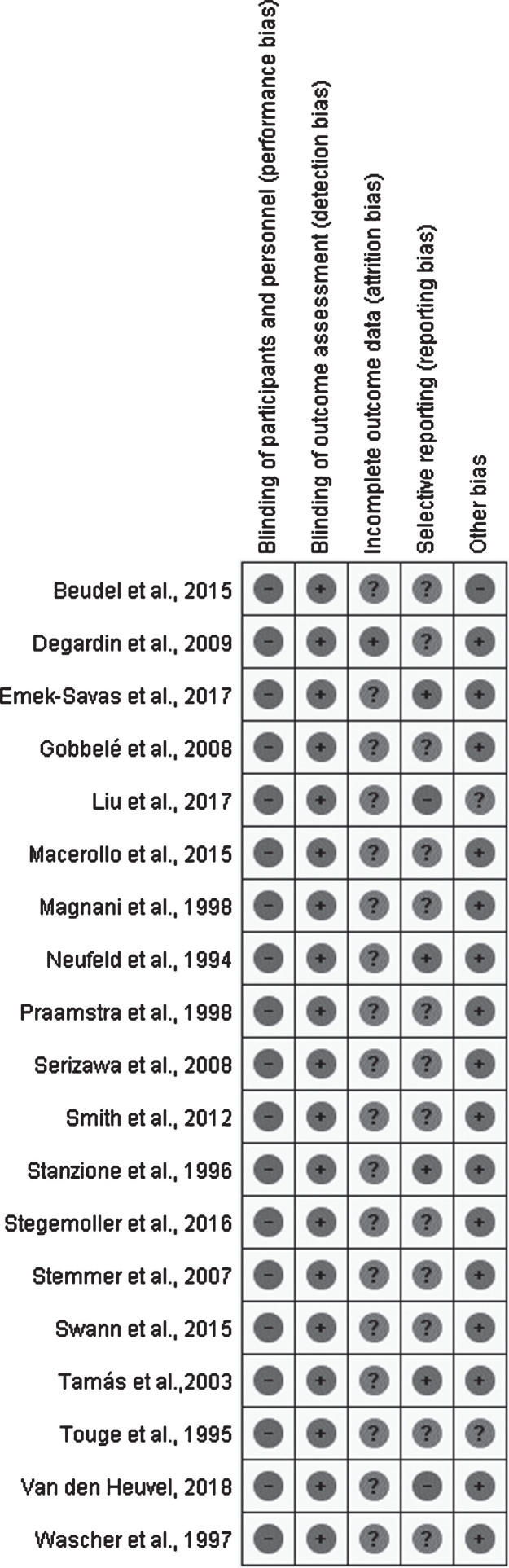
A systematic search was conducted in the databases MEDLINE/PubMed, LILACS/BIREME, CINAHL/EBSCO, Web of Science, and CENTRAL, performed according to PRISMA-statement guidelines. Two independent authors searched for studies that reported qEEG data related to motor outcomes at rest or during movements in patients with PD and compared the data with control healthy group. The studies' methodological quality was examined using the Cochrane Handbook. Studies/sample characteristics, qEEG parameters/analyses, and the studies' results were summarized. Prospero-register: CRD42018085660.
Nineteen studies (18 cross-sectional/one cross-over) with 312 PD patients and 277 controls, published between 1994-2018, were included for the qualitative analysis. In comparison to healthy controls, our findings suggest a slowing down of the cortical activity in patients with PD due to an increase of slower band waves activity and a decrease of fast band waves at resting and during complex movement execution mainly in the central and frontal cortex.
Slowing down of cortical waves suggest excitatory NIBS for motor impairment in PD. However, qEEG biomarker for motor symptoms of PD cannot be established yet because the studies that related qEEG with motor outcomes presented methodological poor quality.
个体化治疗指导生物标志物在不久的将来肯定会在更有效地治疗各种神经疾病方面发挥关键作用。在帕金森病(PD)患者的大脑中识别出脑电图生物标志物,可能有助于健康专业人员在非侵入性脑刺激(NIBS)方案的决策过程中做出决策。
总结有运动症状的 PD 患者静息或运动时的定量脑电图(qEEG)特征,以确定与 PD 运动障碍相关的潜在生物标志物。
根据 PRISMA 声明指南,在 MEDLINE/PubMed、LILACS/BIREME、CINAHL/EBSCO、Web of Science 和 CENTRAL 数据库中进行系统搜索,寻找报告与 PD 患者静息或运动时运动结果相关的 qEEG 数据并与对照组健康组进行比较的研究。使用 Cochrane 手册检查研究的方法学质量。总结研究/样本特征、qEEG 参数/分析以及研究结果。Prospero 注册:CRD42018085660。
纳入了 19 项研究(18 项横断面研究/1 项交叉研究),共 312 名 PD 患者和 277 名对照组,发表于 1994 年至 2018 年之间。与健康对照组相比,我们的研究结果表明,由于较慢频段波活动增加和较快频段波活动减少,PD 患者的皮质活动减慢,主要在中央和额皮质中,在静息和复杂运动执行时。
皮质波的减慢提示兴奋性 NIBS 可改善 PD 的运动障碍。然而,由于与运动结果相关的 qEEG 研究质量较差,因此尚未确定 PD 运动症状的 qEEG 生物标志物。