Centre for Behavioural Economics, Society and Technology (BEST), School of Economics and Finance, Queensland University of Technology (QUT), Brisbane, 4000, Australia.
Centre for Decision Research and Experimental Economics (CeDEx), University of Nottingham, Nottingham, UK.
BMC Public Health. 2020 Feb 17;20(1):240. doi: 10.1186/s12889-020-8246-3.
Influenza vaccine uptake remains low worldwide, inflicting substantial costs to public health. Messages promoting social welfare have been shown to increase vaccination intentions, and it has been recommended that health professionals communicate the socially beneficial aspects of vaccination. We provide the first test whether this prosocial vaccination hypothesis applies to actual vaccination behaviour of high-risk patients.
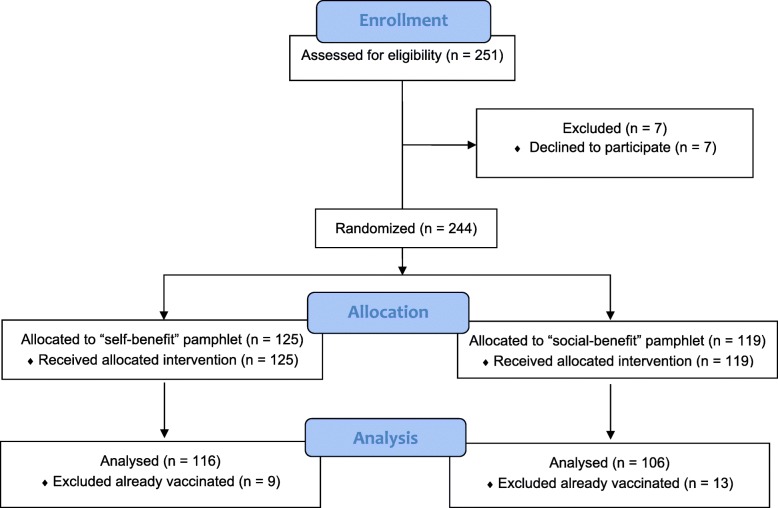
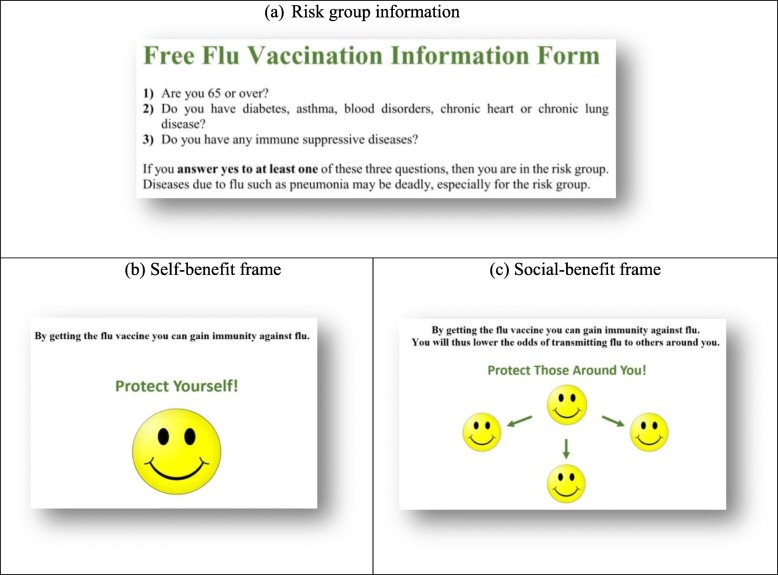
In a field experiment at a tertiary care public hospital in Istanbul, Turkey, we compare the effects of two motivational messages for promoting vaccination. Using a between-subjects single-blind experimental design patients were randomly assigned to frames emphasizing the vaccine's benefits to self (n = 125) or social benefits (n = 119). Free influenza vaccination was offered to each patient.
Among 222 patients who were not vaccinated for the season prior to the study (72% medically assessed to be at high risk), 42% in the self-benefit frame chose to receive a vaccination compared with 34% in the social-benefits frame, but the difference was not statistically significant (aOR = 1.63, 95% CI 0.90 to 2.95, p = 0.108). Reasons for vaccination focused primarily on self-benefit (67%) rather than social-benefit (5%). Exploratory analysis showed that the effect of messages depended on patient perception of risk group membership (aOR / aOR = 5.59, 95% CI 1.30 to 24.05, p = 0.021). In particular, emphasis on self-benefit was more influential among patients who perceived themselves to be in the risk group (aOR = 6.22, 95% CI 1.69 to 22.88, p = 0.006).
In contrast to the literature observing intentions of low-risk populations, we found no evidence that social-benefit motivates actual vaccination behaviour among a high-risk patient population. Instead, those who self-categorize as being in the high risk group are more motivated by the self-benefit message. Our results suggest that a stratified approach can improve coverage: even if an emphasis on social-benefit could be effective among low-risk groups, an emphasis on self-benefit holds more promise for increasing vaccination in medical organizational settings where high-risk groups are prevalent.
ClinicalTrials.gov NCT04230343 Retrospectively registered on the 13th January 2020.
流感疫苗接种率在全球范围内仍然较低,给公共卫生造成了巨大的损失。已证实,宣传社会福利的信息可以提高接种意愿,因此建议卫生专业人员传达疫苗接种的社会效益。我们首次检验了亲社会疫苗接种假说是否适用于高危患者的实际接种行为。
在土耳其伊斯坦布尔的一家三级保健公立医院进行的现场试验中,我们比较了两种促进疫苗接种的动机信息的效果。使用基于个体的单盲实验设计,将患者随机分配到强调疫苗对自身益处(n=125)或社会益处(n=119)的框架中。为每位患者提供免费流感疫苗接种。
在研究前一个季节未接种疫苗的 222 名患者中(72%经医学评估为高风险),自我受益框架中 42%的人选择接种疫苗,而社会受益框架中为 34%,但差异无统计学意义(aOR=1.63,95%CI 0.90 至 2.95,p=0.108)。接种疫苗的原因主要集中在自我受益(67%)而不是社会受益(5%)。探索性分析表明,信息的效果取决于患者对风险群体成员身份的感知(aOR/aOR=5.59,95%CI 1.30 至 24.05,p=0.021)。特别是,对于那些认为自己处于风险群体的患者,强调自我受益的效果更为明显(aOR=6.22,95%CI 1.69 至 22.88,p=0.006)。
与观察低风险人群接种意愿的文献相反,我们没有发现证据表明社会利益会促使高危人群实际接种疫苗。相反,那些自我归类为高危人群的人更受自身受益信息的激励。我们的研究结果表明,分层方法可以提高疫苗接种覆盖率:即使强调社会利益可能对低风险人群有效,在高危人群普遍存在的医疗组织环境中,强调自身利益更有可能增加疫苗接种率。
ClinicalTrials.gov NCT04230343 于 2020 年 1 月 13 日进行了回顾性注册。