College of Physical Education, Federal University of Pará, Castanhal, Pará, Brazil.
College of Physical Education and Dance, Federal University of Goiás, Goiânia, Brazil.
J Transl Med. 2020 Feb 17;18(1):88. doi: 10.1186/s12967-020-02261-8.
The present study compared the effects of training and detraining periods of high-intensity interval training (HIIT), moderate-intensity interval training (MIIT) and moderate-intensity continuous training (MICT) on functional performance, body composition, resting blood pressure and heart rate in elderly women nursing home residents.
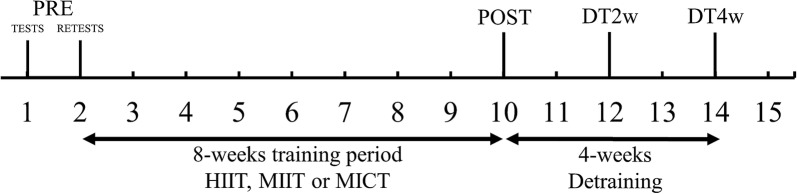
Forty-six volunteers (age, 80.8 ± 5.2 y; body mass, 69.8 ± 5.2 kg, height, 164.2 ± 4.12 cm) were divided into groups that performed treadmill exercise twice-weekly HIIT (4 bouts of 4-min intervals at 85-95% of the maximal heart rate [HR], interspersed by 4 min at 65% HR), MIIT (4 bouts of 4 min intervals at 55-75% HR, interspersed by 4 min at 45-50% HR) and MICT (30-min at 55-75% HR). Tests were performed before and after 8 weeks of training and 2 and 4 weeks of detraining. ANCOVA was used to analyze dependent variable changes.
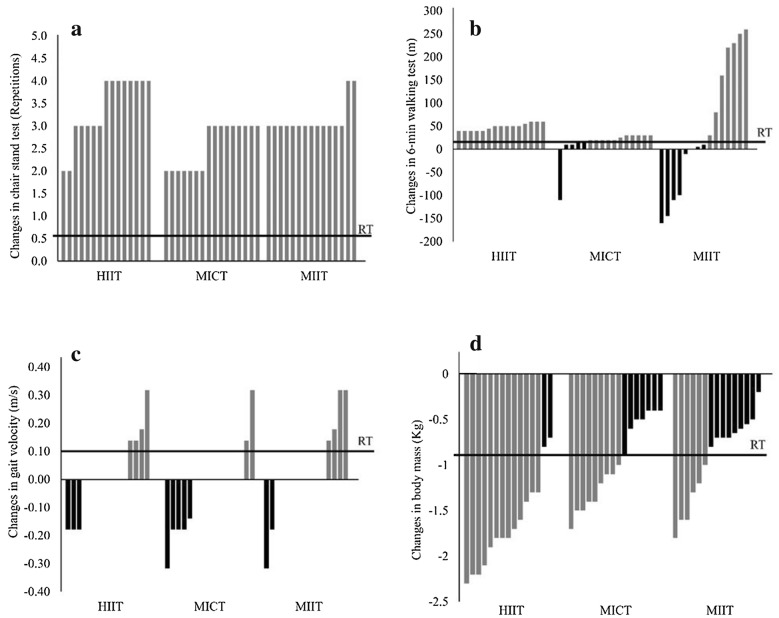
After 8 weeks HIIT promoted greater reductions in body mass (HIIT = - 1.6 ± 0.1 kg; MICT = - 0.9 ± 0.1 kg; MIIT = - 0.9 ± 0.1 kg; p = 0.001), fat mass (HIIT = - 2.2 ± 0.1%; MICT = - 0.7 ± 0.1%; MIIT = - 1.2 ± 0.1%; p < 0.001) and resting heart rate (HIIT = - 7.3 ± 0.3%; MICT = - 3.6 ± 0.3%; MIIT = - 5.1 ± 0.3%; p < 0.001) and greater improvement in the chair stand test (HIIT = 3.4 ± 0.1 reps; MICT = 2.5 ± 0.1 reps; MIIT = 3.1 ± 0.1 reps; p < 0.001) when compared to MIIT and MICT. These improvements were sustained after 2 and 4 weeks of detraining only in the HIIT group.
HIIT promoted greater benefits for body composition and functional performance than MICT and MIIT and also showed less pronounced effects of detraining. This suggests that the intensity of physical exercise is an important factor to consider when prescribing exercise to the elderly.
本研究比较了高强度间歇训练(HIIT)、中等强度间歇训练(MIIT)和中等强度持续训练(MICT)在训练和停训期间对老年女性养老院居民的功能表现、身体成分、静息血压和心率的影响。
46 名志愿者(年龄 80.8±5.2 岁;体重 69.8±5.2kg,身高 164.2±4.12cm)分为三组,分别进行跑步机运动:HIIT(4 组 4 分钟间隔,心率达到最大心率的 85-95%,间隔 4 分钟心率达到 65%)、MIIT(4 组 4 分钟间隔,心率达到 55-75%,间隔 4 分钟心率达到 45-50%)和 MICT(55-75%心率下 30 分钟),每周训练两次。在 8 周训练和 2 周和 4 周停训后进行测试。采用协方差分析(ANCOVA)分析依赖变量的变化。
8 周 HIIT 后,体重(HIIT=-1.6±0.1kg;MICT=-0.9±0.1kg;MIIT=-0.9±0.1kg;p=0.001)、体脂(HIIT=-2.2±0.1%;MICT=-0.7±0.1%;MIIT=-1.2±0.1%;p<0.001)和静息心率(HIIT=-7.3±0.3%;MICT=-3.6±0.3%;MIIT=-5.1±0.3%;p<0.001)下降幅度更大,同时坐站测试(HIIT=3.4±0.1 次;MICT=2.5±0.1 次;MIIT=3.1±0.1 次;p<0.001)改善更明显,与 MIIT 和 MICT 相比。这些改善在停训 2 周和 4 周后仅在 HIIT 组中持续。
与 MICT 和 MIIT 相比,HIIT 对身体成分和功能表现的益处更大,停训效果也不那么明显。这表明,当为老年人开运动处方时,运动强度是一个重要的考虑因素。