Department of Pediatric Rheumatology, autoinflammation reference centre Tuebingen (arcT), University Children's Hospital Tuebingen, Tuebingen, Germany.
Department of Pediatric Rheumatology, University Children's Hospital Essen, Essen, Germany.
Pediatr Rheumatol Online J. 2020 Feb 17;18(1):17. doi: 10.1186/s12969-020-0409-3.
Rare autoinflammatory diseases (AIDs) including Cryopyrin-Associated Periodic Syndrome (CAPS), Tumor Necrosis Receptor-Associated Periodic Syndrome (TRAPS) and Mevalonate Kinase Deficiency Syndrome (MKD)/ Hyper-IgD Syndrome (HIDS) are genetically defined and characterized by recurrent fever episodes and inflammatory organ manifestations. Early diagnosis and early start of effective therapies control the inflammation and prevent organ damage. The PRO-KIND initiative of the German Society of Pediatric Rheumatology (GKJR) aims to harmonize the diagnosis and management of children with rheumatic diseases nationally. The task of the PRO-KIND CAPS/TRAPS/MKD/HIDS working group was to develop evidence-based, consensus diagnosis and management protocols including the first AID treat-to-target strategies.
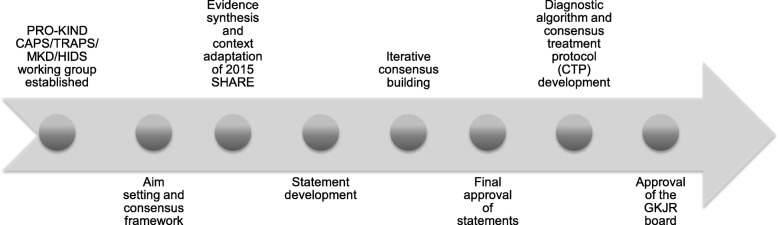
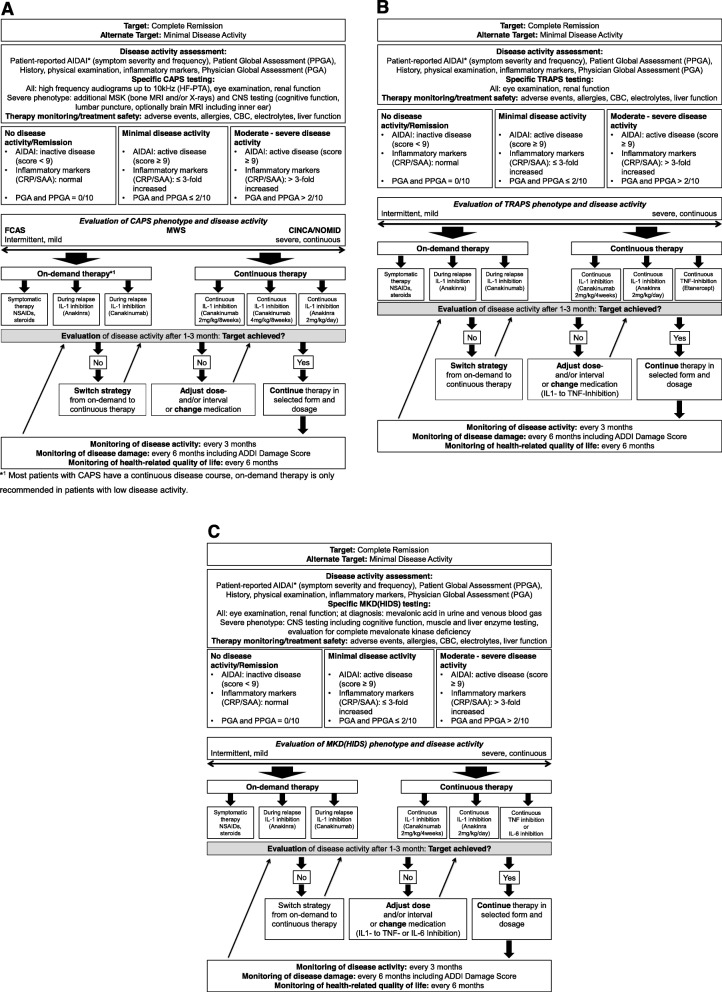
The national CAPS/TRAPS/MKD/HIDS expert working group was established, defined its aims and conducted a comprehensive literature review synthesising the recent (2013 to 2018) published evidence including all available recommendations for diagnosis and management. General and disease-specific statements were anchored in the 2015 SHARE recommendations. An iterative expert review process discussed, adapted and refined these statements. Ultimately the GKJR membership vetted the proposed consensus statements, agreement of 80% was mandatory for inclusion. The approved statements were integrated into three disease specific consensus treatment plans (CTPs). These were developed to enable the implementation of evidence-based, standardized care into clinical practice.
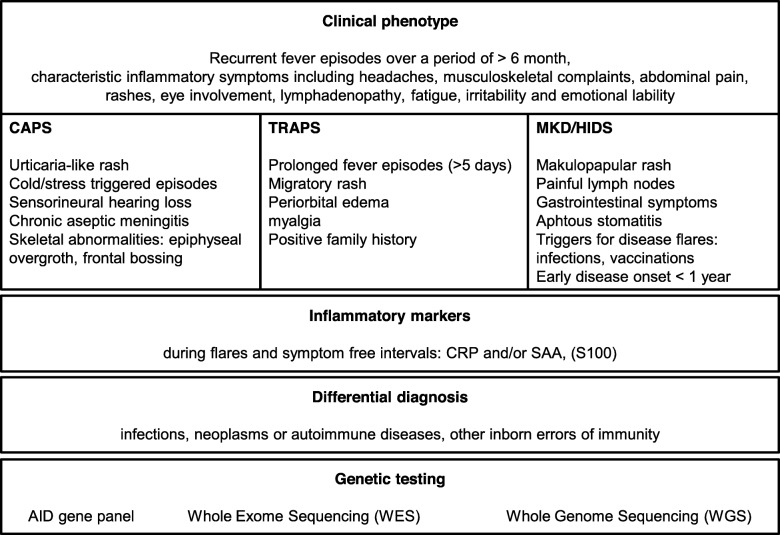
The CAPS/TRAPS/MKD/HIDS expert working group of 12 German and Austrian paediatric rheumatologists completed the evidence synthesis and modified a total of 38 statements based on the SHARE recommendation framework. In iterative reviews 36 reached the mandatory agreement threshold of 80% in the final GKJR member survey. These included 9 overarching principles and 27 disease-specific statements (7 for CAPS, 11 TRAPS, 9 MKD/HIDS). A diagnostic algorithm was established based on the synthesized evidence. Statements were integrated into diagnosis- and disease activity specific treat-to-target CTPs for CAPS, TRAPS and MKD/HIDS.
The PRO-KIND CAPS/TRAPS/MKD/HIDS working group established the first evidence-based, actionable treat-to-target consensus treatment plans for three rare hereditary autoinflammatory diseases. These provide a path to a rapid evaluation, effective control of disease activity and tailored adjustment of therapies. Their implementation will decrease variation in care and optimize health outcomes for children with AID.
包括 Cryopyrin 相关周期综合征 (CAPS)、肿瘤坏死因子受体相关周期综合征 (TRAPS) 和甲羟戊酸激酶缺乏综合征 (MKD)/高 IgD 综合征 (HIDS) 在内的罕见自身炎症性疾病 (AIDs) 具有明确的遗传性,其特征是反复出现发热和炎症性器官表现。早期诊断和早期开始有效的治疗可以控制炎症并预防器官损伤。德国儿科风湿病学会 (GKJR) 的 PRO-KIND 倡议旨在协调全国儿童风湿病的诊断和管理。PRO-KIND CAPS/TRAPS/MKD/HIDS 工作组的任务是制定基于证据的共识诊断和管理方案,包括首次针对 AID 的治疗目标策略。
成立了全国性的 CAPS/TRAPS/MKD/HIDS 专家工作组,确定了其目标,并对最近(2013 年至 2018 年)发表的文献进行了全面综述,综合了所有现有的诊断和管理建议。一般和疾病特异性陈述以 2015 年 SHARE 建议为基础。迭代专家审查过程讨论、调整和完善了这些陈述。最终,GKJR 成员对拟议的共识陈述进行了审查,必须有 80%的成员同意才能纳入。经批准的陈述被纳入三个特定疾病的共识治疗计划 (CTP)。这些计划旨在将基于证据的标准化护理纳入临床实践。
由 12 名德国和奥地利儿科风湿病专家组成的 CAPS/TRAPS/MKD/HIDS 专家工作组完成了证据综合,并根据 SHARE 建议框架修改了总共 38 个陈述。在迭代审查中,36 个陈述在最终的 GKJR 成员调查中达到了 80%的强制性同意阈值。其中包括 9 项总体原则和 27 项疾病特异性陈述(7 项 CAPS、11 项 TRAPS、9 项 MKD/HIDS)。根据综合证据建立了诊断算法。陈述被整合到 CAPS、TRAPS 和 MKD/HIDS 的诊断和疾病活动特异性治疗目标 CTP 中。
PRO-KIND CAPS/TRAPS/MKD/HIDS 工作组为三种罕见遗传性自身炎症性疾病制定了首个基于证据的、可操作的治疗目标共识治疗计划。这些计划为快速评估、有效控制疾病活动和调整治疗方法提供了途径。它们的实施将减少护理差异,优化儿童 AID 的健康结果。