Science Division, World Health Organization, Avenue Appia 20, 1211, Geneva 27, Switzerland.
Data, Analytics and Delivery for Impact Division, World Health Organization, Geneva, Switzerland.
Health Res Policy Syst. 2020 Feb 17;18(1):20. doi: 10.1186/s12961-020-0532-0.
Data on grants for biomedical research by 10 major funders of health research were collected from the World RePORT platform to explore what is being funded, by whom and where. This analysis is part of the World Health Organization Global Observatory on Health Research and Development's work with the overall aim to enable evidence-informed deliberations and decisions on new investments in health research and development. The analysis expands on the interactive data visualisations of these data on the Observatory's website and describes the methods used to enable the categorisation of grants by health categories using automated data-mining techniques.
Grants data were extracted from the World RePORT platform for 2016, the most recent year with data from all funders. A data-mining algorithm was developed in Java to categorise grants by health category. The analysis explored the distribution of grants by funder, recipient country and organisation, type of grant, health category, average grant duration, and the nature of collaborations between recipients of direct grants and the institutions they collaborated with.
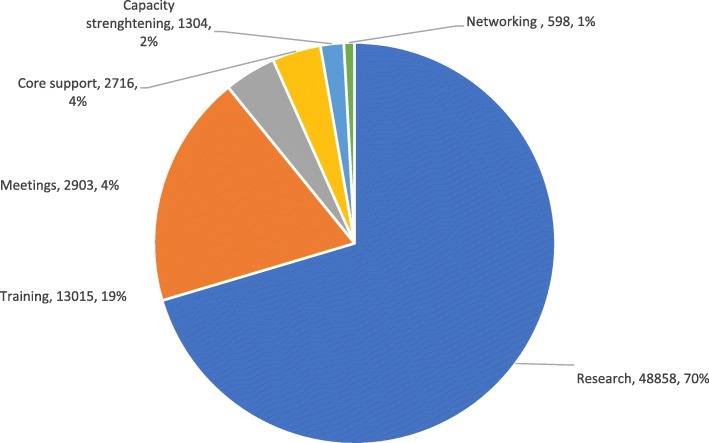
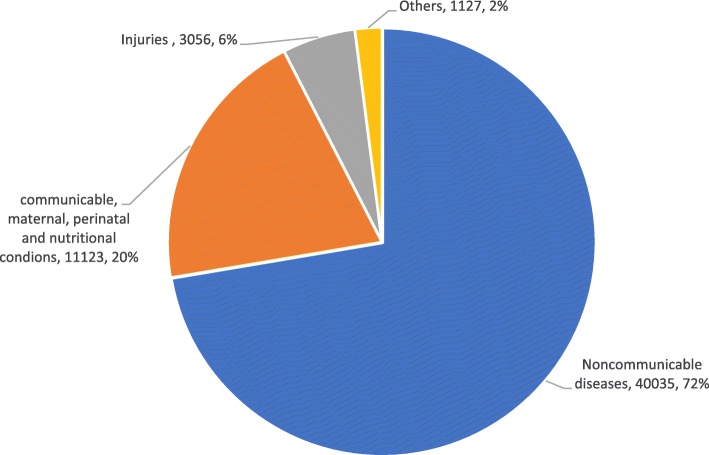
Out of a total of 69,420 grants in 2016, the United States of America's National Institutes of Health funded the greatest number of grants (52,928; 76%) and had the longest average grant duration (6 years and 10 months). Grants for research constituted 70.4% (48,879) of all types of grants, followed by grants for training (13,008; 18.7%) and meetings (2907; 4.2%). Of grant recipients by income group, low-income countries received only 0.2% (165) of all grants. Almost three-quarters of all grants were for non-communicable diseases (72%; 40,035), followed by communicable, maternal, perinatal and nutritional conditions (20%; 11,123), and injuries (6%; 3056). Only 1.1% of grants were for neglected tropical diseases and 0.4% for priority diseases on the WHO list of highly infectious (R&D blueprint) pathogens.
The findings highlight the importance of considering funding decisions by other actors in future health research and capacity-strengthening decisions. This will not only improve efficiency and equity in allocating scarce resources but will also allow informed investment decisions that aim to support research on public health needs and neglected areas.
从世界报告平台收集了 10 个主要卫生研究资助者的生物医学研究赠款数据,以探讨资助的内容、资助者和资助地点。这项分析是世界卫生组织全球卫生研究与发展观察站工作的一部分,其总体目标是为新的卫生研究与发展投资提供循证审议和决策。该分析扩展了观察站网站上这些数据的交互式数据可视化,并描述了使用自动化数据挖掘技术按卫生类别对赠款进行分类的方法。
从世界报告平台提取了 2016 年的赠款数据,这是所有资助者都有数据的最近一年。用 Java 开发了一个数据挖掘算法来按卫生类别对赠款进行分类。该分析探讨了按资助者、受赠国和组织、赠款类型、卫生类别、平均赠款期限以及直接赠款接受者与其合作机构之间合作的性质对赠款的分布情况。
在 2016 年总共 69420 笔赠款中,美国国立卫生研究院资助的赠款数量最多(52928 笔;76%),平均赠款期限最长(6 年零 10 个月)。研究赠款占所有赠款类型的 70.4%(48879 笔),其次是培训赠款(13008 笔;18.7%)和会议赠款(2907 笔;4.2%)。按收入组别划分的赠款接受者中,低收入国家仅获得所有赠款的 0.2%(165 笔)。近四分之三的赠款用于非传染性疾病(72%;40035 笔),其次是传染性疾病、孕产妇、围产期和营养状况(20%;11123 笔)和伤害(6%;3056 笔)。只有 1.1%的赠款用于被忽视的热带病,0.4%的赠款用于世界卫生组织高度传染性(研发蓝图)病原体清单上的优先疾病。
研究结果强调了在未来的卫生研究和能力建设决策中考虑其他行为者的供资决定的重要性。这不仅将提高稀缺资源分配的效率和公平性,还将作出知情的投资决策,旨在支持公共卫生需求和被忽视领域的研究。