WHO Collaborating Centre for Arbovirus and Hemorrhagic Fever Reference and Research, Bernhard Nocht Institute for Tropical Medicine, Hamburg, Germany.
University of Agricultural Sciences and Veterinary Medicine, Cluj-Napoca, Romania.
Parasit Vectors. 2020 Feb 17;13(1):79. doi: 10.1186/s13071-020-3938-1.
Culicoides biting midges are potential vectors of different pathogens. However, especially for eastern Europe, there is a lack of knowledge on the host-feeding patterns of this vector group. Therefore, this study aimed to identify Culicoides spp. and their vertebrate hosts collected in a wetland ecosystem.
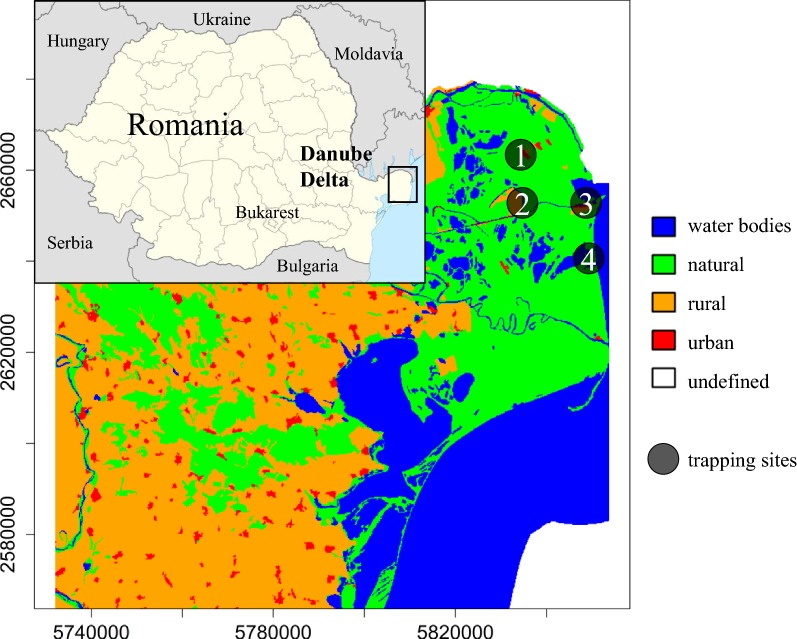
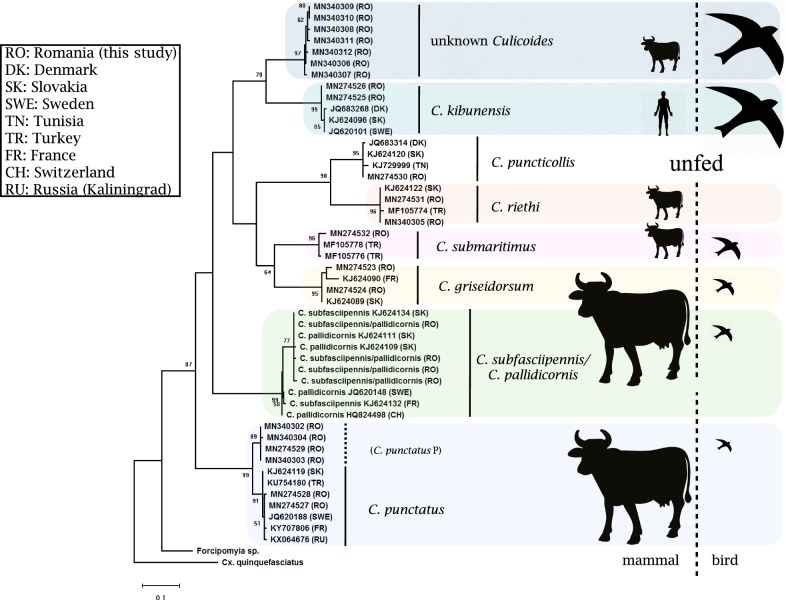
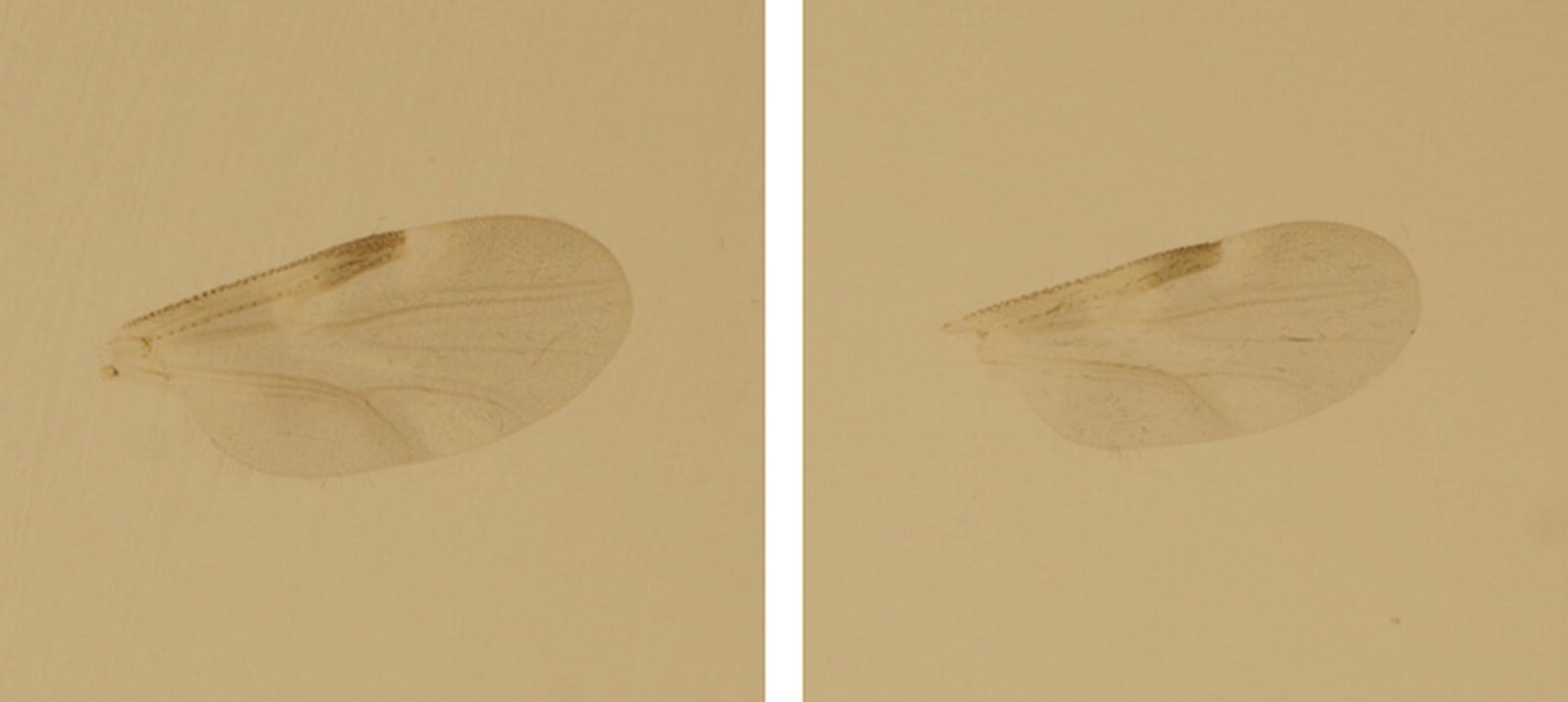
Culicoides spp. were collected weekly from May to August 2017, using Biogents traps with UV light at four sites in the Danube Delta Biosphere Reserve, Romania. Vectors and hosts were identified with a DNA barcoding approach. The mitochondrial cytochrome c oxidase subunit 1 was used to identify Culicoides spp., while vertebrate hosts were determined targeting cytochrome b or 16S rRNA gene fragments. A maximum likelihood phylogenetic tree was constructed to verify the biting midge identity against other conspecific Palaearctic Culicoides species. A set of unfed midges was used for morphological confirmation of species identification using slide-mounted wings.
Barcoding allowed the species identification and detection of corresponding hosts for 1040 (82.3%) of the 1264 analysed specimens. Eight Culicoides spp. were identified with Culicoides griseidorsum, Culicoides puncticollis and Culicoides submaritimus as new species records for Romania. For 39 specimens no similar sequences were found in GenBank. This group of unknown Culicoides showed a divergence of 15.6-16.3% from the closest identified species and clustered in a monophyletic clade, i.e. a novel species or a species without reference sequences in molecular libraries. For all Culicoides spp., nine mammalian and 24 avian species were detected as hosts. With the exception of C. riethi (n = 12), at least one avian host was detected for all Culicoides spp., but this host group only dominated for Culicoides kibunensis and the unknown Culicoides sp.. The most common host group were mammals (n = 993, 87.6% of all identified blood sources) dominated by cattle (n = 817, 70.6%).
Most Culicoides spp. showed a broad host-feeding pattern making them potential bridge vectors. At the same time, new records of biting midge species for Romania, as well as a potentially unknown Culicoides species, highlight the lack of knowledge regarding the biting midge species and their genetic diversity in eastern Europe.
厩螫蝇是多种病原体的潜在媒介。然而,特别是对于东欧而言,该媒介群的宿主取食模式知识仍然匮乏。因此,本研究旨在确定在罗马尼亚多瑙河三角洲生物圈保护区的四个地点采集的湿地生态系统中的库蠓属物种及其脊椎动物宿主。
2017 年 5 月至 8 月,每周使用配备紫外线灯的 Biogents 陷阱在罗马尼亚多瑙河三角洲生物圈保护区的四个地点采集库蠓属昆虫。使用 DNA 条形码方法鉴定库蠓属物种和宿主。线粒体细胞色素 c 氧化酶亚基 1 用于鉴定库蠓属物种,而脊椎动物宿主则通过靶向细胞色素 b 或 16S rRNA 基因片段来确定。构建最大似然系统发育树以验证针对其他近缘库蠓属鳞翅目昆虫的吸血蝇的身份。使用载玻片上的翅膀对一组未进食的中肠进行形态学确认,以确认物种鉴定。
条形码允许对 1264 个分析标本中的 1040 个(82.3%)进行物种鉴定和相应宿主的检测。确定了 8 种库蠓属物种,其中包括库蠓灰体亚种、库蠓点刻亚种和库蠓亚海亚种,这是罗马尼亚的新物种记录。在 GenBank 中未发现 39 个标本的相似序列。该组未知库蠓属的种间差异为 15.6-16.3%,与最接近的鉴定种聚类形成单系群,即一种新种或分子文库中无参考序列的种。对于所有库蠓属物种,检测到 9 种哺乳动物和 24 种鸟类作为宿主。除了 C. riethi(n=12)外,所有库蠓属物种至少有一种鸟类宿主,但该宿主群仅在库蠓基敦亚种和未知库蠓属中占主导地位。最常见的宿主群是哺乳动物(n=993,所有鉴定血液来源的 87.6%),其中以牛为主(n=817,70.6%)。
大多数库蠓属物种表现出广泛的宿主取食模式,使它们成为潜在的桥梁媒介。同时,罗马尼亚的吸血蝇种新记录以及潜在的未知库蠓种凸显了东欧吸血蝇种及其遗传多样性知识的缺乏。