M Hernández-Triana Luis, A Brugman Victor, I Nikolova Nadya, Barrero Elsa, Thorne Leigh, Fernández de Marco Mar, Krüger Andreas, Lumley Sarah, Johnson Nicholas, R Fooks Anthony
Animal and Plant Health Agency, Woodham Lane, Addlestone, Surrey, KT15 3NB, UK.
Vecotech Ltd., Keppel Street, London, WC1E 7HT, UK.
Zookeys. 2019 Mar 19;832:57-76. doi: 10.3897/zookeys.832.32257. eCollection 2019.
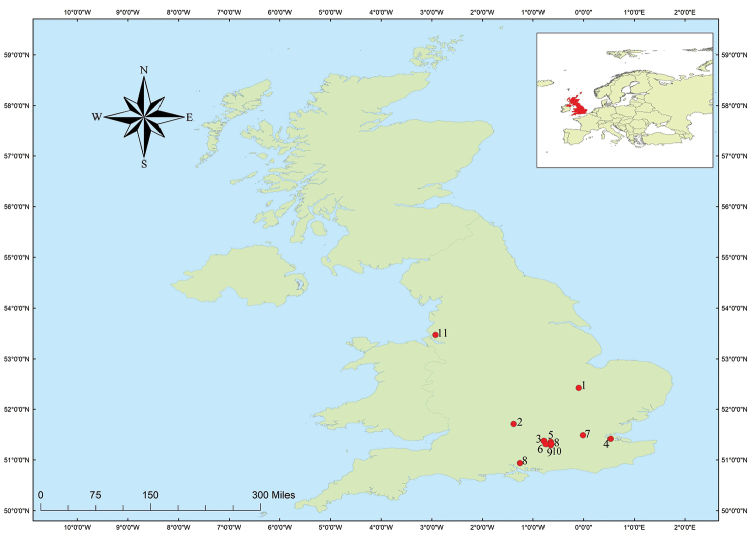
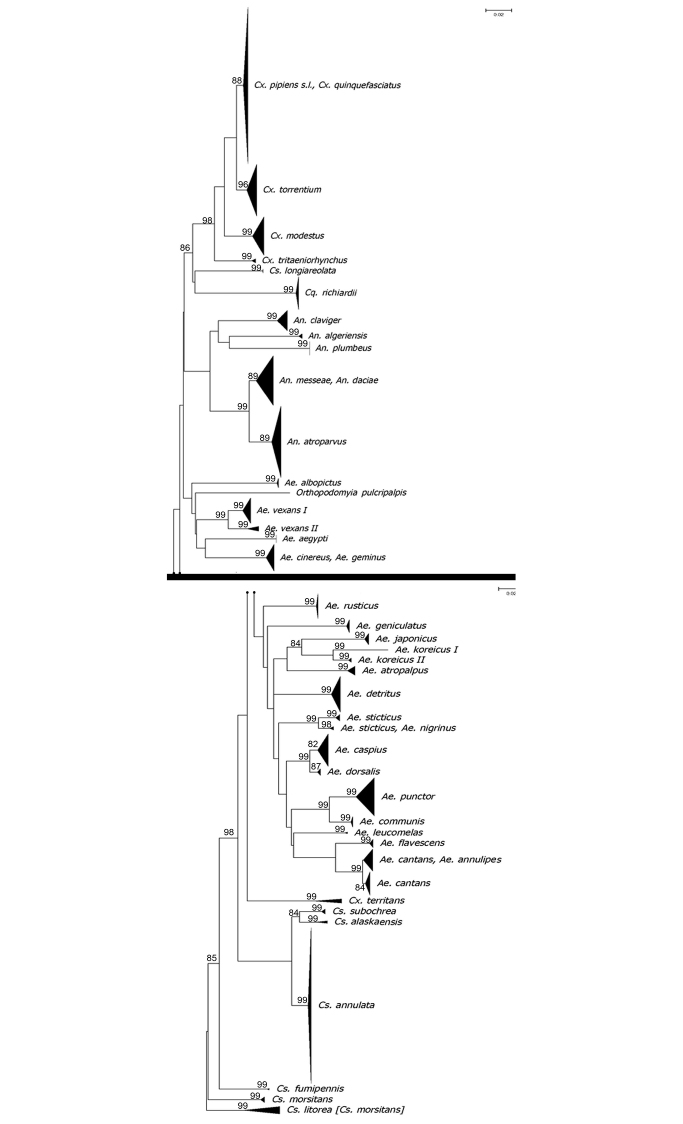
Correct mosquito species identification is essential for mosquito and disease control programs. However, this is complicated by the difficulties in morphologically identifying some mosquito species. In this study, variation of a partial sequence of the cytochrome oxidase unit I () gene was used for the molecular identification of British mosquito species and to facilitate the discovery of cryptic diversity, and monitoring invasive species. Three DNA extraction methods were compared to obtain DNA barcodes from adult specimens. In total, we analyzed 42 species belonging to the genera Meigen, 1818 (21 species), Meigen, 1818 (7 species), Theobald, 1904 (1 species), Linnaeus, 1758 (6 species), Felt, 1904 (7 species), and Theobald, 1904 (1 species). Intraspecific genetic divergence ranged from 0% to 5.4%, while higher interspecific divergences were identified between Peus, 1971/ (Shute, 1928) (24.6%) and / Stephens, 1828 (22.5%). Taxonomic discrepancy was shown between Linton, Nicolescu & Harbach, 2004 and Falleroni, 1828 indicating the poor resolution of the DNA barcoding region in separating these taxa. Other species such as (Meigen, 1818)/ (Meigen, 1830) showed similar discrepancies indicating some limitation of this genetic marker to identify certain mosquito species. The combination of morphology and DNA barcoding is an effective approach for the identification of British mosquitoes, for invasive mosquitoes posing a threat to the UK, and for the detection of hidden diversity within species groups.
正确识别蚊虫种类对于蚊虫及疾病控制项目至关重要。然而,由于某些蚊虫种类在形态学上难以识别,这一过程变得复杂。在本研究中,细胞色素氧化酶亚基I(COI)基因部分序列的变异被用于英国蚊虫种类的分子鉴定,以促进隐秘多样性的发现及入侵物种的监测。比较了三种DNA提取方法以从成虫标本中获取DNA条形码。我们总共分析了属于以下属的42个物种:梅根蚊属(Meigen,1818年)(21种)、伊蚊属(Aedes Meigen,1818年)(7种)、库蚊属(Culex Theobald,1904年)(1种)、按蚊属(Anopheles Linnaeus,1758年)(6种)、脉毛蚊属(Culiseta Felt,1904年)(7种)以及曼蚊属(Mansonia Theobald,1904年)(1种)。种内遗传差异范围为0%至5.4%,而在1971年的皮蚊属(Peus)/(舒特,1928年)(24.6%)和1828年的(属名缺失)/斯蒂芬斯(22.5%)之间发现了更高的种间差异。2004年的林顿、尼科莱斯库和哈巴赫分类与1828年的法勒罗尼分类之间存在分类差异,这表明COI DNA条形码区域在区分这些分类单元时分辨率较差。其他物种,如(梅根蚊属,1818年)/(梅根蚊属,1830年)也显示出类似差异,表明该遗传标记在识别某些蚊虫种类时存在一定局限性。形态学和DNA条形码相结合是鉴定英国蚊虫、对英国构成威胁的入侵蚊虫以及检测物种组内隐藏多样性的有效方法。