Department of Psychiatry and Human Behavior, Alpert Medical School of Brown University, 700 Butler Drive, Providence, RI, 02906, USA.
Butler Hospital, 345 Blackstone Boulevard, Providence, RI, 02906, USA.
Transl Psychiatry. 2020 Jan 21;10(1):14. doi: 10.1038/s41398-020-0683-3.
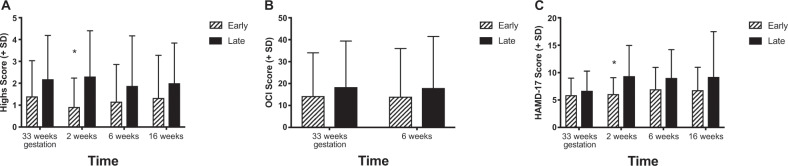
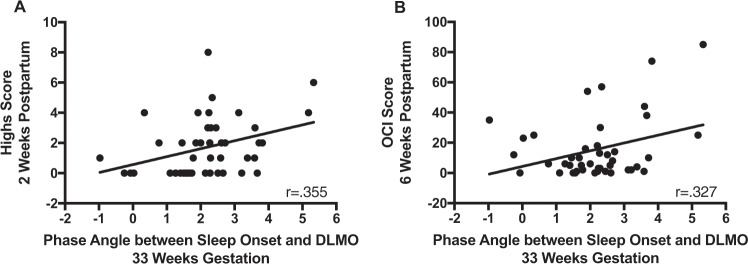
Later sleep timing, circadian preference, and circadian rhythm timing predict worse outcomes across multiple domains, including mood disorders, substance use, impulse control, and cognitive function. Disturbed sleep is common among pregnant and postpartum women. We examined whether sleep timing during third trimester of pregnancy predicted postpartum symptoms of mania, depression, and obsessive-compulsive disorder (OCD). Fifty-one women with a previous, but not active, episode of unipolar or bipolar depression had symptoms evaluated and sleep recorded with wrist actigraphy at 33 weeks of gestation and 2, 6, and 16 weeks postpartum. Circadian phase was measured in a subset of women using salivary dim light melatonin onset (DLMO). We divided the sample into "early sleep" and "late sleep" groups using average sleep onset time at 33 weeks of gestation, defined by the median-split time of 11:27 p.m. The "late sleep" group reported significantly more manic and depressive symptoms at postpartum week 2. Longer phase angle between DLMO and sleep onset at 33 weeks was associated with more manic symptoms at postpartum week 2 and more obsessive-compulsive symptoms at week 6. Delayed sleep timing in this sample of at-risk women was associated with more symptoms of mania, depression, and OCD in the postpartum period. Sleep timing may be a modifiable risk factor for postpartum depression.
后期的睡眠时间、昼夜节律偏好和昼夜节律计时会预测多个领域的预后更差,包括情绪障碍、物质使用、冲动控制和认知功能。睡眠障碍在孕妇和产后妇女中很常见。我们研究了妊娠晚期的睡眠时间是否会预测产后躁狂、抑郁和强迫症(OCD)的症状。51 名患有单相或双相抑郁但无活动期发作的女性在妊娠 33 周、产后 2、6 和 16 周时进行了症状评估和腕部活动记录。在一部分女性中,使用唾液褪黑素起始时间(DLMO)测量昼夜节律相位。我们使用 11:27 晚上的中位数分割时间将样本分为“早睡”和“晚睡”组。“晚睡”组在产后第 2 周报告的躁狂和抑郁症状明显更多。33 周时 DLMO 和睡眠开始之间的相位角更长与产后第 2 周的躁狂症状更多和第 6 周的强迫症症状更多有关。在这个有风险的女性样本中,睡眠时间延迟与产后期间的躁狂、抑郁和强迫症症状更多有关。睡眠时间可能是产后抑郁的一个可改变的风险因素。