Service de Psychiatrie de l'Enfant, AP-HP, Hôpital Necker, 149 rue de Sèvres, 75015, Paris, France.
Institut des Systèmes Intelligents et de Robotique, CNRS, UMR 7222, Sorbonne Université, 4 Place Jussieu, 75252, Paris Cedex, France.
Transl Psychiatry. 2020 Feb 3;10(1):54. doi: 10.1038/s41398-020-0743-8.
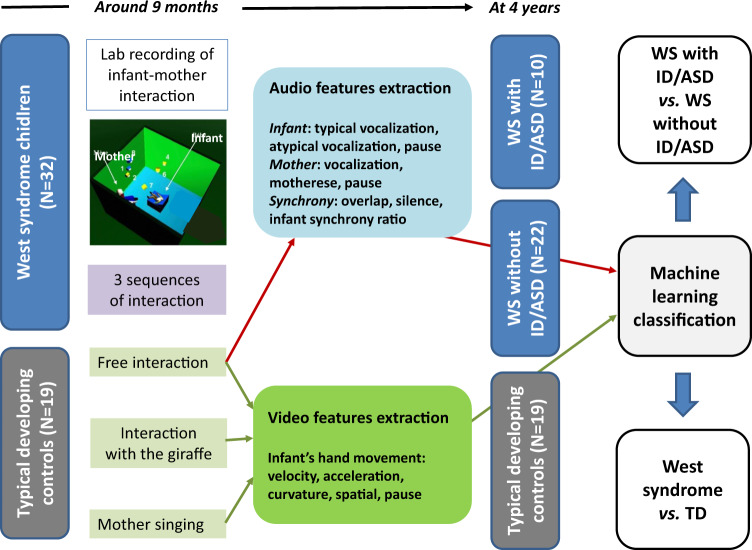
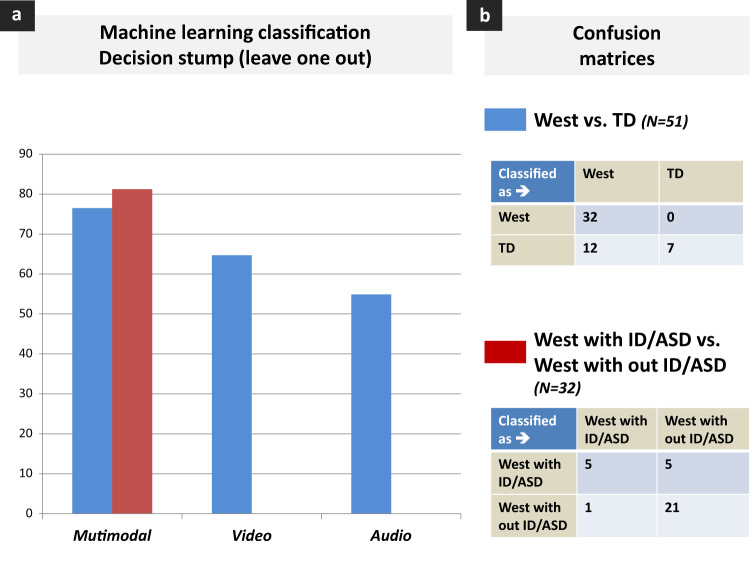
Automated behavior analysis are promising tools to overcome current assessment limitations in psychiatry. At 9 months of age, we recorded 32 infants with West syndrome (WS) and 19 typically developing (TD) controls during a standardized mother-infant interaction. We computed infant hand movements (HM), speech turn taking of both partners (vocalization, pause, silences, overlap) and motherese. Then, we assessed whether multimodal social signals and interactional synchrony at 9 months could predict outcomes (autism spectrum disorder (ASD) and intellectual disability (ID)) of infants with WS at 4 years. At follow-up, 10 infants developed ASD/ID (WS+). The best machine learning reached 76.47% accuracy classifying WS vs. TD and 81.25% accuracy classifying WS+ vs. WS-. The 10 best features to distinguish WS+ and WS- included a combination of infant vocalizations and HM features combined with synchrony vocalization features. These data indicate that behavioral and interaction imaging was able to predict ASD/ID in high-risk children with WS.
自动化行为分析是一种有前途的工具,可以克服精神病学目前的评估局限性。在 9 个月大时,我们记录了 32 名患有 West 综合征(WS)的婴儿和 19 名典型发育(TD)对照在标准化母婴互动期间的行为。我们计算了婴儿的手部运动(HM)、双方的言语轮流(发声、停顿、沉默、重叠)和母亲语。然后,我们评估了 9 个月时的多模态社交信号和互动同步是否可以预测 4 岁时 WS 婴儿的结局(自闭症谱系障碍(ASD)和智力障碍(ID))。随访时,有 10 名婴儿发展为 ASD/ID(WS+)。最佳机器学习的准确率为 76.47%,可区分 WS 与 TD,准确率为 81.25%,可区分 WS+与 WS-。区分 WS+和 WS-的 10 个最佳特征包括婴儿发声和 HM 特征与同步发声特征的组合。这些数据表明,行为和互动成像能够预测高危 WS 儿童的 ASD/ID。