Leclère C, Avril M, Viaux-Savelon S, Bodeau N, Achard C, Missonnier S, Keren M, Feldman R, Chetouani M, Cohen D
Institut des Systèmes Intelligents et de Robotiques, CNRS, UMR 7222, Sorbonne Universités, Université Pierre et Marie Curie, Paris, France.
Department of Child and Adolescent Psychiatry, Pitié-Salpêtrière Hospital, AP-HP, Paris, France.
Transl Psychiatry. 2016 May 24;6(5):e816. doi: 10.1038/tp.2016.82.
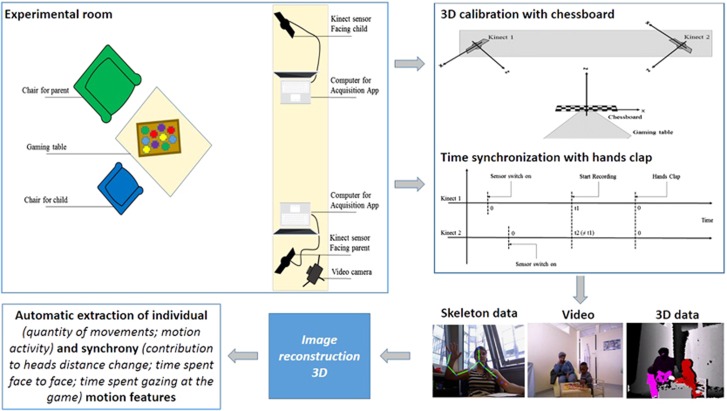
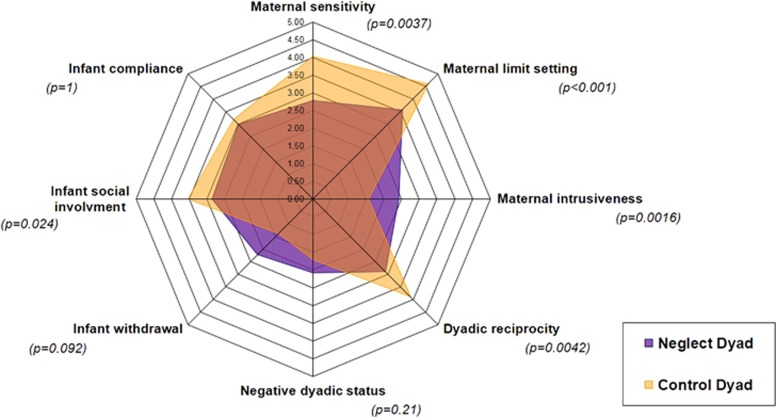
Studying early interaction is essential for understanding development and psychopathology. Automatic computational methods offer the possibility to analyse social signals and behaviours of several partners simultaneously and dynamically. Here, 20 dyads of mothers and their 13-36-month-old infants were videotaped during mother-infant interaction including 10 extremely high-risk and 10 low-risk dyads using two-dimensional (2D) and three-dimensional (3D) sensors. From 2D+3D data and 3D space reconstruction, we extracted individual parameters (quantity of movement and motion activity ratio for each partner) and dyadic parameters related to the dynamics of partners heads distance (contribution to heads distance), to the focus of mutual engagement (percentage of time spent face to face or oriented to the task) and to the dynamics of motion activity (synchrony ratio, overlap ratio, pause ratio). Features are compared with blind global rating of the interaction using the coding interactive behavior (CIB). We found that individual and dyadic parameters of 2D+3D motion features perfectly correlates with rated CIB maternal and dyadic composite scores. Support Vector Machine classification using all 2D-3D motion features classified 100% of the dyads in their group meaning that motion behaviours are sufficient to distinguish high-risk from low-risk dyads. The proposed method may present a promising, low-cost methodology that can uniquely use artificial technology to detect meaningful features of human interactions and may have several implications for studying dyadic behaviours in psychiatry. Combining both global rating scales and computerized methods may enable a continuum of time scale from a summary of entire interactions to second-by-second dynamics.
研究早期互动对于理解发展和精神病理学至关重要。自动计算方法提供了同时动态分析多个伙伴的社会信号和行为的可能性。在此,使用二维(2D)和三维(3D)传感器,对20对母亲及其13至36个月大的婴儿在母婴互动期间进行了录像,其中包括10对极高风险和10对低风险的二元组。从2D + 3D数据和3D空间重建中,我们提取了个体参数(每个伙伴的运动数量和运动活动比率)以及与伙伴头部距离动态(对头部距离的贡献)、相互参与焦点(面对面或专注于任务所花费的时间百分比)和运动活动动态(同步比率、重叠比率、暂停比率)相关的二元组参数。使用编码互动行为(CIB)将这些特征与互动的盲态整体评分进行比较。我们发现,2D + 3D运动特征的个体和二元组参数与评定的CIB母亲和二元组综合评分完美相关。使用所有2D - 3D运动特征的支持向量机分类将100%的二元组正确分类到其所属组,这意味着运动行为足以区分高风险和低风险二元组。所提出的方法可能是一种有前景的低成本方法,它可以独特地利用人工智能技术来检测人类互动的有意义特征,并且可能对精神病学中二元组行为的研究有若干启示。结合整体评分量表和计算机化方法可能实现从整个互动总结到逐秒动态的连续时间尺度。