Departamento de Acuicultura, Universidad Católica del Norte, Doctorado en Acuicultura, Programa Cooperativo Universidad de Chile, Pontificia Universidad Católica de Valparaíso, Universidad Católica del Norte, Larrondo 1281, Coquimbo, Chile.
Laboratorio de Biotecnología de Alimentos, Unidad de Alimentos, Instituto de Nutrición y Tecnología de los Alimentos (INTA), Universidad de Chile, El Líbano 5524, Macul, Santiago, Chile.
Sci Rep. 2020 Feb 17;10(1):2719. doi: 10.1038/s41598-020-59587-y.
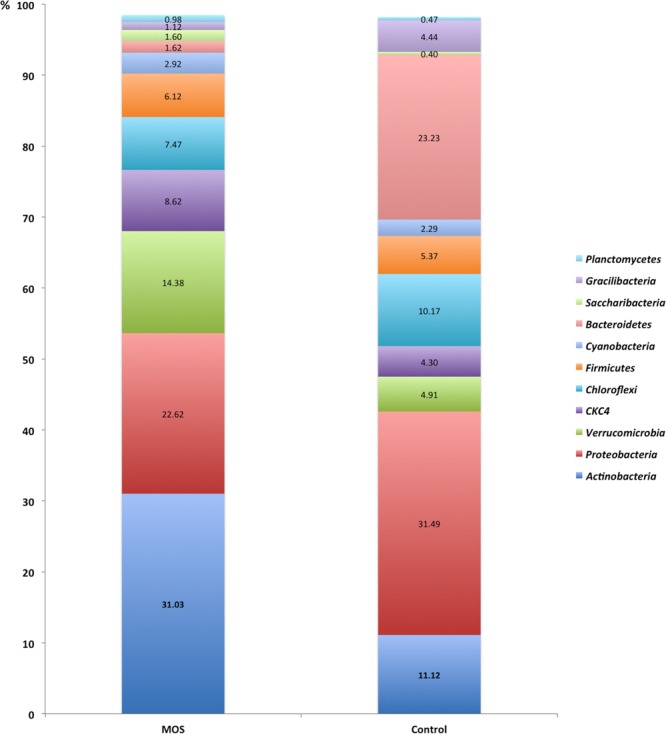
The white leg Litopenaeus vannamei shrimp is of importance to the eastern Pacific fisheries and aquaculture industry but suffer from diseases such as the recently emerged early mortality syndrome. Many bacterial pathogens have been identified but the L. vannamei microbiota is still poorly known. Using a next-generation sequencing (NGS) approach, this work evaluated the impact of the inclusion in the diet of mannan oligosaccharide, (MOS, 0.5% w/w), over the L. vannamei microbiota and production behavior of L. vannamei under intensive cultivation in Ecuador. The MOS supplementation lasted for 60 days, after which the shrimp in the ponds were harvested, and the production data were collected. MOS improved productivity outcomes by increasing shrimp survival by 30%. NGS revealed quantitative differences in the shrimp microbiota between MOS and control conditions. In the treatment with inclusion of dietary MOS, the predominant phylum was Actinobacteria (28%); while the control group was dominated by the phylum Proteobacteria (30%). MOS has also been linked to an increased prevalence of Lactococcus- and Verrucomicrobiaceae-like bacteria. Furthermore, under the treatment of MOS, the prevalence of potential opportunistic pathogens, like Vibrio, Aeromonas, Bergeyella and Shewanella, was negligible. This may be attributable to MOS blocking the adhesion of pathogens to the surfaces of the host tissues. Together, these findings point to the fact that the performance (survival) improvements of the dietary MOS may be linked to the impact on the microbiota, since bacterial lines with pathogenic potential towards shrimps were excluded in the gut.
白脚凡纳滨对虾是东太平洋渔业和水产养殖业的重要组成部分,但易患早死综合征等疾病。已经鉴定出许多细菌病原体,但对凡纳滨对虾的微生物群仍然知之甚少。本研究采用下一代测序(NGS)方法,评估了在饮食中添加甘露寡糖(MOS,0.5%w/w)对凡纳滨对虾微生物群和在厄瓜多尔集约化养殖条件下凡纳滨对虾生产行为的影响。MOS 补充持续 60 天,之后在池塘中收获对虾,并收集生产数据。MOS 通过将虾的存活率提高 30%来提高生产性能。NGS 揭示了 MOS 和对照条件下虾微生物群的定量差异。在添加膳食 MOS 的处理中,优势门是放线菌(28%);而对照组则以变形菌门(30%)为主。MOS 还与乳球菌科和疣微菌科样细菌的流行增加有关。此外,在 MOS 处理下,潜在机会性病原体(如弧菌、气单胞菌、贝氏不动杆菌和希瓦氏菌)的流行率可以忽略不计。这可能归因于 MOS 阻止了病原体与宿主组织表面的粘附。总之,这些发现表明,膳食 MOS 的性能(存活率)提高可能与其对微生物群的影响有关,因为对虾具有潜在致病性的细菌线在肠道中被排除。