Associated Graduated Program in Physical Education Universidade de Pernambuco e Universidade da Paraíba Recife Brazil.
Graduated Program in Medicine Universidade Nove de Julho São Paulo Brazil.
J Am Heart Assoc. 2020 Feb 18;9(4):e013596. doi: 10.1161/JAHA.119.013596. Epub 2020 Feb 6.
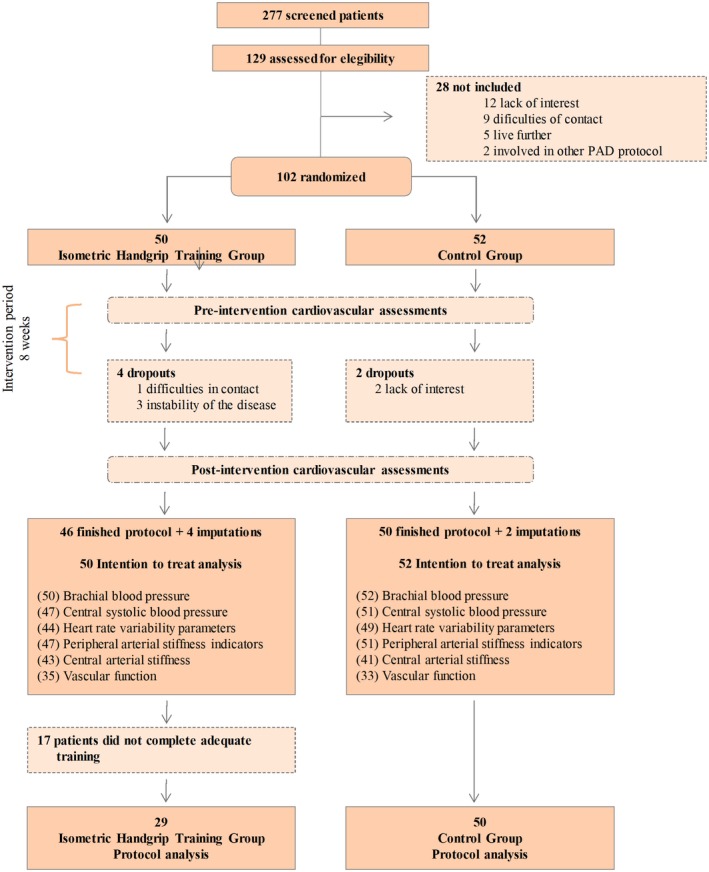
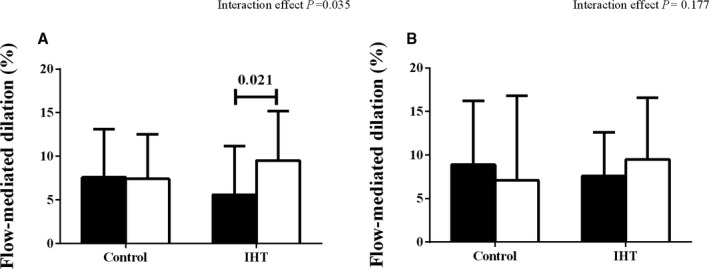
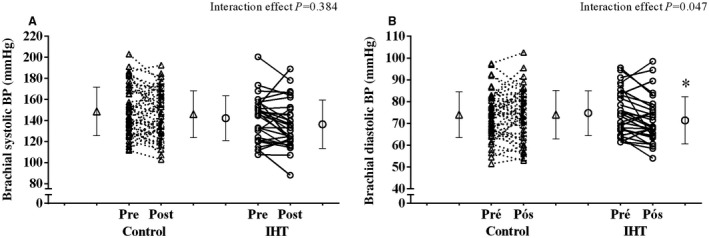
Background Meta-analyses have shown that isometric handgrip training (IHT) can reduce brachial systolic and diastolic blood pressure (BP) by >6/4 mm Hg, respectively. However, whether IHT promotes these effects among patients with peripheral artery disease, who exhibit severe impairment in cardiovascular function, is currently unknown. This study aimed to evaluate the effects of IHT on the cardiovascular function of patients with peripheral artery disease. Methods and Results A randomized controlled trial with peripheral artery disease patients assigned to either the IHT or control group was conducted. The IHT group performed 3 sessions per week, for 8 weeks, of unilateral handgrip exercises, consisting of 4 sets of isometric contractions for 2 minutes at 30% of maximum voluntary contraction and a 4-minute interval between sets. The control group received a compression ball in order to minimize the placebo effects, representing sham training. The primary outcome was brachial BP. The secondary outcomes were central BP, arterial stiffness parameters, cardiac autonomic modulation, and vascular function. The IHT program reduced diastolic BP (75 [10] mm Hg preintervention versus 72 [11] mm Hg postintervention), with no change in the control group (74 [11] mm Hg preintervention versus 74 [11] mm Hg postintervention), with this between-group difference being significant (=0.04). Flow-mediated dilation improved in the IHT group (6.0% [5.7] preintervention versus 9.7% [5.5] postintervention), with no change in the control group (7.6% [5.5] preintervention versus 7.4% [5.1] postintervention), with this between-group difference being significant (=0.04). There was no change in other measured variables over the intervention period. Conclusions IHT reduced brachial diastolic BP and improved local vascular function in patients with peripheral artery disease. Clinical Trial Registration URL: https://www.clinicaltrials.gov/. Unique identifier: NCT02742220.
荟萃分析表明,等长握力训练(IHT)可分别降低肱动脉收缩压和舒张压(BP)>6/4mmHg。然而,在心血管功能严重受损的外周动脉疾病患者中,IHT 是否能促进这些作用目前尚不清楚。本研究旨在评估 IHT 对外周动脉疾病患者心血管功能的影响。
进行了一项外周动脉疾病患者的随机对照试验,将患者分为 IHT 组或对照组。IHT 组每周进行 3 次,每次 8 周,单侧握力训练,包括 4 组 30%最大自主收缩力的等长收缩,每组之间间隔 4 分钟。对照组接受压缩球以最小化安慰剂效应,代表假训练。主要结局为肱动脉血压。次要结局为中心血压、动脉僵硬度参数、心脏自主神经调节和血管功能。IHT 方案降低了舒张压(干预前 75[10]mmHg 与干预后 72[11]mmHg),对照组无变化(干预前 74[11]mmHg 与干预后 74[11]mmHg),组间差异有统计学意义(=0.04)。IHT 组血流介导的扩张改善(干预前 6.0%[5.7]与干预后 9.7%[5.5]),对照组无变化(干预前 7.6%[5.5]与干预后 7.4%[5.1]),组间差异有统计学意义(=0.04)。干预期间其他测量变量无变化。
IHT 降低了外周动脉疾病患者的肱动脉舒张压并改善了局部血管功能。