Screening and Health Impact Assessment Unit, Azienda Zero-Veneto Region, Padua, Italy.
Directorate of Prevention, Food Safety, and Veterinary Public Health-Veneto Region, Venice, Italy.
Environ Health Perspect. 2020 Feb;128(2):27007. doi: 10.1289/EHP5337. Epub 2020 Feb 18.
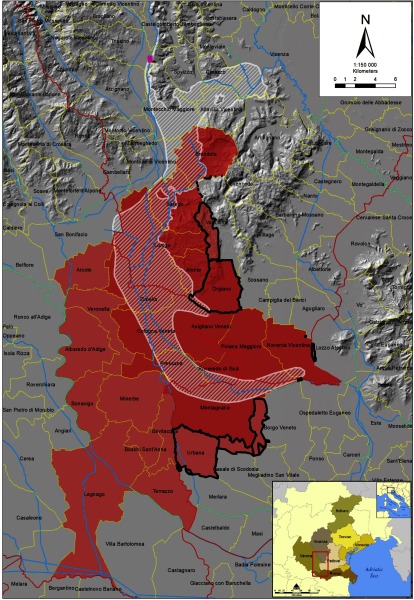
In spring 2013, groundwater of a vast area of the Veneto Region (northeastern Italy) was found to be contaminated by perfluoroalkyl substances (PFAS) from a PFAS manufacturing plant active since the late 1960s. Residents were exposed to high concentrations of PFAS, particularly perfluorooctanoic acid (PFOA), through drinking water until autumn 2013. A publicly funded health surveillance program is under way to aid in the prevention, early diagnosis, and treatment of chronic disorders possibly associated with PFAS exposure.
The objectives of this paper are: ) to describe the organization of the health surveillance program, ) to report serum PFAS concentrations in adolescents and young adults, and ) to identify predictors of serum PFAS concentrations in the studied population.
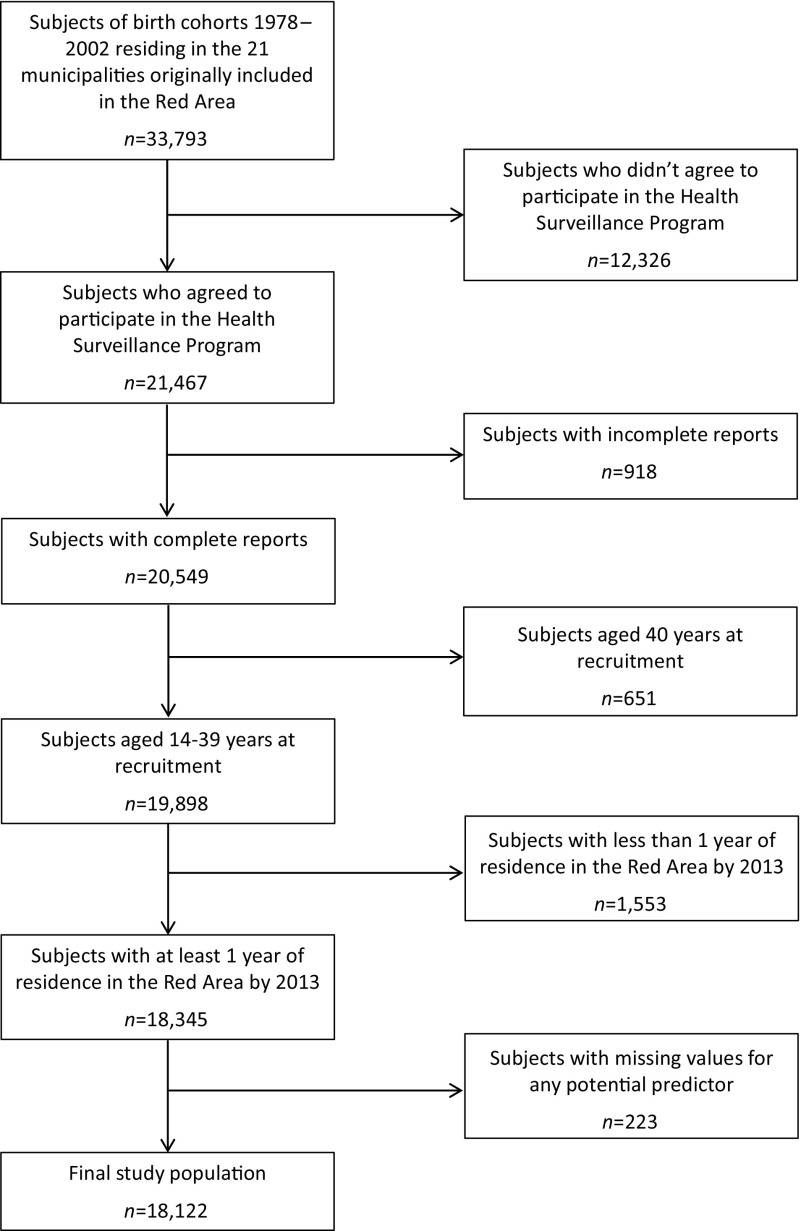
The health surveillance program offered to residents of municipalities supplied by contaminated waterworks includes a structured interview, routine blood and urine tests, and measurement of 12 PFAS in serum by high-performance liquid chromatography-tandem mass spectrometry. We studied 18,345 participants born between 1978 and 2002, 14-39 years of age at recruitment. Multivariable linear regression was used to identify sociodemographic, lifestyle, dietary, and reproductive predictors of serum PFAS concentrations.
The PFAS with the highest serum concentrations were PFOA [median , interquartile range (IQR) 19.3-84.9], perfluorohexanesulfonic acid (PFHxS) (median , IQR 1.9-7.4), and perfluorooctanesulfonic acid (PFOS) (median , IQR 2.6-5.8). The major predictors of serum levels were gender, municipality, duration of residence in the affected area, and number of deliveries. Overall, the regression models explained 37%, 23%, and 43% of the variance of PFOA, PFOS, and PFHxS, respectively.
Serum PFOA concentrations were high relative to concentrations in populations with background residential exposures only. Interindividual variation of serum PFAS levels was partially explained by the considered predictors. https://doi.org/10.1289/EHP5337.
2013 年春季,发现意大利东北部威尼托地区(Veneto Region)大片地区的地下水受到自 20 世纪 60 年代末以来一直活跃的全氟烷基物质(PFAS)的污染。居民通过饮用水暴露于高浓度的 PFAS 中,尤其是全氟辛酸(PFOA),直到 2013 年秋季。一个由公共资金资助的健康监测计划正在进行中,以帮助预防、早期诊断和治疗可能与 PFAS 暴露有关的慢性疾病。
本文的目的是:)描述健康监测计划的组织,)报告青少年和年轻人的血清 PFAS 浓度,以及)确定研究人群中血清 PFAS 浓度的预测因素。
向受污染水厂供水的市政当局的居民提供健康监测计划,包括结构化访谈、常规血液和尿液测试以及通过高效液相色谱-串联质谱法测量血清中的 12 种 PFAS。我们研究了 18345 名出生于 1978 年至 2002 年之间的参与者,招募时年龄在 14 至 39 岁之间。使用多变量线性回归来确定血清 PFAS 浓度的社会人口统计学、生活方式、饮食和生殖预测因素。
血清中浓度最高的 PFAS 是全氟辛酸(PFOA)[中位数,四分位距(IQR)19.3-84.9]、全氟己烷磺酸(PFHxS)(中位数,IQR 1.9-7.4)和全氟辛烷磺酸(PFOS)(中位数,IQR 2.6-5.8)。血清水平的主要预测因素是性别、市政当局、在受影响地区的居住时间和分娩次数。总体而言,回归模型分别解释了 PFOA、PFOS 和 PFHxS 的 37%、23%和 43%的方差。
血清 PFOA 浓度与仅存在背景居住暴露的人群相比处于较高水平。血清 PFAS 水平的个体间差异部分由考虑的预测因素解释。https://doi.org/10.1289/EHP5337.