Cardenas Andres, Gold Diane R, Hauser Russ, Kleinman Ken P, Hivert Marie-France, Calafat Antonia M, Ye Xiaoyun, Webster Thomas F, Horton Edward S, Oken Emily
Division of Chronic Disease Research Across the Lifecourse, Department of Population Medicine, Harvard Medical School and Harvard Pilgrim HealthCare Institute , Boston, Massachusetts, USA.
Channing Laboratory, Brigham and Women's Hospital, Boston, Massachusetts, USA.
Environ Health Perspect. 2017 Oct 2;125(10):107001. doi: 10.1289/EHP1612.
Several per- and polyfluoroalkyl substances (PFAS) are ubiquitous anthropogenic pollutants almost universally detected in humans. Experimental evidence indicates that PFAS alter glucose metabolism and insulin secretion. However, epidemiological studies have yielded inconsistent results.
We sought to examine associations between plasma PFAS concentrations, glycemic indicators, and diabetes incidence among high-risk adults.
Within the Diabetes Prevention Program (DPP), a trial for the prevention of type 2 diabetes among high-risk individuals, we quantified baseline plasma concentrations of nine PFAS among 957 participants randomized to a lifestyle intervention or placebo. We evaluated adjusted associations for plasma PFAS concentrations with diabetes incidence and key glycemic indicators measured at baseline and annually over up to 4.6 y.
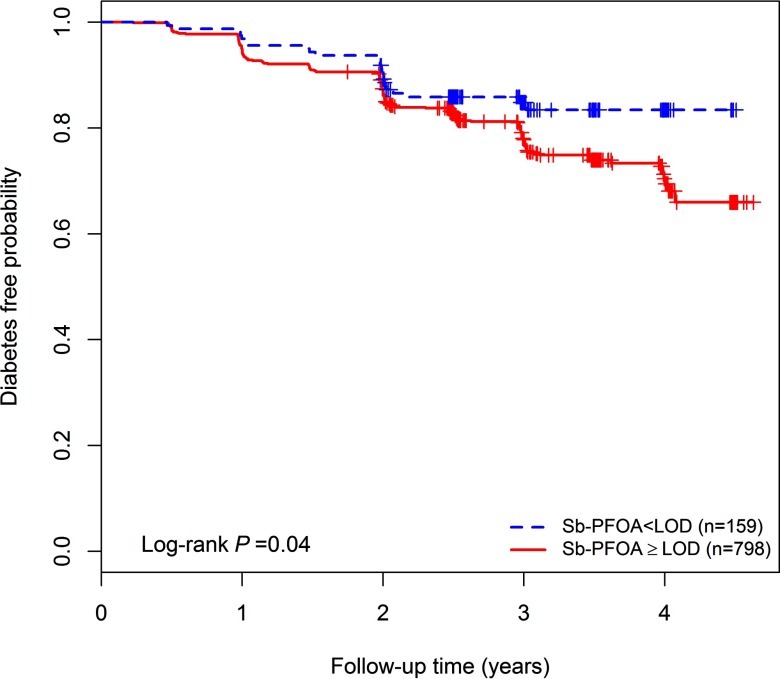
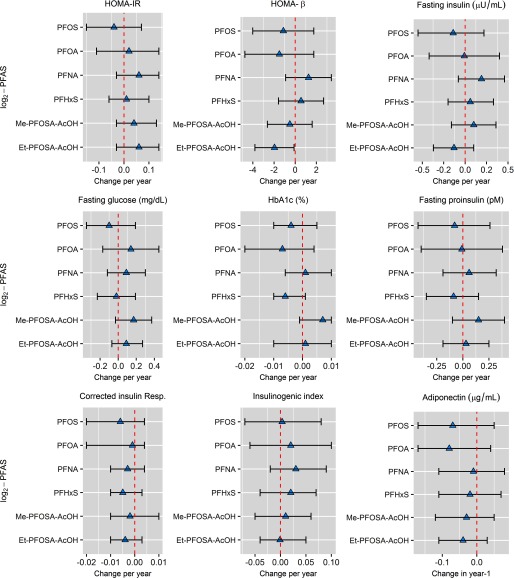
Plasma PFAS concentrations were similar to those reported in the U.S. population in 1999-2000. At baseline, in cross-sectional analysis, a doubling in plasma perfluorooctanesulfonic acid (PFOS) and perfluorooctanoic acid (PFOA) concentrations was associated with higher homeostatic model assessment of insulin resistance (HOMA-IR) [β=0.39; 95% confidence interval (CI): 0.13, 0.66; β=0.64; 95% CI: 0.34, 0.94], β-cell function (HOMA-β) (β=9.62; 95% CI: 1.55, 17.70; β=15.93; 95% CI: 6.78, 25.08), fasting proinsulin (β=1.37 pM; 95% CI: 0.50, 2.25; β=1.71 pM; 95% CI: 0.72, 2.71), and glycated hemoglobin (HbA) (β=0.03%; 95% CI: 0.002, 0.07; β=0.04%; 95% CI: 0.001, 0.07). There was no strong evidence of associations between plasma PFAS concentrations and diabetes incidence or prospective changes in glycemic indicators during the follow-up period.
At baseline, several PFAS were cross-sectionally associated with small differences in markers of insulin secretion and β-cell function. However, there was limited evidence suggesting that PFAS concentrations are associated with diabetes incidence or changes in glycemic indicators during the follow-up period. https://doi.org/10.1289/EHP1612.
几种全氟和多氟烷基物质(PFAS)是普遍存在的人为污染物,几乎在人类中普遍被检测到。实验证据表明,PFAS会改变葡萄糖代谢和胰岛素分泌。然而,流行病学研究结果并不一致。
我们试图研究高危成年人血浆PFAS浓度、血糖指标与糖尿病发病率之间的关联。
在糖尿病预防计划(DPP)中,一项针对高危个体预防2型糖尿病的试验,我们对957名随机分配到生活方式干预组或安慰剂组的参与者的九种PFAS的基线血浆浓度进行了量化。我们评估了血浆PFAS浓度与糖尿病发病率以及在基线时和长达4.6年的随访期间每年测量的关键血糖指标之间的校正关联。
血浆PFAS浓度与1999 - 2000年美国人群报告的浓度相似。在基线时,横断面分析显示,血浆全氟辛烷磺酸(PFOS)和全氟辛酸(PFOA)浓度翻倍与胰岛素抵抗稳态模型评估(HOMA - IR)升高相关[β = 0.39;95%置信区间(CI):0.13,0.66;β = 0.64;95% CI:0.34,0.94],β细胞功能(HOMA - β)(β = 9.62;95% CI:1.55,17.70;β = 15.93;95% CI:6.78,25.08),空腹胰岛素原(β = 1.37 pM;95% CI:0.50,2.25;β = 1.71 pM;95% CI:0.72,2.71),以及糖化血红蛋白(HbA)(β = 0.03%;95% CI:0.002,0.07;β = 0.04%;95% CI:0.001,0.07)。没有强有力的证据表明血浆PFAS浓度与糖尿病发病率或随访期间血糖指标的前瞻性变化之间存在关联。
在基线时,几种PFAS与胰岛素分泌和β细胞功能标志物中的微小差异存在横断面关联。然而,仅有有限的证据表明PFAS浓度与随访期间的糖尿病发病率或血糖指标变化有关。https://doi.org/10.1289/EHP1612