Population Division, Department of Economic and Social Affairs, United Nations, New York, New York, United States of America.
PLoS Med. 2020 Feb 18;17(2):e1003026. doi: 10.1371/journal.pmed.1003026. eCollection 2020 Feb.
Expanding access to contraception and ensuring that need for family planning is satisfied are essential for achieving universal access to reproductive healthcare services, as called for in the 2030 Agenda for Sustainable Development. Monitoring progress towards these outcomes is well established for women of reproductive age (15-49 years) who are married or in a union (MWRA). For those who are not, limited data and variability in data sources and indicator definitions make monitoring challenging. To our knowledge, this study is the first to provide data and harmonised estimates that enable monitoring for all women of reproductive age (15-49 years) (WRA), including unmarried women (UWRA). We seek to quantify the gaps that remain in meeting family-planning needs among all WRA.
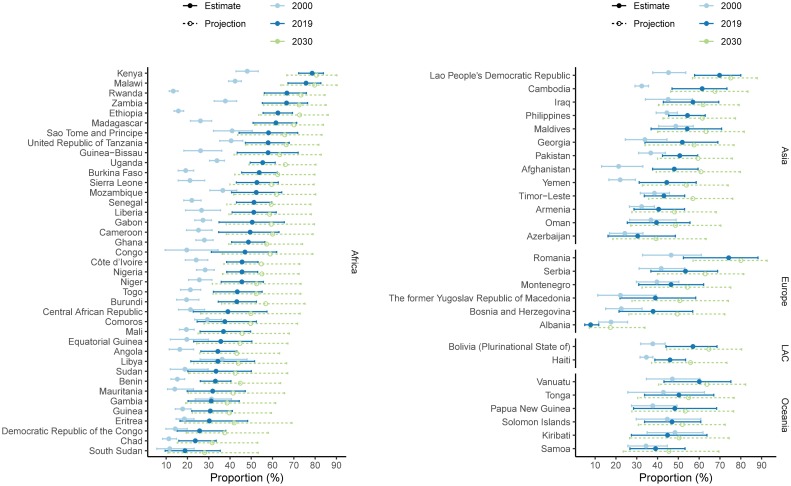
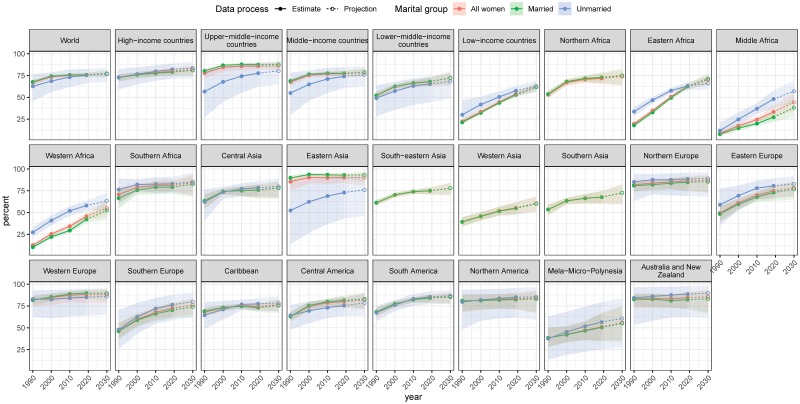
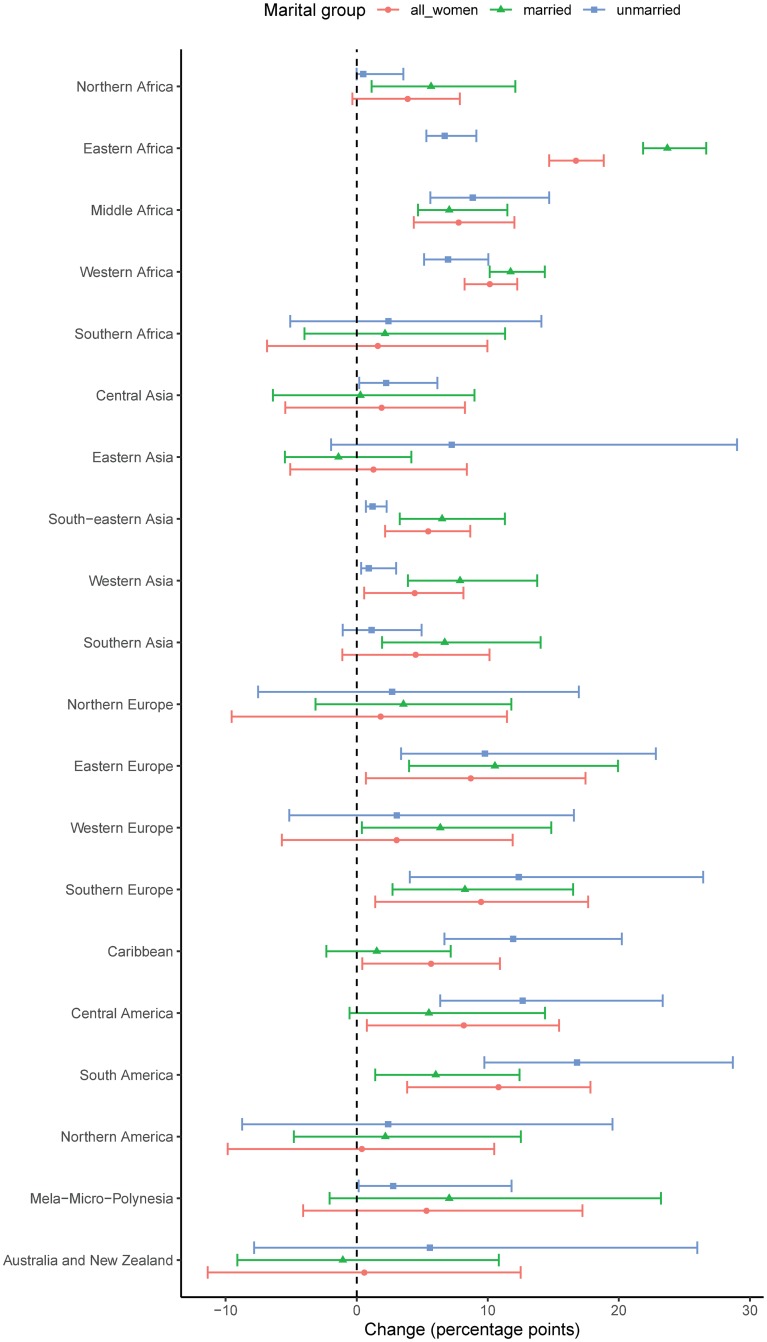
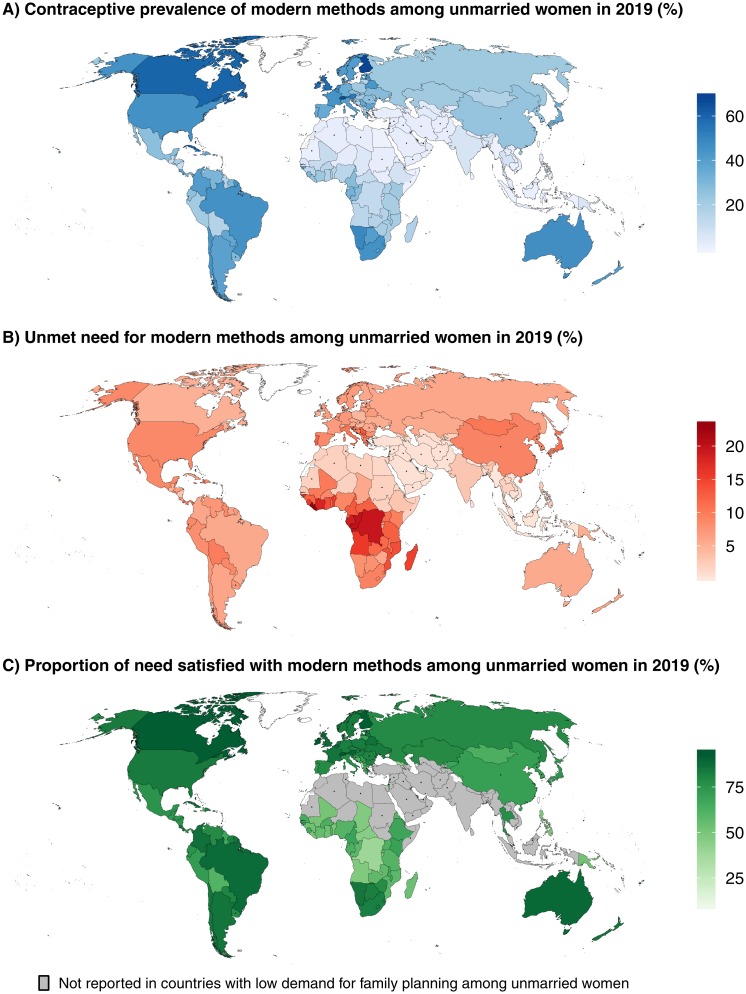
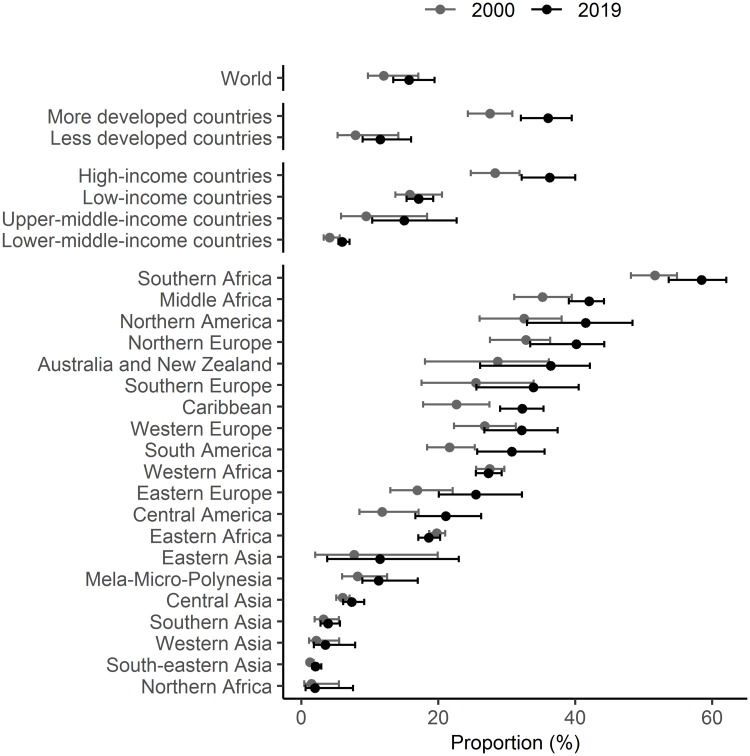
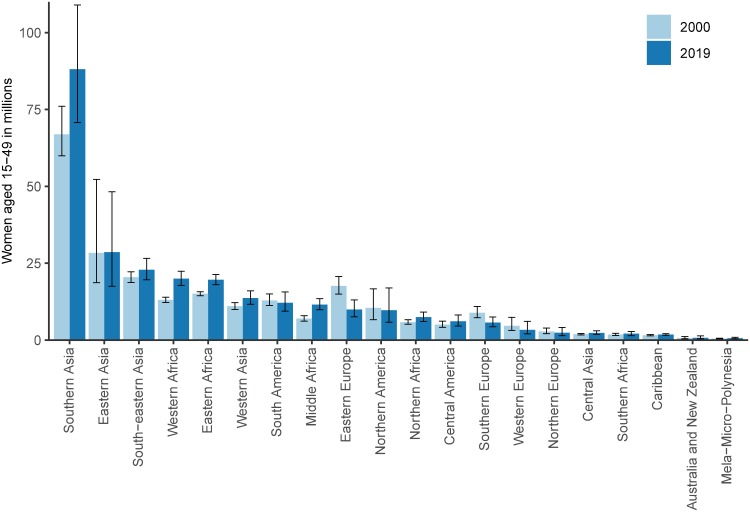
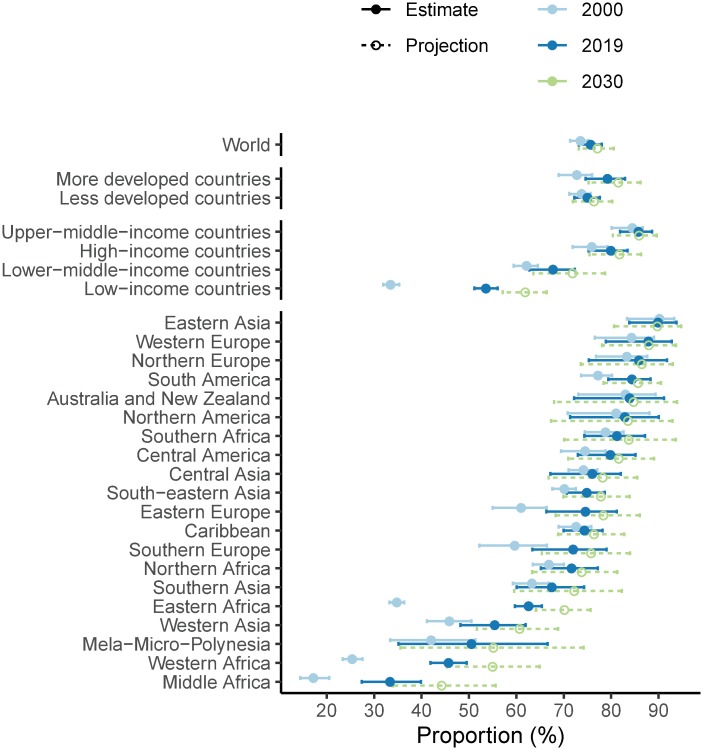
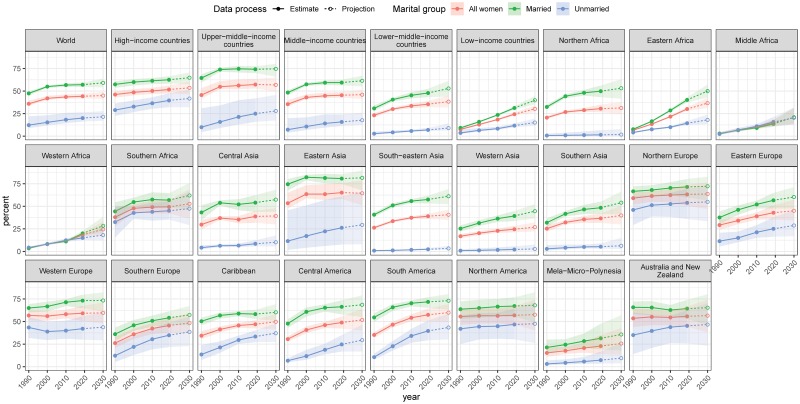
In a systematic analysis, we compiled a comprehensive dataset of family-planning indicators among WRA from 1,247 nationally representative surveys. We used a Bayesian hierarchical model with country-specific time trends to estimate these indicators, with 95% uncertainty intervals (UIs), for 185 countries. We produced estimates from 1990 to 2019 and projections from 2019 to 2030 of contraceptive prevalence and unmet need for family planning among MWRA, UWRA, and all WRA, taking into account the changing proportions that were married or in a union. The model accounted for differences in the prevalence of sexual activity among UWRA across countries. Among 1.9 billion WRA in 2019, 1.11 billion (95% UI 1.07-1.16) have need for family planning; of those, 842 million (95% UI 800-893) use modern contraception, and 270 million (95% UI 246-301) have unmet need for modern methods. Globally, UWRA represented 15.7% (95% UI 13.4%-19.4%) of all modern contraceptive users and 16.0% (95% UI 12.9%-22.1%) of women with unmet need for modern methods in 2019. The proportion of the need for family planning satisfied by modern methods, Sustainable Development Goals (SDG) indicator 3.7.1, was 75.7% (95% UI 73.2%-78.0%) globally, yet less than half of the need for family planning was met in Middle and Western Africa. Projections to 2030 indicate an increase in the number of women with need for family planning to 1.19 billion (95% UI 1.13-1.26) and in the number of women using modern contraception to 918 million (95% UI 840-1,001). The main limitations of the study are as follows: (i) the uncertainty surrounding estimates for countries with little or no data is large; and (ii) although some adjustments were made, underreporting of contraceptive use and needs is likely, especially among UWRA.
In this study, we observed that large gaps remain in meeting family-planning needs. The projected increase in the number of women with need for family planning will create challenges to expand family-planning services fast enough to fulfil the growing need. Monitoring of family-planning indicators for all women, not just MWRA, is essential for accurately monitoring progress towards universal access to sexual and reproductive healthcare services-including family planning-by 2030 in the SDG era with its emphasis on 'leaving no one behind.'
扩大避孕措施的可及性并确保计划生育的需求得到满足,对于实现 2030 年可持续发展议程中所呼吁的生殖健康服务的普及至关重要。对于已婚或处于婚姻关系中的育龄妇女(15-49 岁),监测这些成果的进展情况已经得到很好的建立。对于那些没有结婚的人来说,有限的数据以及数据来源和指标定义的可变性使得监测具有挑战性。据我们所知,这项研究首次提供了数据和协调估计值,能够对所有育龄妇女(15-49 岁)(WRA)进行监测,包括未婚妇女(UWRA)。我们旨在量化在满足所有 WRA 的计划生育需求方面仍然存在的差距。
在一项系统分析中,我们从 1247 项具有代表性的全国性调查中汇编了一套全面的 WRA 计划生育指标数据集。我们使用具有国家特定时间趋势的贝叶斯分层模型来估计这些指标,同时考虑到婚姻或处于婚姻关系中的比例的变化,对 185 个国家的指标进行了估计,并给出了 95%的置信区间(UI)。我们从 1990 年到 2019 年进行了估计,并从 2019 年到 2030 年进行了预测,包括 MWRA、UWRA 和所有 WRA 中避孕方法的流行率和计划生育未满足的需求,同时考虑了不断变化的婚姻或婚姻关系比例。该模型考虑了 UWRA 之间性活动流行率的差异。在 2019 年的 19 亿 WRA 中,有 11.1 亿(95%UI 10.7-11.6)有计划生育需求;其中,8.42 亿(95%UI 8.00-8.93)使用现代避孕方法,2.7 亿(95%UI 2.46-3.01)有现代方法的未满足需求。在全球范围内,UWRA 占所有现代避孕方法使用者的 15.7%(95%UI 13.4%-19.4%)和有未满足现代方法需求的妇女的 16.0%(95%UI 12.9%-22.1%)在 2019 年。计划生育需求由现代方法满足的比例,可持续发展目标 3.7.1,为 75.7%(95%UI 73.2%-78.0%),但在中非和西非,计划生育的需求只有不到一半得到满足。到 2030 年的预测显示,有计划生育需求的妇女人数将增加到 11.9 亿(95%UI 11.3-12.6),使用现代避孕方法的妇女人数将增加到 9.18 亿(95%UI 8.40-1,001)。这项研究的主要限制如下:(i)数据很少或没有的国家的估计值存在很大的不确定性;(ii)尽管进行了一些调整,但避孕措施和需求的报告不足,尤其是在 UWRA 中。
在这项研究中,我们观察到在满足计划生育需求方面仍然存在很大差距。预计有计划生育需求的妇女人数增加,将给扩大计划生育服务带来挑战,难以迅速满足不断增长的需求。对所有妇女,而不仅仅是 MWRA 的计划生育指标进行监测,对于在 2030 年可持续发展目标时代准确监测普及生殖健康服务(包括计划生育)的进展情况至关重要,该时代强调“不落下任何人”。