Univ. Lille, Institute for Translational Research in Inflammation (INFINITE), F-59000, Lille, France.
CHU Lille, Service de Médecine Interne, Centre de Référence des Maladies Auto-immunes et Systémiques Rares du Nord et Nord-Ouest de France (CeRAINO), F-59000, Lille, France.
Arthritis Res Ther. 2020 Feb 18;22(1):30. doi: 10.1186/s13075-020-2113-6.
Systemic sclerosis (SSc) is a severe and highly heterogeneous disease. The modified Rodnan skin score (mRSS) is a widely used tool for the assessment of the extent and degree of skin thickness. This study aimed to identify the classes of patients with early similar skin thickening trajectories without any a priori assumptions and study their associations with organ involvement and survival.
From the French SSc national cohort, patients with a disease duration of less than 2 years at inclusion and with at least 2 mRSS available within the first 4 years of follow-up were enrolled. Classes of patients with similar mRSS trajectories were identified based on a latent class mixed model. The clinical characteristics and survival rate were compared between the obtained classes.
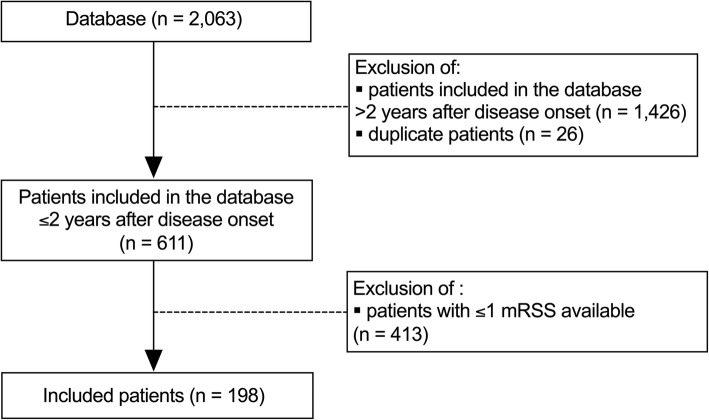
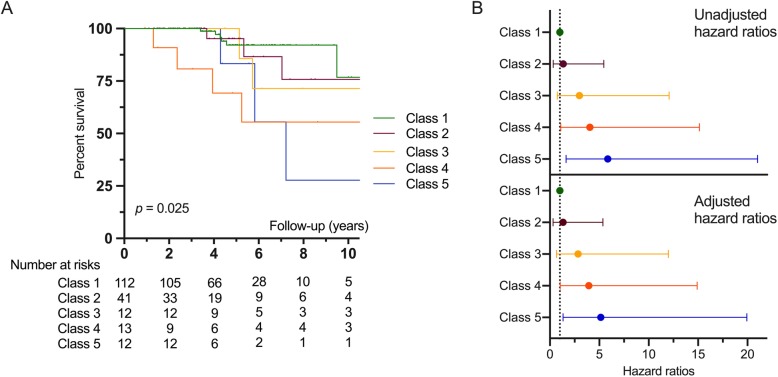
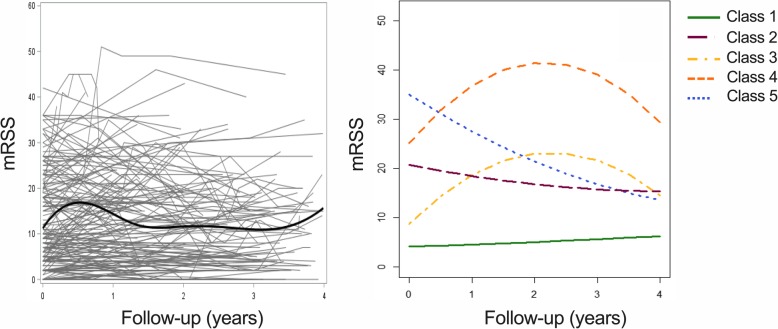
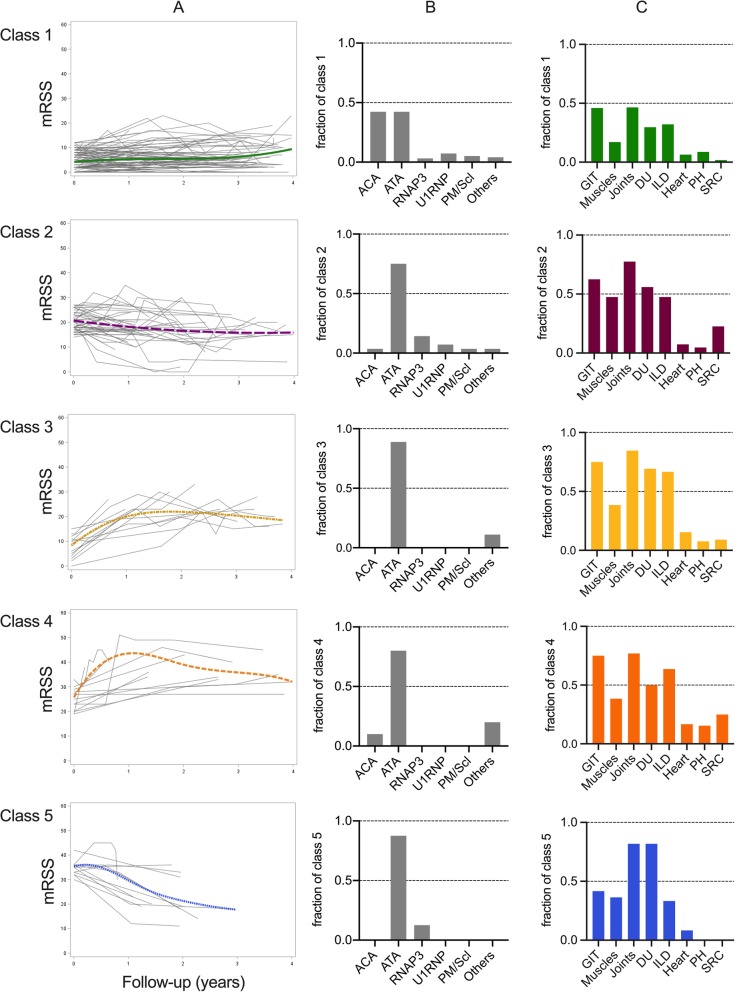
A total of 198 patients fulfilled the inclusion criteria, with a total of 641 mRSS available. The median disease duration and follow-up were 0.8 (interquartile range 0.4; 1.2) and 6.3 (3.8; 8.9) years, respectively. Individual trajectories of mRSS were highly heterogeneous between patients. Models with 1-6 latent classes of trajectories were sequentially assessed, and the 5-class model represented the best fit to data. Each class was characterized by a unique global trajectory of mRSS. The median disease duration did not differ significantly between classes. Baseline organ involvement was more frequent in classes with significant change over time (classes 2-5) than in class 1 (low baseline mRSS without significant change over time). Using Cox regression, we observed a progressively increasing risk of death from classes 1 to 5.
Early identification of clinical phenotype based on skin thickening trajectories could predict morbi-mortality in SSc. This study suggested that mRSS trajectories characterization might be pivotal for clinical practice and future trial designs.
系统性硬化症(SSc)是一种严重且高度异质性的疾病。改良 Rodnan 皮肤评分(mRSS)是评估皮肤厚度范围和程度的广泛使用的工具。本研究旨在确定早期具有相似皮肤增厚轨迹的患者类别,而无需任何先验假设,并研究它们与器官受累和生存的关联。
从法国 SSc 国家队列中,纳入在纳入时疾病持续时间少于 2 年且在随访的前 4 年内至少有 2 次 mRSS 可用的患者。基于潜在类别混合模型确定具有相似 mRSS 轨迹的患者类别。比较获得的类别之间的临床特征和生存率。
共有 198 名患者符合纳入标准,共有 641 次 mRSS 可用。中位疾病持续时间和随访时间分别为 0.8(四分位距 0.4;1.2)和 6.3(3.8;8.9)年。患者之间的 mRSS 个体轨迹高度异质。依次评估具有 1-6 个潜在轨迹类别的模型,5 类模型最符合数据。每个类别都具有独特的 mRSS 全局轨迹。各类别之间的中位疾病持续时间无显著差异。与基线 mRSS 无明显变化的类别 1(无时间变化的低基线 mRSS)相比,随时间变化的类别 2-5 中基线器官受累更为频繁。使用 Cox 回归,我们观察到从类别 1 到 5,死亡风险逐渐增加。
基于皮肤增厚轨迹的早期识别临床表型可能预测 SSc 的病死率。本研究表明,mRSS 轨迹特征分析可能对临床实践和未来试验设计至关重要。