Li Zeyun, Du Yue, Yuan Yongliang, Zhang Xiaojian, Wang Zhengtao, Tian Xin
1Department of Pharmacy, The First Affiliated Hospital of Zhengzhou University, Zhengzhou, 450052 China.
2Institute of Chinese Materia Medica, Shanghai University of Traditional Chinese Medicine, Shanghai, 201203 China.
Chin Med. 2020 Feb 11;15:16. doi: 10.1186/s13020-020-0292-3. eCollection 2020.
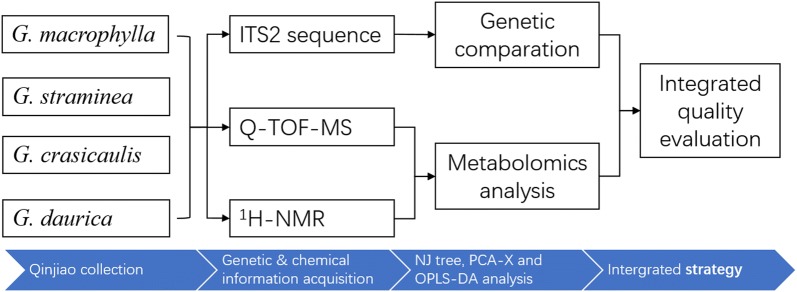
Quality evaluation of multi-species resourced herb medicine (MSRHM) is a main problem for quality control of herb medicine. Current quality evaluation methodology lost consideration of species discrepancy. New quality evaluation strategy for MSRHM is in urgent need. Qinjiao, a representative MSRHM, originated from Pall., Maxim., Duthie ex Burk. or Fisch., has been used as an important herb medicine over 2000 years for expelling wind-dampness and relieving impediment pain. However, quality evaluation among species has never been revealed. The current work proposes an integrated quality evaluation strategy for MSRHM of Qinjiao, which may promote innovation of quality control of MSRHM.
In this work, 58 batches of Qinjiao covering 4 species were collected. Genetic comparative analysis based on ITS2 sequence was conducted. Metabolomics analysis based on TOF-MS and NMR spectrum were carried out. Compounds underlying species differences were identified and their discrepancies among species were investigated by ANOVA analysis and multivariate analysis.
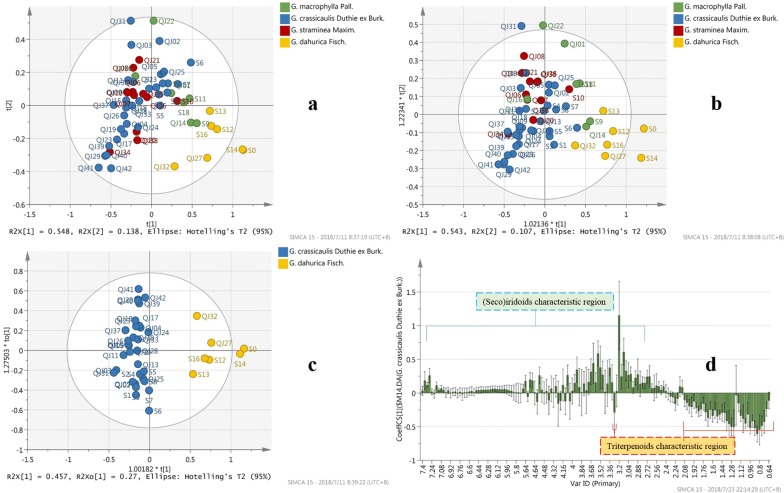
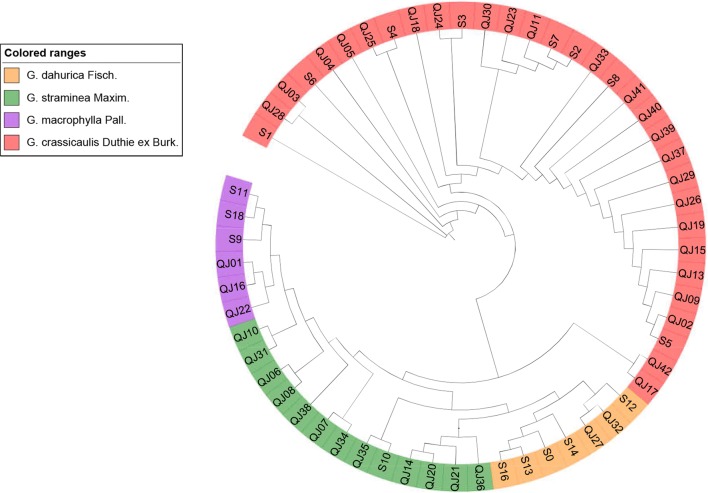
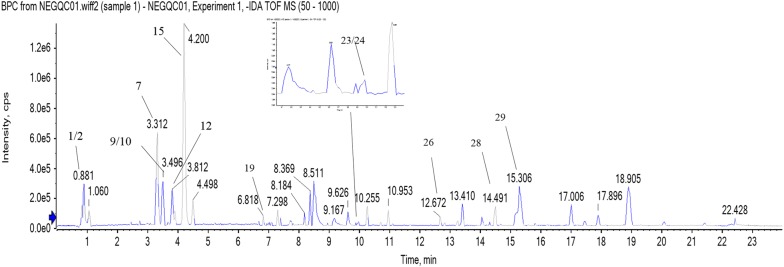
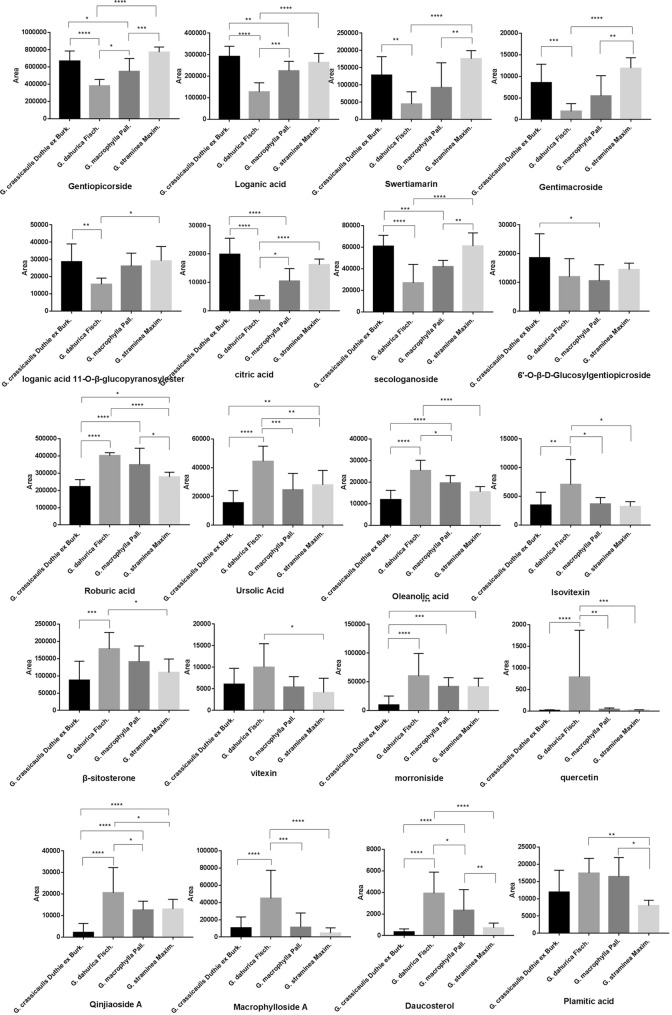
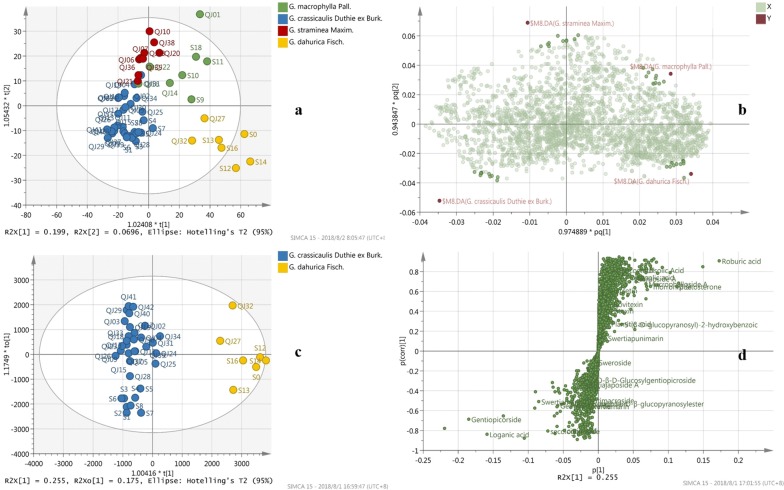
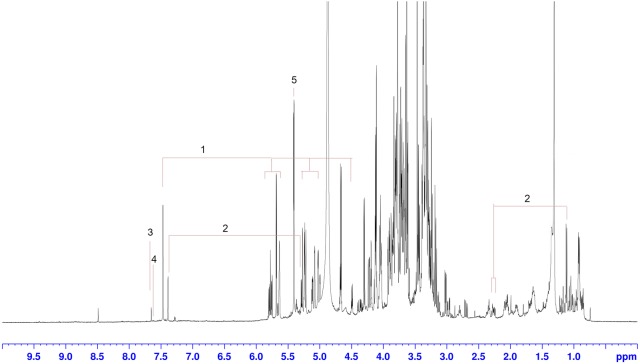
Four species of Qinjiao can be authenticated by ITS2 sequence comparation. Metabolomics analysis by TOF/MS and NMR revealed chemical discrepancies among species of Qinjiao. Maximum discrepancy was present between Duthie ex Burk. and Fisch. Chemical difference among species were tentative explored. For TOF-MS profiling, 28 constituents were tentative identified, 17 of which were further confirmed by standards. For H-NMR profiling, signals from 5 compounds were assigned. Contents discrepancies were investigated by ANOVA analysis. It seems that (seco)iridoids like loganic acid, gentiopicroside or swertiamarin were richer in specie of Duthie ex Burk., while flavonoid (morroniside) and triterpenoids (roburic aicd, ursolic acid, oleanolic acid, β-sitosterone) were richer in specie of Fisch. The current research demonstrates that metabolite profiling based on both UPLC/Q-TOF MS and H-NMR coupled with ITS2 sequence comparation can be a powerful tool for quality investigation of MSRHM of Qinjiao.
A comprehensive quality evaluation strategy for MSRHM was proposed by integrating UPLC-Q-TOF-MS, NMR based metabolic analysis and ITS2 sequence genetic comparation. The proposed quality evaluation strategy shall promote innovation of quality control of traditional Chinese medicine.
多来源中药材的质量评价是中药质量控制的主要问题。目前的质量评价方法未考虑物种差异。多来源中药材急需新的质量评价策略。秦艽是一种典型的多来源中药材,来源于秦艽(Gentiana macrophylla Pall.)、麻花秦艽(Gentiana straminea Maxim.)、粗茎秦艽(Gentiana crassicaulis Duthie ex Burk.)或小秦艽(Gentiana dahurica Fisch.),两千多年来一直作为祛风除湿、通络止痛的重要中药材使用。然而,从未有过对不同物种间质量评价的报道。目前的研究提出了一种针对秦艽这种多来源中药材的综合质量评价策略,这可能会推动多来源中药材质量控制的创新。
本研究收集了涵盖4个物种的58批次秦艽。基于ITS2序列进行了遗传比较分析。基于飞行时间质谱(TOF-MS)和核磁共振谱(NMR)进行了代谢组学分析。鉴定了物种差异背后的化合物,并通过方差分析和多变量分析研究了它们在物种间的差异。
通过ITS2序列比较可以鉴别出4种秦艽。通过TOF/MS和NMR进行的代谢组学分析揭示了秦艽不同物种间的化学差异。粗茎秦艽和小秦艽之间的差异最大。初步探索了物种间的化学差异。对于TOF-MS图谱,初步鉴定了28种成分,其中17种通过标准品进一步确认。对于氢核磁共振(H-NMR)图谱,归属了5种化合物的信号。通过方差分析研究了含量差异。似乎裂环环烯醚萜类如龙胆酸、龙胆苦苷或獐牙菜苦苷在粗茎秦艽中含量更丰富,而黄酮类(山茱萸苷)和三萜类(蔷薇酸、熊果酸、齐墩果酸、β-谷甾醇)在小秦艽中含量更丰富。目前的研究表明,基于超高效液相色谱/四极杆飞行时间质谱(UPLC/Q-TOF MS)和H-NMR并结合ITS2序列比较的代谢物图谱分析可以成为秦艽这种多来源中药材质量研究的有力工具。
通过整合UPLC-Q-TOF-MS、基于NMR的代谢分析和ITS2序列遗传比较,提出了一种针对多来源中药材的综合质量评价策略。所提出的质量评价策略将推动中药质量控制的创新。