Ikeuchi Kaori, Ishiguro Hiroshi, Nakamura Yasunori, Izawa Tomoko, Shinkura Nobuhiko, Nin Kazuko
1Department of Human Health Sciences, Graduate School of Medicine, Kyoto University, 53 Kawara-cho Shogo-in, Sakyo-ku, Kyoto, 606-8507 Japan.
2Department of Nursing, University of Shitennoji, 3-2-1 Gakuenmae, Habikino, Osaka, 583-8501 Japan.
Biopsychosoc Med. 2020 Feb 10;14:1. doi: 10.1186/s13030-020-0175-y. eCollection 2020.
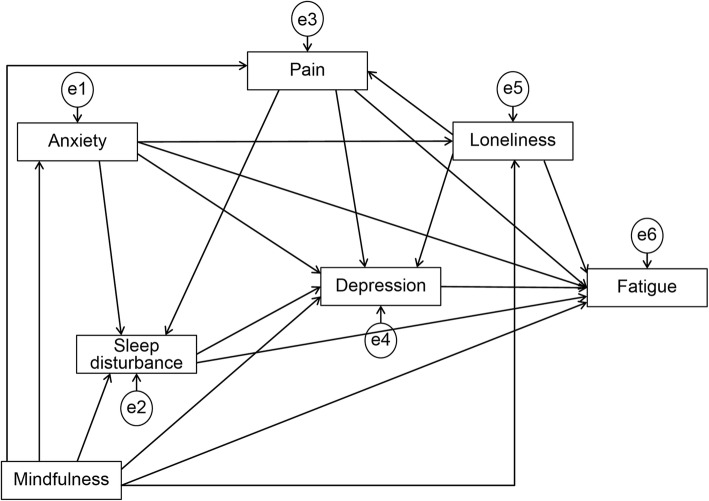
Although fatigue is a common and distressing symptom in cancer survivors, the mechanism of fatigue is not fully understood. Therefore, this study aims to investigate the relation between the fatigue and mindfulness of breast cancer survivors using anxiety, depression, pain, loneliness, and sleep disturbance as mediators.
Path analysis was performed to examine direct and indirect associations between mindfulness and fatigue. Participants were breast cancer survivors who visited a breast surgery department at a university hospital in Japan for hormonal therapy or regular check-ups after treatment. The questionnaire measured cancer-related-fatigue, mindfulness, anxiety, depression, pain, loneliness, and sleep disturbance. Demographic and clinical characteristics were collected from medical records.
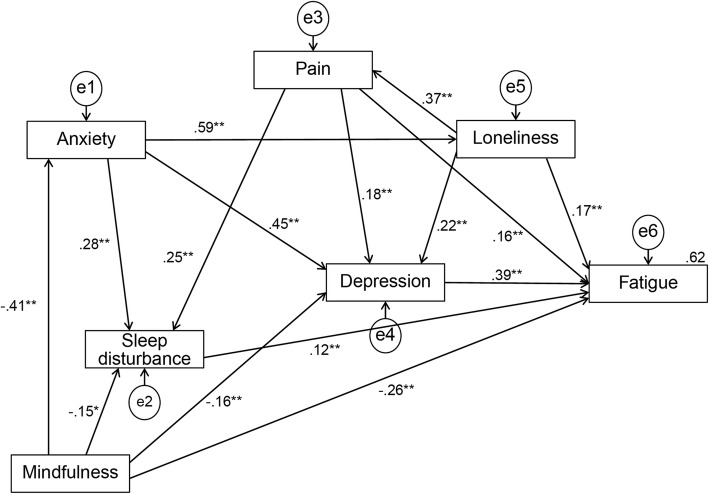
Two-hundred and seventy-nine breast cancer survivors were registered, of which 259 answered the questionnaire. Ten respondents with incomplete questionnaire data were excluded, resulting in 249 participants for the analyses. Our final model fit the data well (goodness of fit index = .993; adjusted goodness of fit index = .966; comparative fit index = .999; root mean square error of approximation = .016). Mindfulness, anxiety, depression, pain, loneliness, and sleep disturbance were related to fatigue, and mindfulness had the most influence on fatigue (β = - .52). Mindfulness affected fatigue not only directly but also indirectly through anxiety, depression, pain, loneliness, and sleep disturbance.
The study model helps to explain the process by which mindfulness affects fatigue. Our results suggest that mindfulness has both direct and indirect effects on the fatigue of breast cancer survivors and that mindfulness can be used to more effectively reduce their fatigue. It also suggests that health care professionals should be aware of factors such as anxiety, depression, pain, loneliness, and sleep disturbance in their care for fatigue of breast cancer survivors.
This study was registered in the University Hospital Medical Information Network Clinical Trials Registry (UMIN number. 000027720) on June 12, 2017.
尽管疲劳是癌症幸存者常见且令人苦恼的症状,但疲劳的机制尚未完全明确。因此,本研究旨在以焦虑、抑郁、疼痛、孤独和睡眠障碍作为中介因素,探讨乳腺癌幸存者的疲劳与正念之间的关系。
采用路径分析来检验正念与疲劳之间的直接和间接关联。研究对象为在日本一家大学医院乳腺外科就诊以接受激素治疗或治疗后定期检查的乳腺癌幸存者。通过问卷测量癌症相关疲劳、正念、焦虑、抑郁、疼痛、孤独和睡眠障碍。从病历中收集人口统计学和临床特征信息。
共登记了279名乳腺癌幸存者,其中259人回答了问卷。排除10名问卷数据不完整的受访者,最终纳入249名参与者进行分析。我们的最终模型与数据拟合良好(拟合优度指数=0.993;调整后拟合优度指数=0.966;比较拟合指数=0.999;近似均方根误差=0.016)。正念、焦虑、抑郁、疼痛、孤独和睡眠障碍均与疲劳相关,其中正念对疲劳的影响最大(β=-0.52)。正念不仅直接影响疲劳,还通过焦虑、抑郁、疼痛、孤独和睡眠障碍间接影响疲劳。
该研究模型有助于解释正念影响疲劳的过程。我们的结果表明,正念对乳腺癌幸存者的疲劳具有直接和间接影响,且正念可用于更有效地减轻她们的疲劳。这也提示医护人员在关注乳腺癌幸存者疲劳问题时,应留意焦虑、抑郁、疼痛、孤独和睡眠障碍等因素。
本研究于2017年6月12日在大学医院医学信息网络临床试验注册中心注册(UMIN编号:000027720)。