Pei Yingchun, Siemann Evan, Tian Baoliang, Ding Jianqing
School of Life Sciences, Henan University, Kaifeng, Henan, China.
State Key Laboratory of Crop Stress Adaptation and Improvement, Henan University, Kaifeng, Henan, China.
AoB Plants. 2020 Jan 11;12(1):plaa002. doi: 10.1093/aobpla/plaa002. eCollection 2020 Feb.
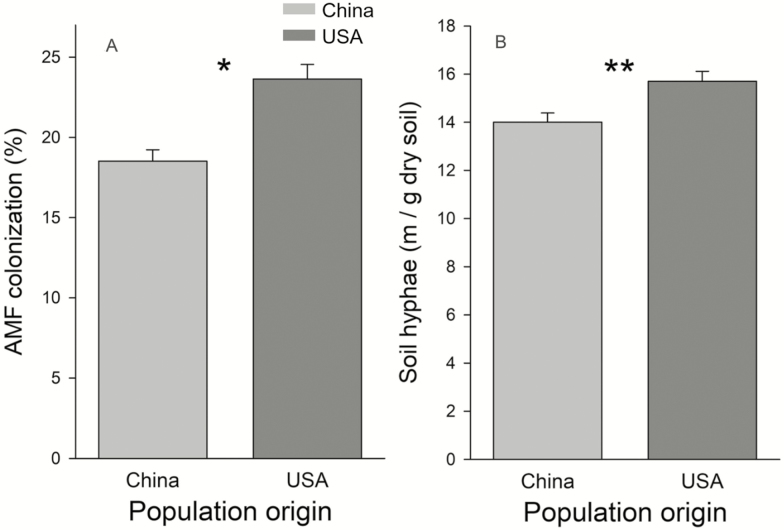
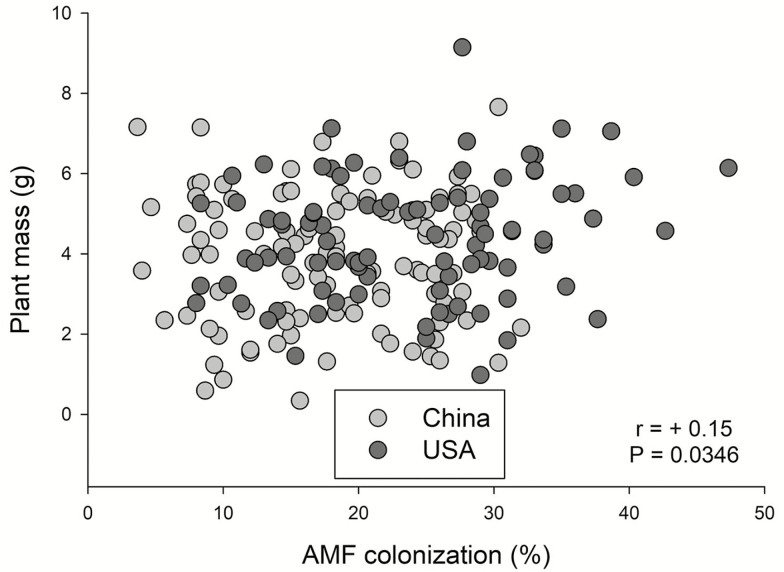
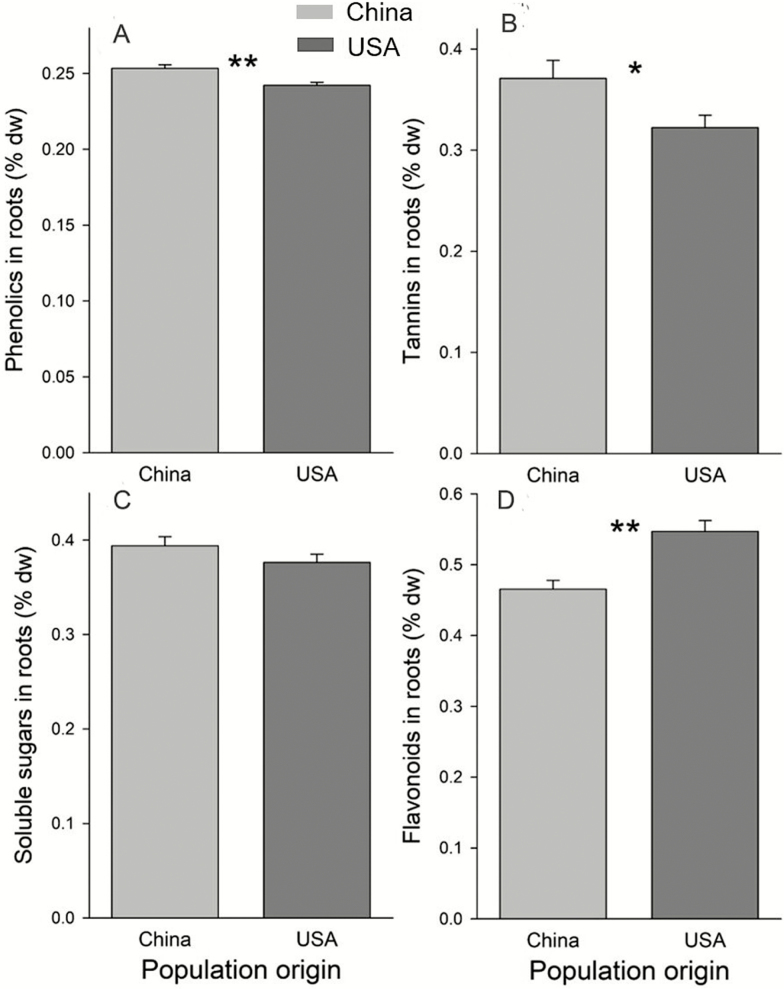
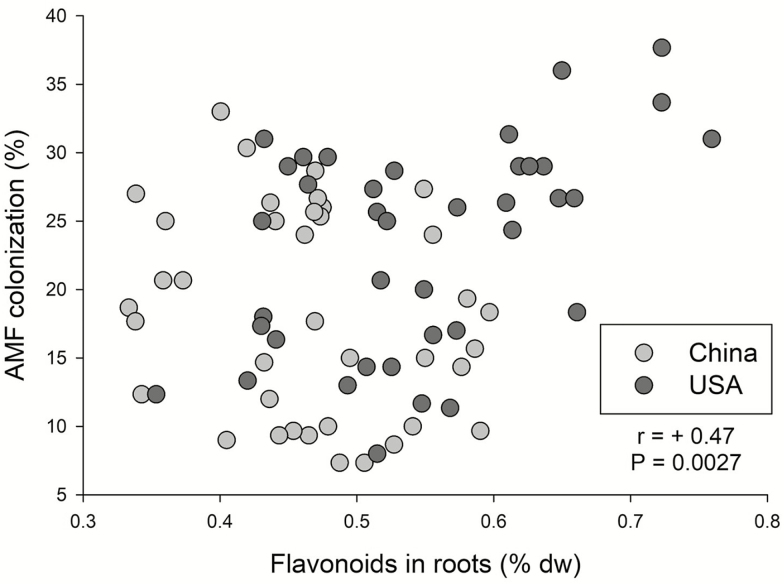
Arbuscular mycorrhizal fungi (AMF) are important mutualistic microbes in soil, which have capacity to form mutualistic associations with most land plants. Arbuscular mycorrhizal fungi play an important role in plant invasions and their interactions with invasive plants have received increasing attention. However, the chemical mechanisms underlying the interactions of AMF and invasive plants are still poorly understood. In this study we aim to test whether root secondary chemicals are related to enhanced AMF colonization and rapid growth in an invasive tree. We conducted a common garden experiment in China with Chinese tallow tree () to examine the relationships among AMF colonization and secondary metabolites in roots of plants from introduced (USA) and native (China) populations. We found that AMF colonization rate was higher in introduced populations compared to native populations. Roots of plants from introduced populations had lower levels of phenolics and tannins, but higher levels of flavonoids than those of plants from native populations. Flavonoids were positively correlated with AMF colonization, and this relationship was especially strong for introduced populations. Besides, AMF colonization was positively correlated with plant biomass suggesting that higher root flavonoids and AMF colonization may impact plant performance. This suggests that higher root flavonoids in plants from introduced populations may promote AMF spore germination and/or attract hyphae to their roots, which may subsequently increase plant growth. Overall, our results support a scenario in which invasive plants enhance their AMF association and invasion success via genetic changes in their root flavonoid metabolism. These findings advance our understanding of the mechanisms underlying plant invasion success and the evolutionary interactions between plants and AMF. Understanding such mechanisms of invasive plant success is critical for predicting and managing plant invasions in addition to providing important insights into the chemical mechanism of AMF-plant interactions.
丛枝菌根真菌(AMF)是土壤中重要的共生微生物,能够与大多数陆地植物形成共生关系。丛枝菌根真菌在植物入侵中发挥着重要作用,其与入侵植物的相互作用受到了越来越多的关注。然而,AMF与入侵植物相互作用的化学机制仍知之甚少。在本研究中,我们旨在测试根系次生化学物质是否与一种入侵树木中增强的AMF定殖和快速生长有关。我们在中国进行了一项共同花园实验,以研究来自引入地(美国)和原生地(中国)的乌桕种群植物根系中AMF定殖与次生代谢产物之间的关系。我们发现,引入种群的AMF定殖率高于原生种群。与原生种群的植物相比,引入种群的植物根系酚类和单宁含量较低,但黄酮类化合物含量较高。黄酮类化合物与AMF定殖呈正相关,这种关系在引入种群中尤为明显。此外,AMF定殖与植物生物量呈正相关,这表明较高的根系黄酮类化合物和AMF定殖可能会影响植物表现。这表明,引入种群植物中较高的根系黄酮类化合物可能会促进AMF孢子萌发和/或将菌丝吸引到它们的根系,这可能随后会促进植物生长。总体而言,我们的结果支持这样一种情况,即入侵植物通过其根系黄酮类代谢的遗传变化增强其与AMF的关联并提高入侵成功率。这些发现推进了我们对植物入侵成功的潜在机制以及植物与AMF之间进化相互作用的理解。了解入侵植物成功的此类机制对于预测和管理植物入侵至关重要,此外还能为AMF与植物相互作用的化学机制提供重要见解。