Errarte Peio, Larrinaga Gorka, López José I
Department of Physiology, University of The Basque Country (UPV/EHU), 48940 Leioa, Spain.
Biomarkers in Cancer Unit, Biocruces-Bizkaia Health Research Institute, 48903 Barakaldo, Spain.
J Adv Res. 2019 Sep 17;21:103-108. doi: 10.1016/j.jare.2019.09.004. eCollection 2020 Jan.
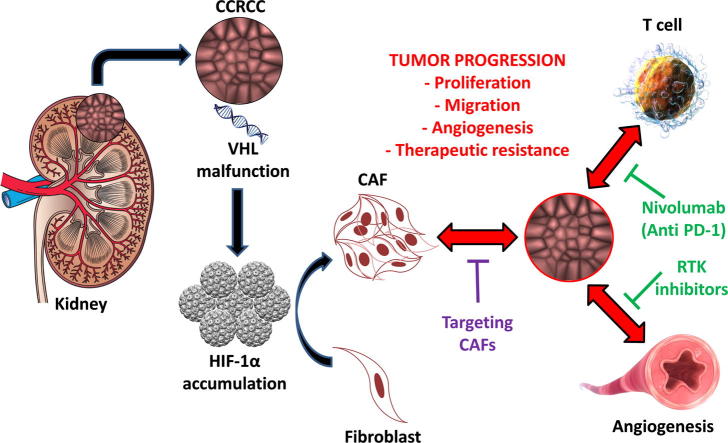
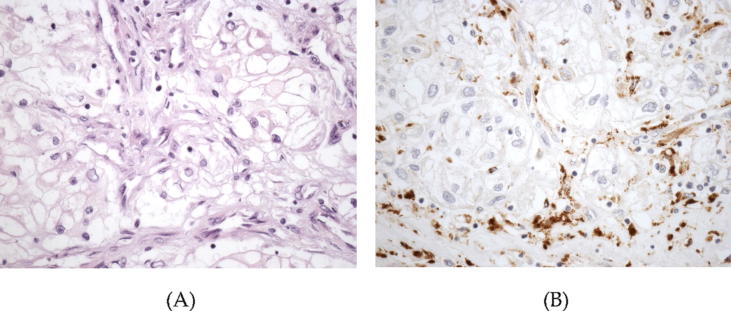
Cancer-associated fibroblasts (CAF) are a cellular compartment of the tumor microenvironment (TME) with critical roles in tumor development. Fibroblast activation protein-α (FAP) is one of the proteins expressed by CAF and its immunohistochemical detection in routine practice is associated with tumor aggressiveness and shorter patient survival. For these reasons, FAP seems a good prognostic marker in many malignant neoplasms, including renal cell carcinoma (RCC). The start point of this paper is to review the role of CAF in the modulation of renal cell carcinoma evolution. In this sense, CAF have demonstrated to develop important protumor and/or antitumor activities. This apparent paradox suggests that some type of temporally or spatially-related specialization is present in this cellular compartment during tumor evolution. The end point is to remark that tumor/non-tumor cell interactions, in particular the symbiotic tumor/CAF connections, are permanent and ever-changing crucial phenomena along tumor lifetime. Interestingly, these interactions may be responsible of many therapeutic failures.
癌症相关成纤维细胞(CAF)是肿瘤微环境(TME)的一个细胞组成部分,在肿瘤发展中起关键作用。成纤维细胞活化蛋白-α(FAP)是CAF表达的蛋白之一,在常规实践中对其进行免疫组织化学检测与肿瘤侵袭性和患者较短生存期相关。基于这些原因,FAP似乎是包括肾细胞癌(RCC)在内的许多恶性肿瘤的良好预后标志物。本文的出发点是综述CAF在肾细胞癌演变调节中的作用。从这个意义上讲,CAF已被证明具有重要的促肿瘤和/或抗肿瘤活性。这种明显的矛盾表明,在肿瘤演变过程中,这个细胞组成部分存在某种时间或空间相关的特化。终点是要指出,肿瘤/非肿瘤细胞相互作用,特别是共生的肿瘤/CAF联系,是肿瘤整个生命周期中永久且不断变化的关键现象。有趣的是,这些相互作用可能是许多治疗失败的原因。