Kluttig Alexander, Zschocke Johannes, Haerting Johannes, Schmermund Axel, Gastell Sylvia, Steindorf Karen, Herbolsheimer Florian, Hillreiner Andrea, Jochem Carmen, Baumeister Sebastian, Sprengeler Ole, Pischon Tobias, Jaeschke Lina, Michels Karin B, Krist Lilian, Greiser Halina, Schmidt Gerhard, Lieb Wolfgang, Waniek Sabina, Becher Heiko, Jagodzinski Annika, Schipf Sabine, Völzke Henry, Ahrens Wolfgang, Günther Kathrin, Castell Stefanie, Kemmling Yvonne, Legath Nicole, Berger Klaus, Keil Thomas, Fricke Julia, Schulze Matthias B, Loeffler Markus, Wirkner Kerstin, Kuß Oliver, Schikowski Tamara, Kalinowski Sonja, Stang Andreas, Kaaks Rudolf, Damms Machado Antje, Hoffmeister Michael, Weber Barbara, Franzke Claus-Werner, Thierry Sigrid, Peters Anette, Kartschmit Nadja, Mikolajczyk Rafael, Fischer Beate, Leitzmann Michael, Brandes Mirko
Institut für Medizinische Epidemiologie, Biometrie und Informatik, Martin-Luther-Universität Halle-Wittenberg, Magdeburger Str. 8, 06112, Halle (Saale), Deutschland.
Institut für Physik, Martin-Luther-Universität Halle-Wittenberg, Halle (Saale), Deutschland.
Bundesgesundheitsblatt Gesundheitsforschung Gesundheitsschutz. 2020 Mar;63(3):312-321. doi: 10.1007/s00103-020-03100-3.
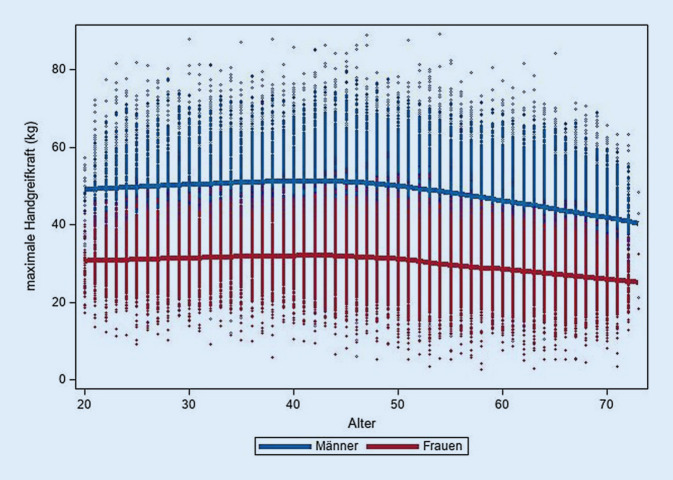
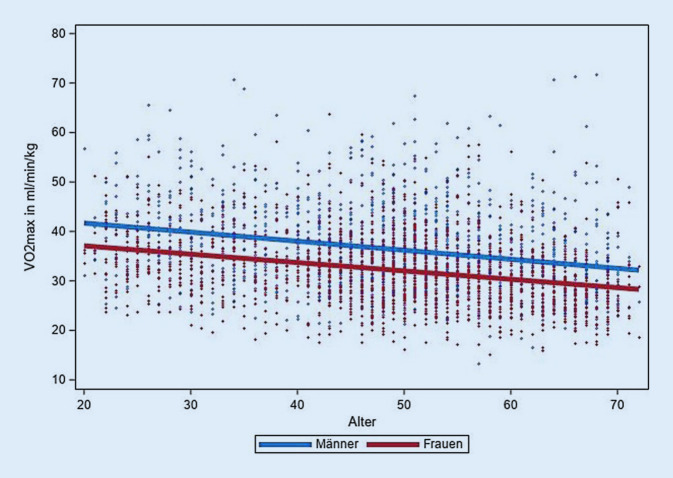
Physical fitness is defined as an individual's ability to be physically active. The main components are cardiorespiratory fitness (CRF), muscle strength, and flexibility. Regardless of physical activity level, physical fitness is an important determinant of morbidity and mortality.The aim of the current study was to describe the physical fitness assessment methodology in the German National Cohort (NAKO) and to present initial descriptive results in a subsample of the cohort.In the NAKO, hand grip strength (GS) and CRF as physical fitness components were assessed at baseline using a hand dynamometer and a submaximal bicycle ergometer test, respectively. Maximum oxygen uptake (VO) was estimated as a result of the bicycle ergometer test. The results of a total of 99,068 GS measurements and 3094 CRF measurements are based on a data set at halftime of the NAKO baseline survey (age 20-73 years, 47% men).Males showed higher values of physical fitness compared to women (males: GS = 47.8 kg, VO = 36.4 ml·min · kg; females: GS = 29.9 kg, VO = 32.3 ml · min · kg). GS declined from the age of 50 onwards, whereas VO levels decreased continuously between the age groups of 20-29 and ≥60 years. GS and VO showed a linear positive association after adjustment for body weight (males β = 0.21; females β = 0.35).These results indicate that the physical fitness measured in the NAKO are comparable to other population-based studies. Future analyses in this study will focus on examining the independent relations of GS and CRF with risk of morbidity and mortality.
体能被定义为个体进行身体活动的能力。其主要组成部分包括心肺适能(CRF)、肌肉力量和柔韧性。无论身体活动水平如何,体能都是发病率和死亡率的重要决定因素。本研究的目的是描述德国国民队列(NAKO)中的体能评估方法,并在该队列的一个子样本中呈现初步描述性结果。在NAKO中,作为体能组成部分的握力(GS)和CRF在基线时分别使用握力计和次极量自行车测力计测试进行评估。通过自行车测力计测试结果估算最大摄氧量(VO)。总共99068次GS测量和3094次CRF测量的结果基于NAKO基线调查中途的一个数据集(年龄20 - 73岁,47%为男性)。男性的体能值高于女性(男性:GS = 47.8千克,VO = 36.4毫升·分钟·千克;女性:GS = 29.9千克,VO = 32.3毫升·分钟·千克)。GS从50岁起下降,而VO水平在20 - 29岁年龄组和≥60岁年龄组之间持续下降。在对体重进行调整后,GS和VO呈现线性正相关(男性β = 0.21;女性β = 0.35)。这些结果表明,在NAKO中测量的体能与其他基于人群的研究结果具有可比性。本研究未来的分析将集中于检验GS和CRF与发病和死亡风险之间的独立关系。