HIV Neurobehavioral Research Program, Department of Psychiatry, University of California San Diego, 220 Dickinson St, Suite B, MC8231, San Diego, CA, 92103-8231, USA.
San Diego State University/University of California San Diego Joint Doctoral Program in Clinical Psychology, San Diego, CA, USA.
J Behav Med. 2020 Dec;43(6):979-988. doi: 10.1007/s10865-020-00141-6. Epub 2020 Feb 18.
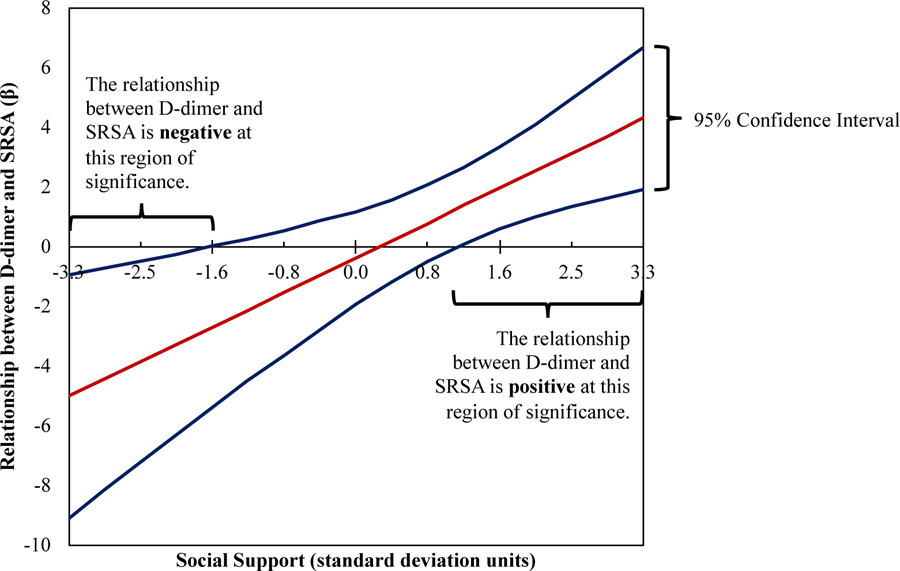
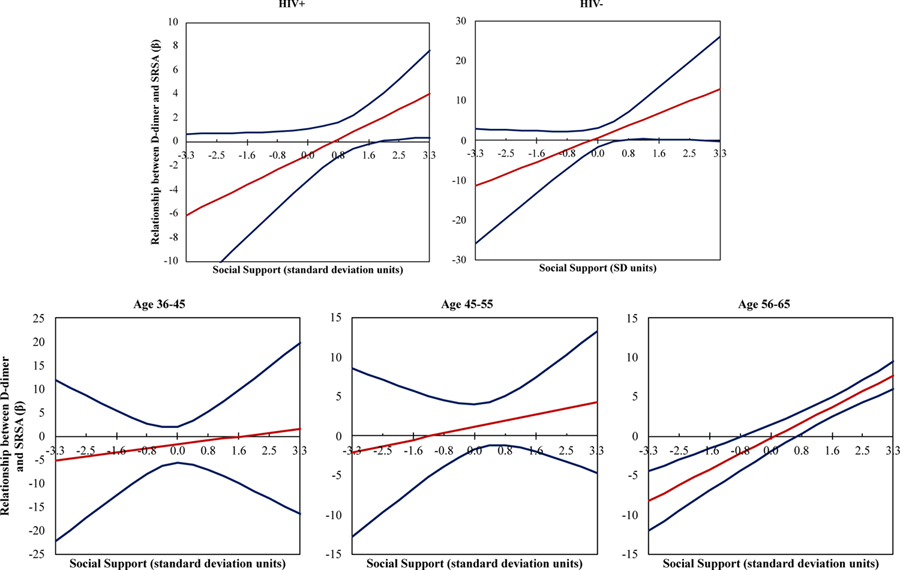
Many factors can influence perceptions of successful aging (SA), including social isolation and poor physical health. We hypothesized that social support attenuates the negative effect of plasma D-dimer, a correlate of HIV and aging, on SA. Participants included 230 adults (134 people with HIV; PWH, 96 HIV-), ages 36-65, segregated into age cohorts with up to 5 yearly visits. Multilevel modeling examined longitudinal within-person associations between D-dimer, social support, and SA. Social support moderated the relationship between D-dimer and SA and was significant among PWH and older individuals (ages 56-65), but not HIV- or younger cohorts. This association was significant only at extreme levels of social support, with significant decreases in social support potentiating the negative impact of D-dimer on SA and significant increases in social support facilitating increased SA. Despite declining health, high social support may improve SA in PWH and older adults, and low support may be especially problematic for older adults.
许多因素会影响对成功老龄化 (SA) 的认知,包括社会孤立和身体不健康。我们假设社会支持可以减轻与 HIV 和衰老相关的血浆 D-二聚体对 SA 的负面影响。参与者包括 230 名成年人(134 名 HIV 感染者;PWH,96 名 HIV-),年龄在 36-65 岁之间,分为最多 5 年一次的随访年龄组。多层次模型检查了 D-二聚体、社会支持和 SA 之间的纵向个体内关联。社会支持调节了 D-二聚体与 SA 之间的关系,在 PWH 和年龄较大的个体(56-65 岁)中具有统计学意义,但在 HIV-或年轻组中没有统计学意义。这种关联仅在社会支持的极端水平上显著,社会支持的显著下降会加剧 D-二聚体对 SA 的负面影响,而社会支持的显著增加会促进 SA 的增加。尽管健康状况在下降,但高社会支持可能会改善 PWH 和老年患者的 SA,而低支持可能对老年患者尤其成问题。