School of Psychology and Clinical Language Sciences, University of Reading, Reading RG1 1AR, UK.
Nutrients. 2020 Feb 14;12(2):483. doi: 10.3390/nu12020483.
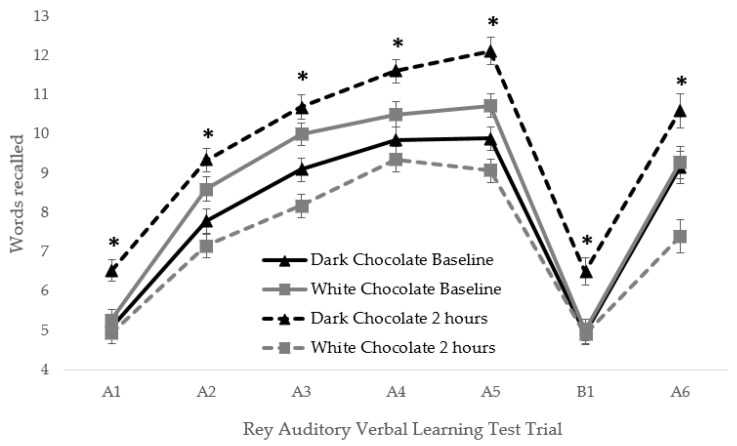
There is good evidence that cocoa flavonoids can acutely improve cognitive function in humans, possibly via mechanisms such as increased cerebral blood flow. To date, much of the evidence is based on measures of executive function with extracts and cocoa-based interventions with a high flavonoid content. The aim of the present study was to explore whether benefits to episodic verbal memory and mood are observed two hours post consumption of a commercially available dark chocolate (DC) bar relative to a 35 g white chocolate bar (WC). Ninety-eight healthy young adults ( = 57 females) aged 18-24 years consumed either a 35 g DC bar or a calorie-matched low flavonoid WC bar. Verbal episodic memory and mood were assessed pre consumption and 2 h post consumption. An ANOVA analysis showed that the DC was associated with better verbal memory performance for several outcome measures of the Rey Auditory Verbal Learning Test relative to the WC, however, there were no effects on mood. These findings lend support to the notion that everyday available portions of dark chocolate can confer benefits to the brain in healthy consumers.
有充分的证据表明,可可黄烷醇可以在短期内改善人类的认知功能,其作用机制可能是增加脑血流量。迄今为止,大部分证据都基于对提取物和富含黄烷醇的可可干预措施的执行功能的测量。本研究旨在探讨与 35 克白巧克力棒(WC)相比,食用市售黑巧克力棒(DC)后 2 小时是否对情景性言语记忆和情绪有好处。98 名年龄在 18-24 岁的健康年轻成年人(=57 名女性)食用了 35 克 DC 棒或卡路里匹配的低黄烷醇 WC 棒。在食用前和食用后 2 小时评估言语情景记忆和情绪。方差分析显示,与 WC 相比,DC 与几项 Rey 听觉言语学习测试的言语记忆表现更好相关,但对情绪没有影响。这些发现支持了这样一种观点,即日常食用黑巧克力可以为健康消费者的大脑带来益处。