Department of Neonatology, Jinan University-affiliated Shenzhen Baoan Women's and Children's Hospital, Shenzhen, China.
Research Laboratory, Jinan University-affiliated Shenzhen Baoan Women's and Children's Hospital, Shenzhen, China.
mSphere. 2020 Feb 19;5(1):e00984-19. doi: 10.1128/mSphere.00984-19.
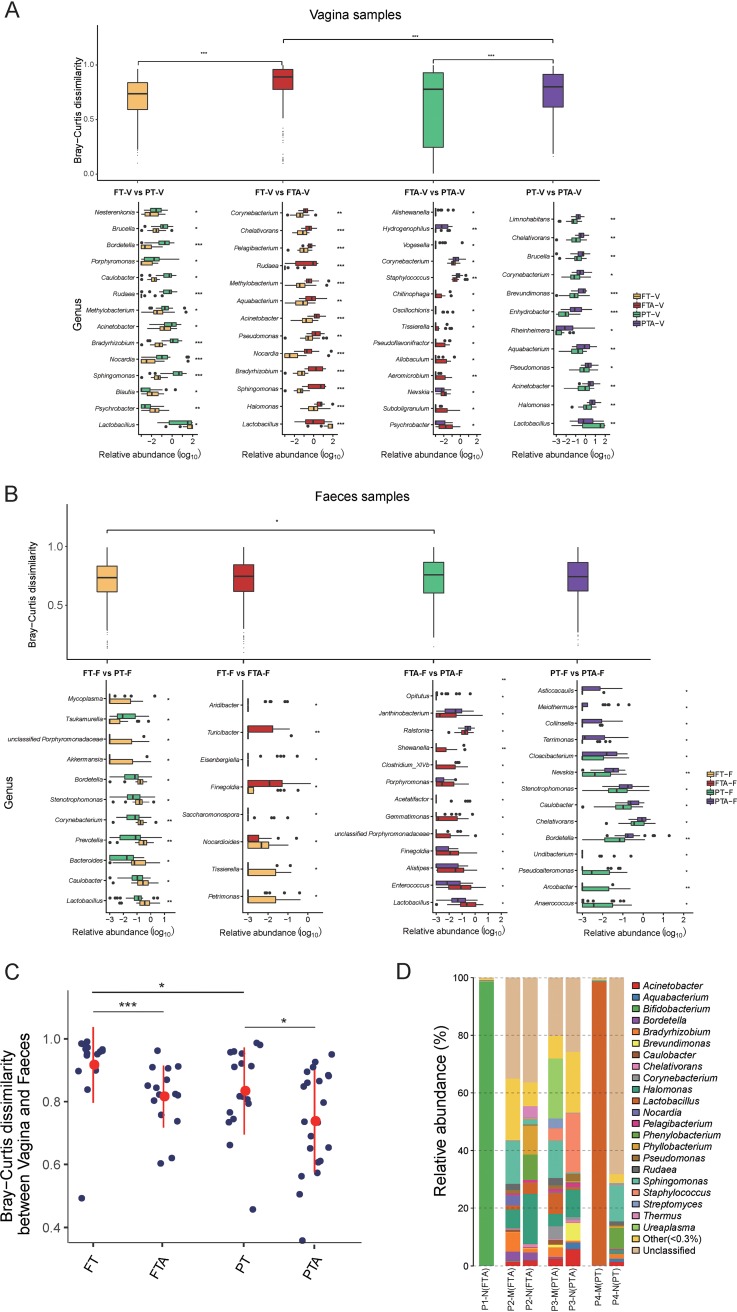
Intrapartum antibiotic prophylaxis reduces the risk of infection to a mother and neonate, but antibiotic-mediated maternal and neonatal microbiota dysbiosis increases other health risks to newborn infants. We studied the impact of perinatal antibiotic prophylaxis on the microbiota in mothers and newborns with full-term or preterm delivery. Ninety-eight pregnant women and their neonates were divided into the following four groups: full term without antibiotic exposure (FT), full term with antibiotic exposure (FTA), preterm without antibiotic exposure (PT), and preterm with antibiotic exposure (PTA). Bacterial composition was analyzed by sequencing the 16S rRNA gene from maternal vaginal swabs (V) and neonatal meconium (F). The results showed that in maternal vaginal and neonatal meconium microbiota, FT and PT groups had a higher load of spp. than did the FTA and PTA groups. In addition, whether in the mother or newborn, the dissimilarity in microbiota between FT and PT was the lowest compared to that between other groups. Compared to the FT and PT groups, the dissimilarity in microbial structures between the vagina and meconium decreased in the FTA and PTA groups. The health outcome of infants reveals an association between early-onset sepsis and antibiotic-mediated microbiota dysbiosis. In conclusion, perinatal antibiotic exposure is related to the establishment of gut microbiota and health risks in newborns. Promoting the rational usage of antibiotics with pregnant women will improve neonatal health. Perinatal antibiotic prophylaxis is an effective method for preventing group B (GBS) infection in newborns. Antibiotic exposure unbalances women's vaginal microbiota, which is associated with the establishment of the newborn gut microbiota. However, the influence of perinatal antibiotic exposure on neonatal gut microbiota colonization and health outcomes remains unclear. In this study, we found that perinatal antibiotic exposure induced microbiota dysbiosis in a woman's vagina and the neonatal gut, and we highlight a significant decrease in the abundance of spp. The influence of antibiotic use on the microbiota was greater than that from gestational age. Additionally, full-term newborns without antibiotic exposure had no evidence of early-onset sepsis, whereas in full-term or preterm newborns with antibiotic exposure before birth, at least one infant was diagnosed with early-onset sepsis. These results suggest an association between perinatal antibiotic exposure and microbial dysbiosis in maternal vaginal and neonatal gut environments, which may be related to the occurrence of early-onset sepsis.
围产期抗生素预防可降低母婴感染风险,但抗生素介导的母婴微生物失调会增加新生儿的其他健康风险。我们研究了围产期抗生素预防对足月或早产分娩的母亲和新生儿微生物群的影响。98 名孕妇及其新生儿分为以下四组:无抗生素暴露的足月组(FT)、有抗生素暴露的足月组(FTA)、无抗生素暴露的早产组(PT)和有抗生素暴露的早产组(PTA)。通过对母体阴道拭子(V)和新生儿胎粪(F)的 16S rRNA 基因进行测序来分析细菌组成。结果表明,在母体阴道和新生儿胎粪微生物群中,FT 和 PT 组的 spp.负荷高于 FTA 和 PTA 组。此外,无论在母亲还是新生儿中,FT 和 PT 组之间的微生物群落差异均低于其他组。与 FT 和 PT 组相比,FTA 和 PTA 组阴道和胎粪之间的微生物结构差异减小。婴儿的健康结果表明,早发性败血症与抗生素介导的微生物失调有关。总之,围产期抗生素暴露与新生儿肠道微生物群的建立和健康风险有关。促进孕妇合理使用抗生素将改善新生儿健康。围产期抗生素预防是预防新生儿 B 组链球菌(GBS)感染的有效方法。抗生素暴露会使女性阴道微生物群失衡,这与新生儿肠道微生物群的建立有关。然而,围产期抗生素暴露对新生儿肠道微生物群定植和健康结果的影响尚不清楚。在这项研究中,我们发现围产期抗生素暴露会导致女性阴道和新生儿肠道的微生物失调,并且 spp.的丰度显著降低。抗生素使用对微生物群的影响大于胎龄的影响。此外,无抗生素暴露的足月新生儿没有早发性败血症的证据,而在出生前有抗生素暴露的足月或早产新生儿中,至少有一名婴儿被诊断为早发性败血症。这些结果表明,围产期抗生素暴露与母体阴道和新生儿肠道环境中的微生物失调有关,这可能与早发性败血症的发生有关。