Smithsonian Tropical Research Institute, Box 0843-03092, Balboa, Republic of Panama.
Department of Biological, Geological and Environmental Sciences, University of Bologna, Piazza Porta San Donato 1, 40126, Bologna, Italy.
Sci Rep. 2020 Feb 19;10(1):2922. doi: 10.1038/s41598-020-59436-y.
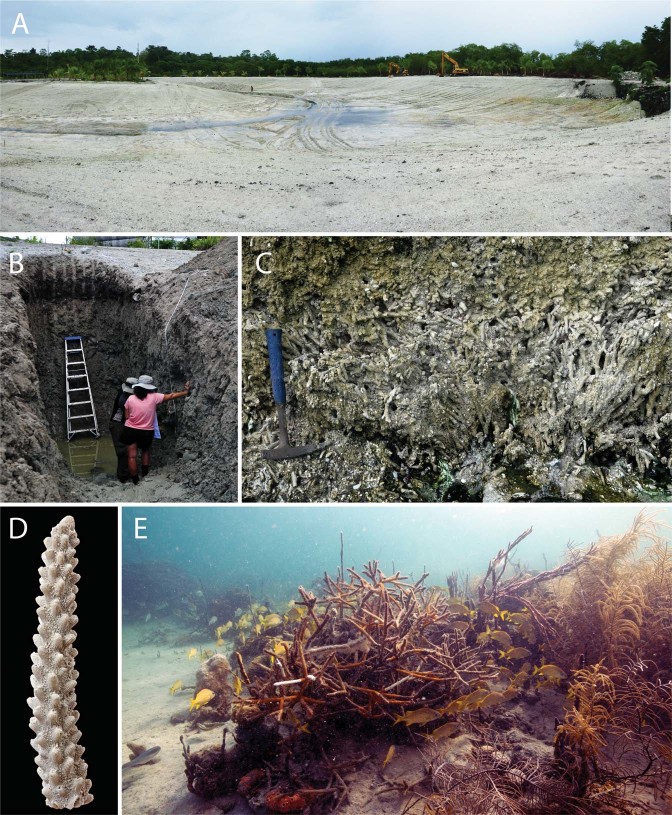
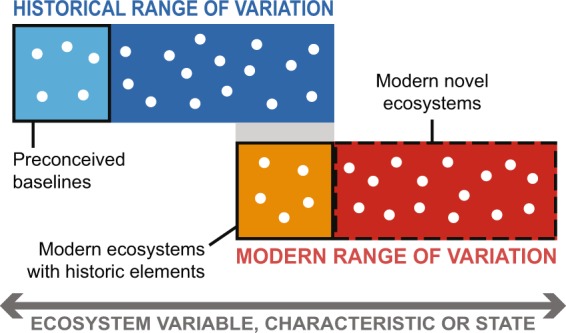
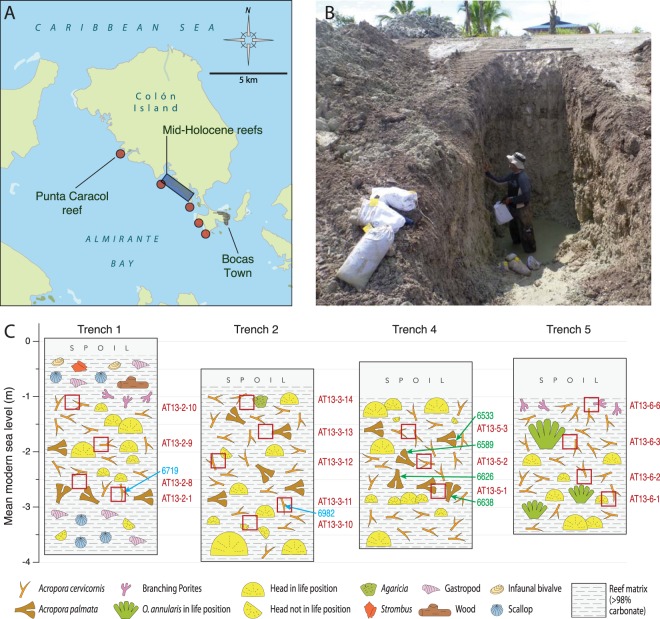
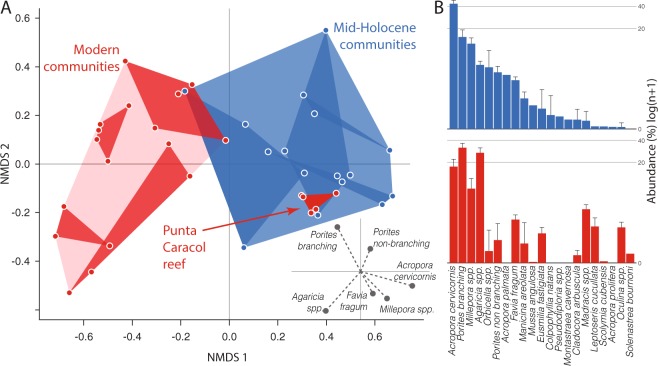
Many Caribbean coral reefs are heavily degraded, yet their pre-human, natural states are often assumed or estimated using space-for-time substitution approaches. Here we use an 11-hectare suite of fossilised mid-Holocene (7.2-5.6 ka) fringing reefs in Caribbean Panama to define natural variation in hard coral community structure before human-impact to provide context to the states of the same reefs today. We collected bulk samples from four trenches dug into the mid-Holocene fossil reef and surficial bulk samples from 2-10 m depths on five adjacent modern reefs extending over 5 km. Analysis of the abundances of coral taxa in fossil bulk samples define the Historical Range of Variation (HRV) in community structure of the reefs. When compared to the community structure of adjacent modern reefs, we find that most coral communities today fall outside the HRV, identifying them as novel ecosystems and corroborating the well-documented transition from acroporid-dominated Caribbean reefs to reefs dominated by stress-tolerant taxa (Porites and Agaricia). We find one modern reef, however, whose community composition remains within the HRV showing that it has not transitioned to a novel state. Reef-matrix cores extracted from this reef reveal that the coral community has remained in this state for over 800 years, suggesting long-term stability and resistance to the region-wide shift to novel states. Without these data to provide historical context, this potentially robust and stable reef would be overlooked since it does not fulfil expectations of what a Caribbean coral reef should look like in the absence of humans. This example illustrates how defining past variation using the fossil record can improve our understanding of modern degradation and guide conservation.
许多加勒比珊瑚礁严重退化,但人们通常会通过时空替代方法来假设或估计它们在人类出现之前的自然状态。在这里,我们利用加勒比巴拿马的一个 11 公顷的中全新世(7.2-5.6 千年前)边缘礁化石套来定义人类影响前硬珊瑚群落结构的自然变化,为今天同一珊瑚礁的状态提供背景。我们从四个挖掘到中全新世化石礁的沟渠中采集了大块样本,并从五个相邻现代礁的 2-10 米深处采集了表面大块样本,这些礁延伸超过 5 公里。对化石大块样本中珊瑚类群丰度的分析定义了礁群落结构的历史变化范围(HRV)。与相邻现代礁的群落结构相比,我们发现今天大多数珊瑚群落都超出了 HRV,将它们确定为新的生态系统,并证实了从以鹿角珊瑚为主的加勒比礁向耐胁迫类群(多孔螅和石芝)为主的礁的转变的良好记录。然而,我们发现一个现代礁的群落组成仍然在 HRV 范围内,表明它没有向新的状态转变。从这个礁提取的礁基质岩芯表明,珊瑚群落一直处于这种状态超过 800 年,表明其具有长期稳定性和对该地区向新状态转变的抵抗力。如果没有这些数据提供历史背景,那么这个潜在的强健和稳定的礁就会被忽视,因为它不符合在没有人类的情况下加勒比珊瑚礁应该是什么样子的预期。这个例子说明了如何使用化石记录来定义过去的变化,以提高我们对现代退化的理解并指导保护。