Li Weitao, Zheng Yulong, Zhang Likun, Lei Yanbao, Li Yangping, Liao Zhiyong, Li Zhongpei, Feng Yulong
CAS Key Laboratory of Tropical Forest Ecology Xishuangbanna Tropical Botanical Garden Chinese Academy of Sciences Mengla China.
Institute of Soil Science Chinese Academy of Sciences Nanjing China.
Ecol Evol. 2020 Jan 14;10(3):1252-1263. doi: 10.1002/ece3.5979. eCollection 2020 Feb.
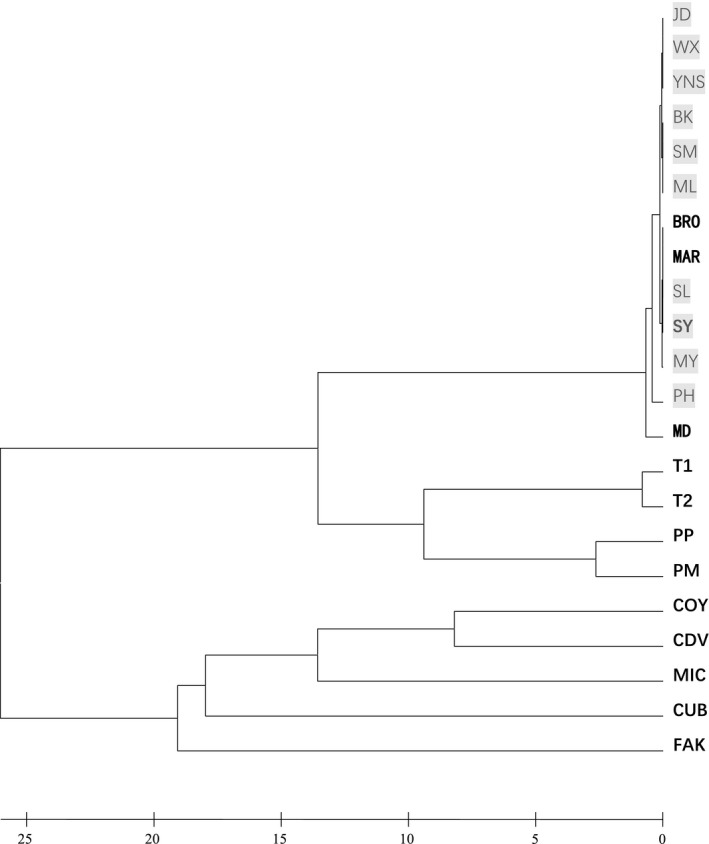
The evolution of increased competitive ability (EICA) hypothesis states that, when introduced in a novel habitat, invasive species may reallocate resources from costly quantitative defense mechanisms against enemies to dispersal and reproduction; meanwhile, the refinement of EICA suggests that concentrations of toxins used for qualitative defense against generalist herbivores may increase. Previous studies considered that only few genotypes were introduced to the new range, whereas most studies to test the EICA (or the refinement of EICA) hypotheses did not consider founder effects.In this study, genetic and phenotypic data of populations sampled across native and introduced ranges were combined to investigate the role of postintroduction evolution in the successful invasion of .Compared with native populations, the introduced populations exhibited lower levels of genetic diversity. Moreover, different founder effects events were interpreted as the main cause of the genetic structure observed in introduced ranges. Three Florida, two Trinidad, and two Puerto Rico populations may have been the sources of the invasive in Asia.When in free of competition conditions, plants from introduced ranges perform better than those from native ranges at high nutrient supply but not at low nutrient level. The differences in performance due to competition were significantly greater for plants from the native range than those from the introduced range at both nutrient levels. Moreover, the differences in performance by competition were significantly greater for putative source populations than for invasive populations.Quantities of three types of secondary compounds in leaves of invasive populations were significantly higher than those in putative source populations. These results provide more accurate evidence that the competitive ability of the introduced is increased with postintroduction evolution.
增强竞争能力进化(EICA)假说指出,当入侵物种被引入新栖息地时,它们可能会将资源从针对敌人的代价高昂的定量防御机制重新分配到扩散和繁殖上;与此同时,EICA的细化表明,用于针对广食性食草动物进行定性防御的毒素浓度可能会增加。以往的研究认为只有少数基因型被引入新的分布范围,而大多数检验EICA(或EICA细化)假说的研究并未考虑奠基者效应。在本研究中,结合了在原生和引入分布范围内采样的种群的遗传和表型数据,以研究引入后进化在[物种名称]成功入侵中的作用。与原生种群相比,引入种群的遗传多样性水平较低。此外,不同的奠基者效应事件被解释为在引入分布范围内观察到的遗传结构的主要原因。三个佛罗里达种群、两个特立尼达种群和两个波多黎各种群可能是亚洲入侵[物种名称]的来源。在无竞争条件下,来自引入分布范围的[物种名称]植物在高养分供应时比来自原生分布范围的植物表现更好,但在低养分水平时并非如此。在两种养分水平下,来自原生分布范围的[物种名称]植物因竞争导致的表现差异均显著大于来自引入分布范围的植物。此外,假定源种群因竞争导致的表现差异显著大于入侵种群。入侵[物种名称]种群叶片中三种次生化合物的含量显著高于假定源种群。这些结果提供了更准确的证据,表明引入的[物种名称]的竞争能力随着引入后的进化而增强。