Gunther Idit, Azriel Lior, Wolf Hila, Raz Tal, Klement Eyal
Koret School of Veterinary Medicine, The Robert H. Smith Faculty of Agriculture, Food & Environment The Hebrew University of Jerusalem Israel.
Ecol Evol. 2020 Jan 21;10(3):1288-1298. doi: 10.1002/ece3.5982. eCollection 2020 Feb.
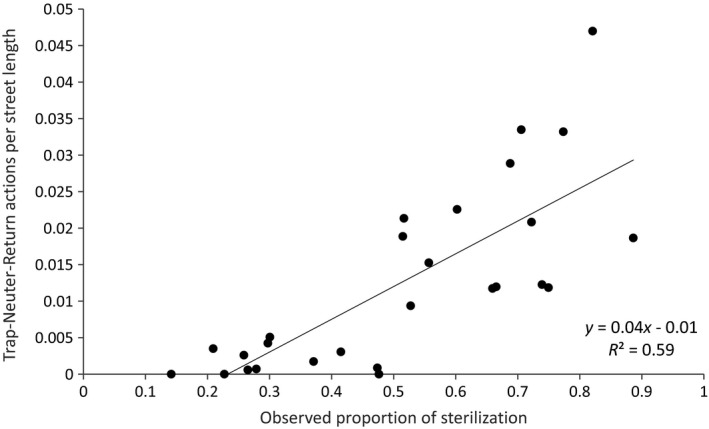
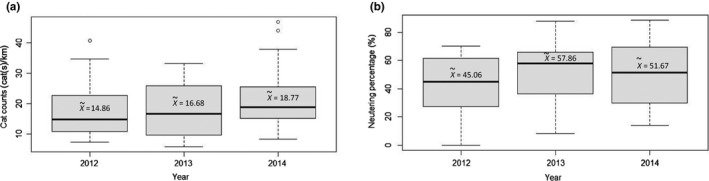
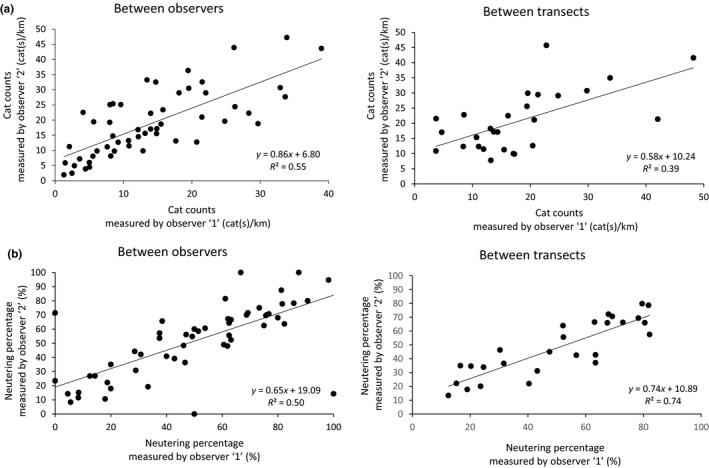
Free-roaming cats (FRCs) form nondomiciliary population groups that might lead to adverse environmental effects, as well as to welfare impairment of the cats themselves. Though criticized by ecologists, for the last two decades, the trap-neuter-return (TNR) programs were often employed aiming to manage these populations. At present, no accepted and accessible monitoring scheme exists to determine the effectiveness of those programs. In the current study, we present the reliability and validity of an applicable monitoring scheme, as an adjunct tool for a TNR program of FRC in an urban environment. The monitoring scheme is based on cat observation counts along randomly chosen transects. Fifty-four transects were repeatedly walked for three years, between 2012-2014, in 27 neighborhoods within an urban area of 19.3 Km. Cat numbers counted in the 2014 observations were significantly higher than cat numbers found in the 2012 observations (prevalence ratio = 1.258, CI= 1.198-1.322, < 0.001). The method revealed high reliability when different observers and different transects in the same neighborhood were compared ( = 0.548 and = 0.391, respectively, for measuring cat counts per km, < 0.001; and = 0.5 and = 0.74, respectively, for measuring neutering percentage, < 0.001). This scheme was constructively validated by measurements of municipal data on the number of neutered cats and demonstrated high correlation ( = 0.59, < 0.001). Conducting cat observations using friendly calling and feeding resulted in an increased number of FRC observed per km walk (by 79% and 22%-30%, respectively). However, these manipulations did not alter the recorded percentage of neutered cats. The proposed scheme provides spatio-temporal data that can contribute to the management programs of such cat metapopulations in an urban environment.
自由放养的猫(FRCs)形成了非定居性种群,这可能会对环境产生不利影响,同时也会损害猫自身的福利。尽管受到生态学家的批评,但在过去二十年里,诱捕-绝育-放归(TNR)计划经常被用于管理这些猫群。目前,尚无公认且可行的监测方案来确定这些计划的有效性。在本研究中,我们展示了一种适用监测方案的可靠性和有效性,作为城市环境中FRC的TNR计划的辅助工具。该监测方案基于沿随机选择的样带对猫的观察计数。在2012年至2014年期间,对19.3平方公里城市区域内的27个社区的54条样带进行了为期三年的重复巡查。2014年观察到的猫的数量显著高于2012年观察到的猫的数量(患病率比 = 1.258,CI = 1.198 - 1.322,P < 0.001)。当比较同一社区内不同观察者和不同样带时,该方法显示出高可靠性(每公里测量猫数量时,ICC分别为0.548和0.391,P < 0.001;测量绝育百分比时,ICC分别为0.5和0.74,P < 0.001)。该方案通过对已绝育猫数量的市政数据测量进行了结构验证,并显示出高度相关性(r = 0.59,P < 0.001)。使用友好呼唤和喂食方式进行猫的观察,导致每公里行走观察到的FRC数量增加(分别增加79%和22% - 30%)。然而,这些操作并未改变记录的绝育猫的百分比。所提出的方案提供了时空数据,可有助于城市环境中此类猫复合种群的管理计划。