Eur J Trauma Emerg Surg. 2021 Feb;47(1):261-268. doi: 10.1007/s00068-020-01316-1. Epub 2020 Feb 19.
The CRASH-3 trial is a randomised trial of tranexamic acid (TXA) on death and disability in patients with traumatic brain injury (TBI). It is based on the hypothesis that early TXA treatment can prevent deaths from post-traumatic intracranial bleeding. The results showed that timely TXA treatment reduces head injury deaths in patients with reactive pupils and those with a mild to moderate GCS at baseline. We examined routinely collected CT scans in a sample of 1767 CRASH-3 trial patients to explore if, why, and how patients are affected by TXA.
The CRASH-3 IBMS is an explanatory study nested within the CRASH-3 trial. We measured the volume of intracranial bleeding on CT scans using established methods (e.g. ABC/2).
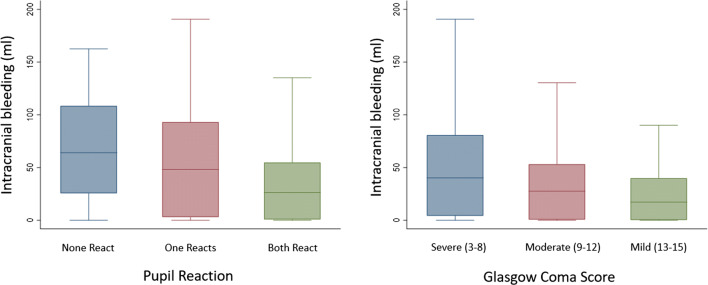
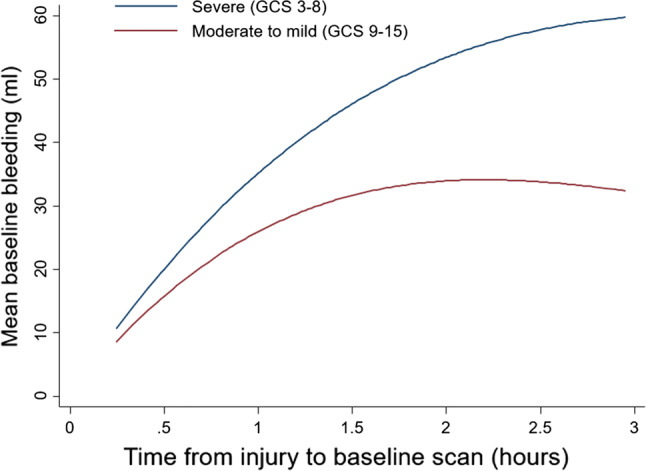
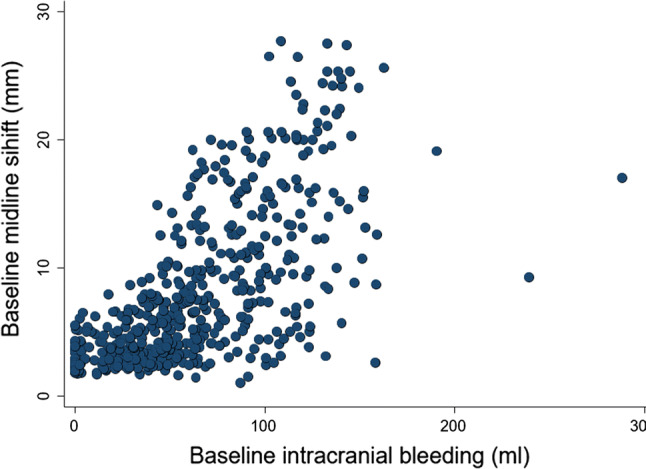
Patients with any un-reactive pupil had a median intracranial bleeding volume of 60 ml (IQR 18-101 ml) and patients with reactive pupils had a median volume of 26 ml (IQR 1-55 ml). Patients with severe GCS had median intracranial bleeding volume of 37 ml (IQR 3-75 ml) and patients with moderate to mild GCS had a median volume of 26 ml (IQR 0.4-50 ml). For every hour increase from injury to the baseline scan, the risk of new bleeding on a further scan decreased by 12% (adjusted RR = 0.88 [95% CI 0.80-0.96], p = 0.0047).
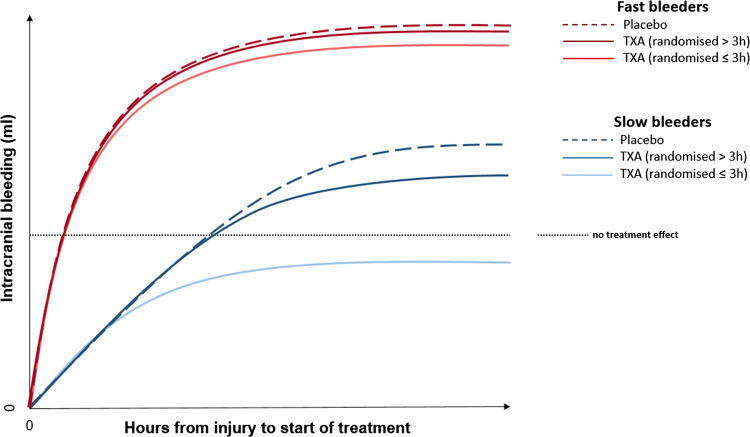
Patients with reactive pupils and/or mild to moderate GCS may have benefited from TXA in the CRASH-3 trial because they had less intracranial bleeding at baseline. However, because bleeding occurs soon after injury, treatment delay reduces the benefit of TXA.
CRASH-3 试验是一项关于创伤性脑损伤(TBI)患者使用氨甲环酸(TXA)治疗死亡和残疾的随机试验。其基于这样一个假设,即早期 TXA 治疗可以预防创伤性颅内出血导致的死亡。结果表明,及时给予 TXA 治疗可减少瞳孔反应性患者和基线时格拉斯哥昏迷量表(GCS)评分轻度至中度患者的颅脑损伤死亡。我们对 CRASH-3 试验的 1767 例患者中常规采集的 CT 扫描进行了检查,以探讨 TXA 治疗对患者的影响、原因和方式。
CRASH-3 IBMS 是一项嵌套于 CRASH-3 试验中的解释性研究。我们使用既定方法(如 ABC/2)测量 CT 扫描中的颅内出血量。
任何无反应性瞳孔的患者颅内出血中位数为 60ml(IQR 18-101ml),有反应性瞳孔的患者颅内出血中位数为 26ml(IQR 1-55ml)。GCS 评分严重的患者颅内出血中位数为 37ml(IQR 3-75ml),GCS 评分中度至轻度的患者颅内出血中位数为 26ml(IQR 0.4-50ml)。从损伤到基线扫描的时间每增加 1 小时,进一步扫描中新出血的风险降低 12%(校正 RR=0.88[95%CI 0.80-0.96],p=0.0047)。
CRASH-3 试验中,瞳孔反应性患者和/或 GCS 评分轻度至中度患者可能从 TXA 治疗中获益,因为他们在基线时的颅内出血较少。然而,由于出血发生在受伤后不久,治疗延迟会降低 TXA 的获益。