Department of Biochemistry and Pharmacogenomics, Faculty of Pharmacy, Medical University of Warsaw, Warsaw, Poland.
Centre for Preclinical Research, Medical University of Warsaw, 02-097, Warsaw, Poland.
Sleep Breath. 2020 Dec;24(4):1573-1580. doi: 10.1007/s11325-020-02029-w. Epub 2020 Feb 20.
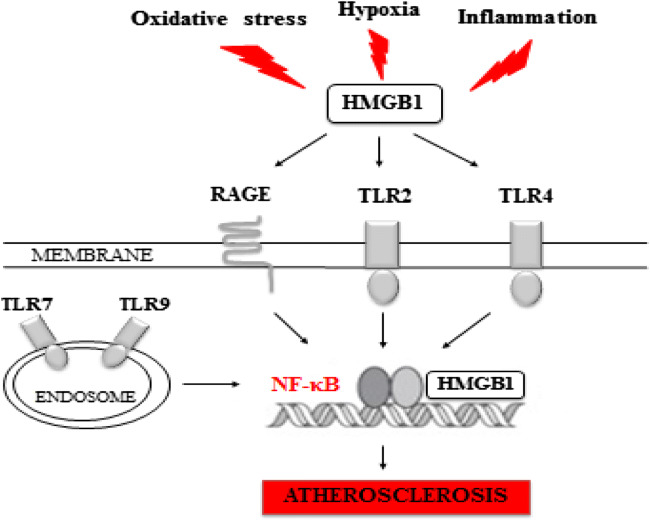
There is growing evidence that obstructive sleep apnea (OSA) promotes vascular endothelial dysfunction and atherogenesis. Pathways that mediate this pathology may include Toll-like receptors (TLRs) and receptor for advanced glycation end products (RAGE) which play a significant role in proinflammatory processes. The aim of this study was to measure the expression of the above-mentioned receptors in relation to OSA severity in carotid plaques obtained during open endarterectomy.
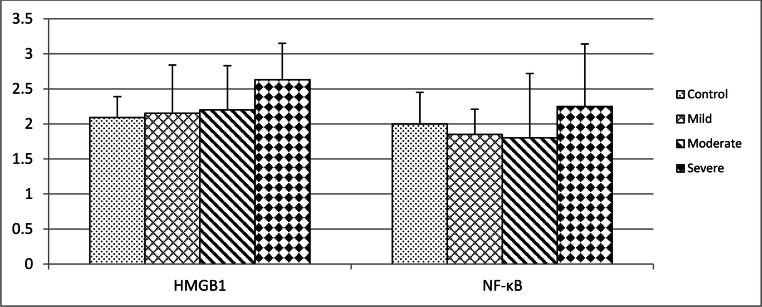
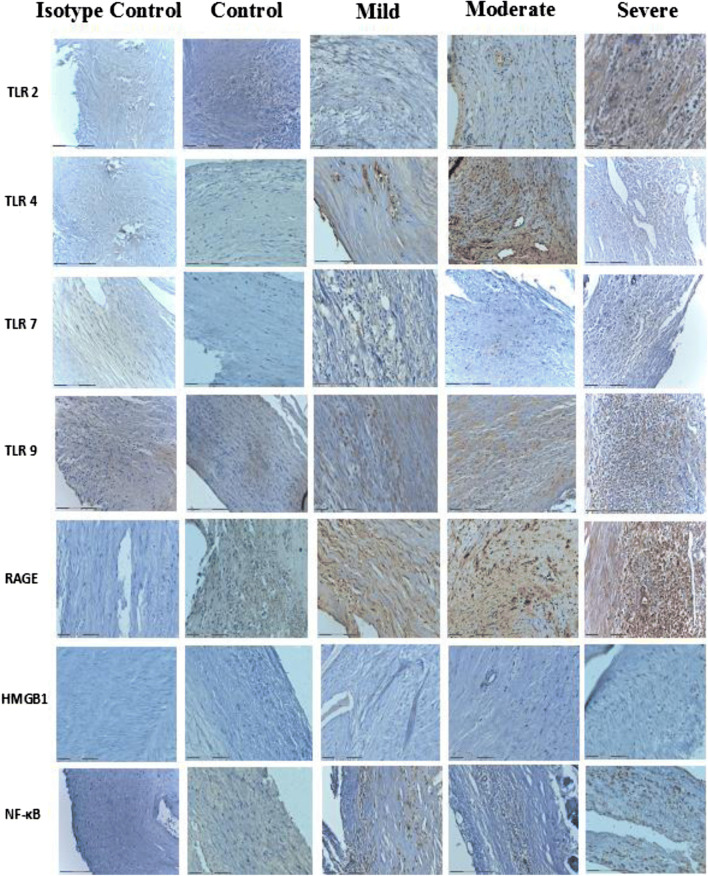
This prospective study included patients with a sleep study prior to surgery and a plaque specimen obtained during standard open endarterectomy. Immunohistochemistry of TLR2, TLR4, TLR7, TLR9, RAGE, HMGB1, and NF-κB was performed on atherosclerotic plaques from carotid arteries of patients with and without OSA.
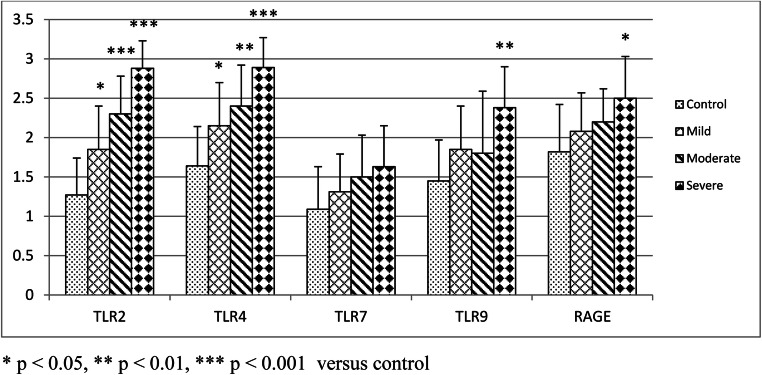
There were 46 patients (22 women, mean age 73.2 ± 1.3 years): 14 control patients, 13 with mild, 11 with moderate, and 8 with severe OSA. The expression of all TLRs and RAGE increased proportionately with increasing OSA severity. The largest differences between patients with severe OSA and no OSA were found for TLR2 (2.88 ± 0.35 vs. 1.27 ± 0.47, p < 0.001), TLR4 (2.88 ± 0.35 vs. 1.64 ± 0.5, p < 0.001), TLR9 (2.38 ± 0.52 vs. 1.45 ± 0.52, p < 0.01), and RAGE (2.5 ± 0.53 vs. 1.82 ± 0.6, p < 0.05).
TLR2, TLR4, TLR9, and RAGE expression was significantly increased in carotid plaques of patients with moderate-to-severe OSA when compared with control patients with no OSA and those with mild OSA. TLR and RAGE-mediated pathways may play a significant role in OSA-dependent atherogenesis.
越来越多的证据表明阻塞性睡眠呼吸暂停(OSA)可促进血管内皮功能障碍和动脉粥样硬化形成。介导这种病理的途径可能包括 Toll 样受体(TLR)和晚期糖基化终产物受体(RAGE),它们在促炎过程中发挥重要作用。本研究旨在测量在开放颈动脉内膜切除术期间获得的颈动脉斑块中上述受体与 OSA 严重程度的关系。
这项前瞻性研究包括在手术前进行睡眠研究且在标准开放颈动脉内膜切除术期间获得斑块标本的患者。对有和无 OSA 的患者颈动脉粥样硬化斑块进行 TLR2、TLR4、TLR7、TLR9、RAGE、HMGB1 和 NF-κB 的免疫组织化学染色。
共纳入 46 例患者(22 例女性,平均年龄 73.2 ± 1.3 岁):14 例对照组患者、13 例轻度 OSA 患者、11 例中度 OSA 患者和 8 例重度 OSA 患者。所有 TLR 和 RAGE 的表达均随 OSA 严重程度的增加而呈比例增加。重度 OSA 患者与无 OSA 患者之间最大的差异见于 TLR2(2.88 ± 0.35 vs. 1.27 ± 0.47,p < 0.001)、TLR4(2.88 ± 0.35 vs. 1.64 ± 0.5,p < 0.001)、TLR9(2.38 ± 0.52 vs. 1.45 ± 0.52,p < 0.01)和 RAGE(2.5 ± 0.53 vs. 1.82 ± 0.6,p < 0.05)。
与无 OSA 的对照组患者和轻度 OSA 患者相比,中重度 OSA 患者颈动脉斑块中 TLR2、TLR4、TLR9 和 RAGE 的表达显著增加。TLR 和 RAGE 介导的途径可能在 OSA 依赖性动脉粥样硬化形成中发挥重要作用。