Viral Vector Laboratory, Centro de Investigação Translacional em Oncologia/LIM24, Instituto do Câncer do Estado de São Paulo, Faculdade de Medicina, Universidade de São Paulo, São Paulo, SP, Brasil.
Biotecnologia Unidade 1, Cristália Produtos Químicos Farmacêuticos, Itapira, SP, Brasil.
Braz J Med Biol Res. 2020 Feb 14;53(3):e8876. doi: 10.1590/1414-431X20198876. eCollection 2020.
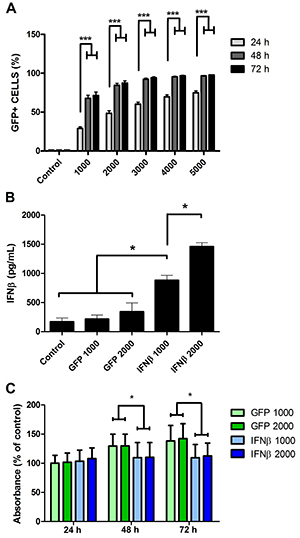
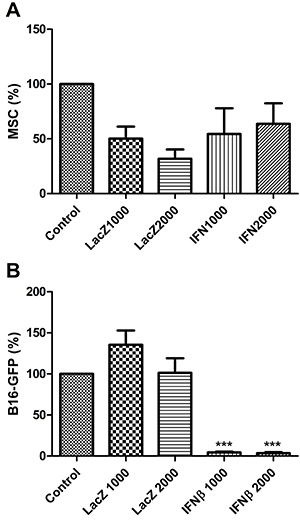
The immune stimulatory and anti-neoplastic functions of type I interferon have long been applied for the treatment of melanoma. However, the systemic application of high levels of this recombinant protein is often met with toxicity. An approach that provides localized, yet transient, production of type I interferon may overcome this limitation. We propose that the use of mesenchymal stem cells (MSCs) as delivery vehicles for the production of interferon-β (IFNβ) may be beneficial when applied together with our cancer gene therapy approach. In our previous studies, we have shown that adenovirus-mediated gene therapy with IFNβ was especially effective in combination with p19Arf gene transfer, resulting in immunogenic cell death. Here we showed that MSCs derived from mouse adipose tissue were susceptible to transduction with adenovirus, expressed the transgene reliably, and yet were not especially sensitive to IFNβ production. MSCs used to produce IFNβ inhibited B16 mouse melanoma cells in a co-culture assay. Moreover, the presence of p19Arf in the B16 cells sensitizes them to the IFNβ produced by the MSCs. These data represent a critical demonstration of the use of MSCs as carriers of adenovirus encoding IFNβ and applied as an anti-cancer strategy in combination with p19Arf gene therapy.
I 型干扰素的免疫刺激和抗肿瘤功能长期以来一直被应用于黑色素瘤的治疗。然而,这种重组蛋白的高水平全身应用常常伴随着毒性。提供局部但短暂的 I 型干扰素产生的方法可能克服这一限制。我们提出,使用间充质干细胞(MSCs)作为干扰素-β(IFNβ)产生的载体,与我们的癌症基因治疗方法结合使用可能是有益的。在我们之前的研究中,我们已经表明,IFNβ 的腺病毒介导的基因治疗与 p19Arf 基因转移联合使用特别有效,导致免疫原性细胞死亡。在这里,我们表明,源自小鼠脂肪组织的 MSC 易于被腺病毒转导,可靠地表达转基因,并且对 IFNβ 的产生不特别敏感。用于产生 IFNβ 的 MSC 在共培养测定中抑制 B16 小鼠黑色素瘤细胞。此外,B16 细胞中 p19Arf 的存在使它们对 MSC 产生的 IFNβ 敏感。这些数据代表了将 MSC 作为携带编码 IFNβ 的腺病毒的载体并与 p19Arf 基因治疗联合用作抗癌策略的重要证明。