Department of Internal Medicine, College of Veterinary Medicine, Seoul National University, Seoul, Republic of Korea.
PLoS One. 2013 Sep 9;8(9):e74897. doi: 10.1371/journal.pone.0074897. eCollection 2013.
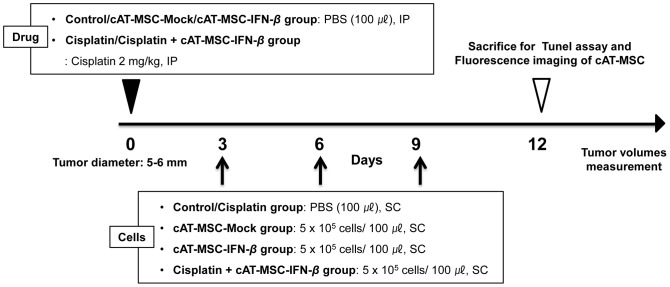
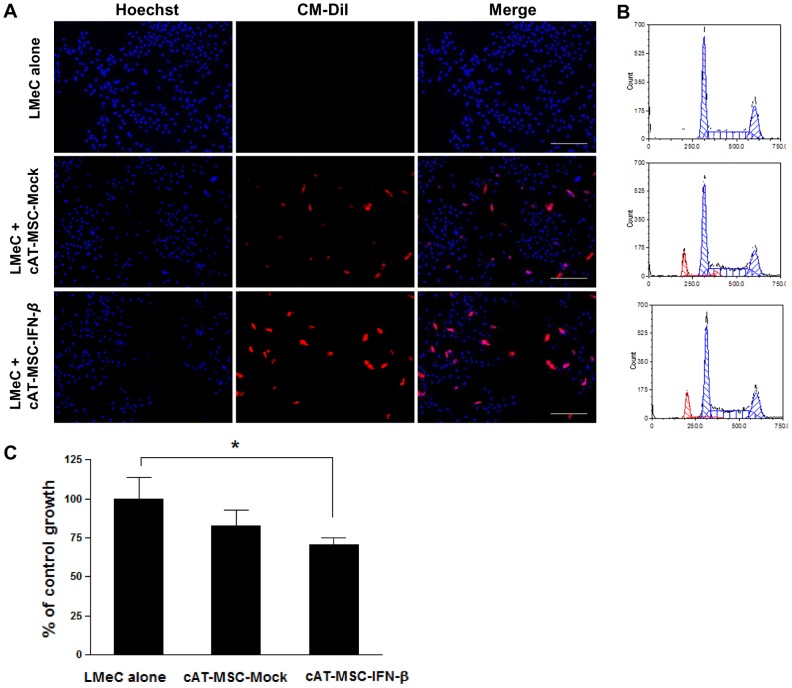
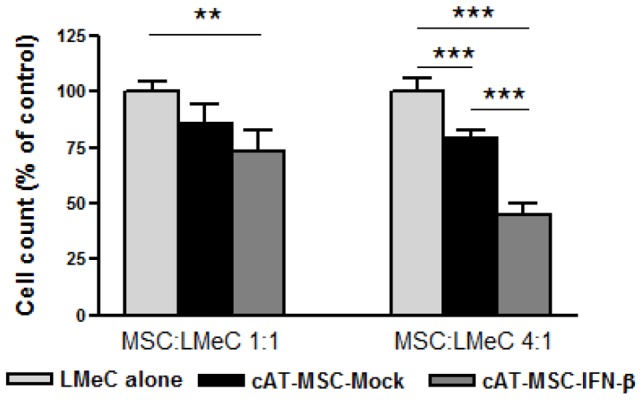
Adipose tissue-derived mesenchymal stem cells (AT-MSCs) are attractive cell-therapy vehicles for the delivery of anti-tumor molecules into the tumor microenvironment. The innate tropism of AT-MSCs for tumors has important implications for effective cellular delivery of anti-tumor molecules, including cytokines, interferon, and pro-drugs. The present study was designed to determine the possibility that the combination of stem cell-based gene therapy with low-dose cisplatin would improve therapeutic efficacy against canine melanoma. The IFN-β transduced canine AT-MSCs (cAT-MSC-IFN-β) inhibited the growth of LMeC canine melanoma cells in direct and indirect in vitro co-culture systems. In animal experiments using BALB/c nude mouse xenografts, which developed by injecting LMeC cells, the combination treatment of cAT-MSC-IFN-β and low-dose cisplatin significantly reduced tumor volume compared with the other treatment groups. Fluorescent microscopic analysis with a TUNEL (terminal deoxynucleotidyl transferase-mediated nick-end labeling) assay of tumor section provided evidence for homing of cAT-MSC-IFN-β to the tumor site and revealed that the combination treatment of cAT-MSC-IFN-β with low-dose cisplatin induced high levels of cell apoptosis. These findings may prove useful in further explorations of the application of these combined approaches to the treatment of malignant melanoma and other tumors.
脂肪组织来源的间充质干细胞(AT-MSCs)是一种有吸引力的细胞治疗载体,可将抗肿瘤分子递送至肿瘤微环境中。AT-MSCs 对肿瘤的固有趋向性对包括细胞因子、干扰素和前体药物在内的抗肿瘤分子的有效细胞递释具有重要意义。本研究旨在确定将基于干细胞的基因治疗与低剂量顺铂联合使用是否有可能提高对犬黑色素瘤的治疗效果。转导 IFN-β 的犬 AT-MSCs(cAT-MSC-IFN-β)在直接和间接体外共培养系统中抑制了 LMeC 犬黑色素瘤细胞的生长。在使用 BALB/c 裸鼠异种移植的动物实验中,通过注射 LMeC 细胞形成肿瘤,与其他治疗组相比,cAT-MSC-IFN-β 和低剂量顺铂的联合治疗显著降低了肿瘤体积。对肿瘤切片进行 TUNEL(末端脱氧核苷酸转移酶介导的缺口末端标记)荧光显微镜分析提供了证据证明 cAT-MSC-IFN-β 归巢至肿瘤部位,并且联合治疗 cAT-MSC-IFN-β 与低剂量顺铂诱导高水平的细胞凋亡。这些发现可能有助于进一步探索将这些联合方法应用于恶性黑色素瘤和其他肿瘤的治疗。