• 文献检索
  • 文档翻译
  • 深度研究
  • 学术资讯
  • Suppr Zotero 插件Zotero 插件
  • 邀请有礼
  • 套餐&价格
  • 历史记录
应用&插件
Suppr Zotero 插件Zotero 插件浏览器插件Mac 客户端Windows 客户端微信小程序
定价
高级版会员购买积分包购买API积分包
服务
文献检索文档翻译深度研究API 文档MCP 服务
关于我们
关于 Suppr公司介绍联系我们用户协议隐私条款
关注我们

Suppr 超能文献

核心技术专利:CN118964589B侵权必究
粤ICP备2023148730 号-1Suppr @ 2026

文献检索

告别复杂PubMed语法,用中文像聊天一样搜索,搜遍4000万医学文献。AI智能推荐,让科研检索更轻松。

立即免费搜索

文件翻译

保留排版,准确专业,支持PDF/Word/PPT等文件格式,支持 12+语言互译。

免费翻译文档

深度研究

AI帮你快速写综述,25分钟生成高质量综述,智能提取关键信息,辅助科研写作。

立即免费体验

基于生理的药代动力学建模与模拟方法分析纳米颗粒向肿瘤的递送

Meta-Analysis of Nanoparticle Delivery to Tumors Using a Physiologically Based Pharmacokinetic Modeling and Simulation Approach.

机构信息

Institute of Computational Comparative Medicine (ICCM), Department of Anatomy and Physiology, College of Veterinary Medicine, Kansas State University, Manhattan, Kansas 66506, United States.

Nanotechnology Innovation Center of Kansas State (NICKS), Department of Anatomy and Physiology, College of Veterinary Medicine, Kansas State University, Manhattan, Kansas 66506, United States.

出版信息

ACS Nano. 2020 Mar 24;14(3):3075-3095. doi: 10.1021/acsnano.9b08142. Epub 2020 Mar 4.

DOI:10.1021/acsnano.9b08142
PMID:32078303
原文链接:https://pmc.ncbi.nlm.nih.gov/articles/PMC7098057/
Abstract

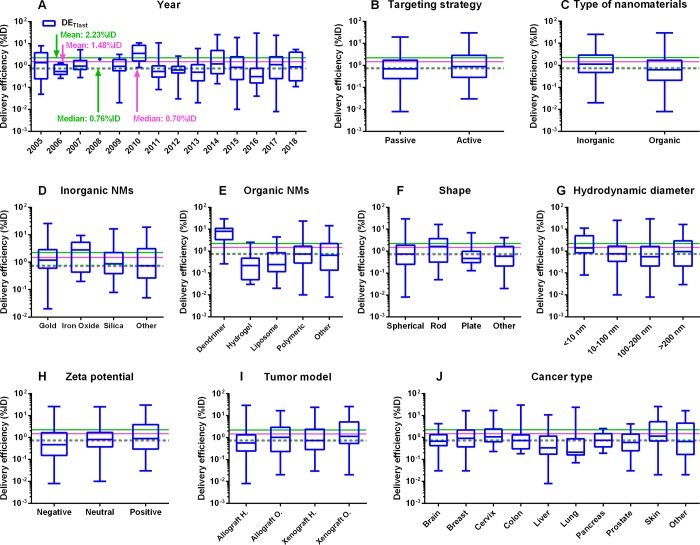
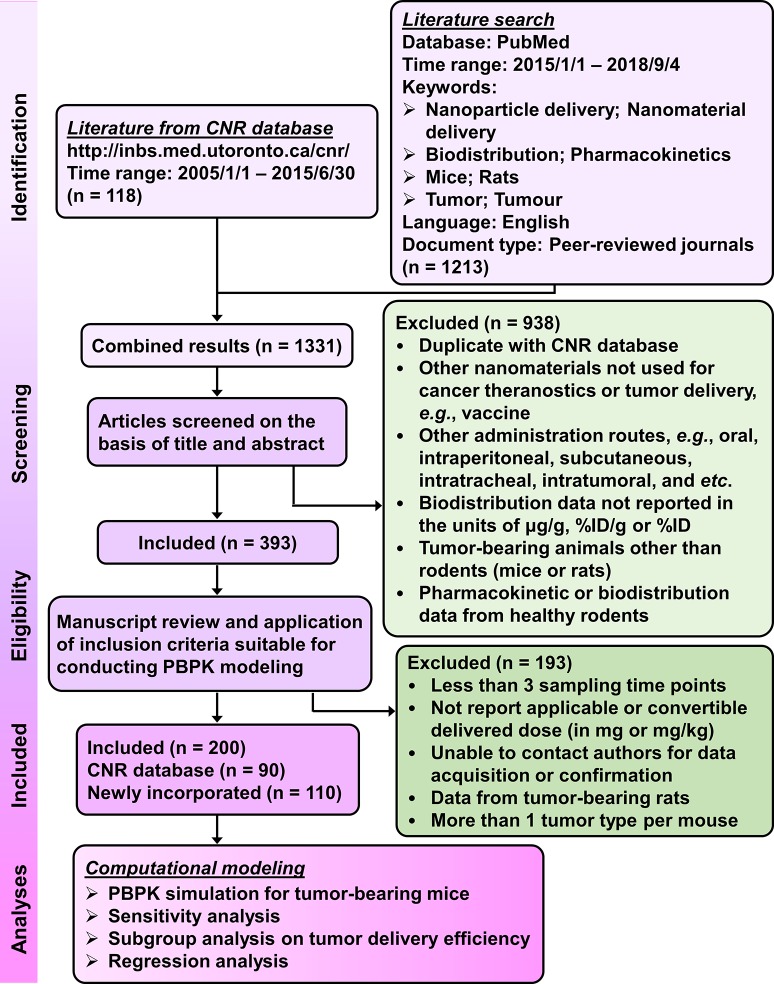
Numerous studies have engineered nanoparticles with different physicochemical properties to enhance the delivery efficiency to solid tumors, yet the mean and median delivery efficiencies are only 1.48% and 0.70% of the injected dose (%ID), respectively, according to a study using a nonphysiologically based modeling approach based on published data from 2005 to 2015. In this study, we used physiologically based pharmacokinetic (PBPK) models to analyze 376 data sets covering a wide range of nanomedicines published from 2005 to 2018 and found mean and median delivery efficiencies at the last sampling time point of 2.23% and 0.76%ID, respectively. Also, the mean and median delivery efficiencies were 2.24% and 0.76%ID at 24 h and were decreased to 1.23% and 0.35%ID at 168 h, respectively, after intravenous administration. While these delivery efficiencies appear to be higher than previous findings, they are still quite low and represent a critical barrier in the clinical translation of nanomedicines. We explored the potential causes of this poor delivery efficiency using the more mechanistic PBPK perspective applied to a subset of gold nanoparticles and found that low delivery efficiency was associated with low distribution and permeability coefficients at the tumor site ( < 0.01). We also demonstrate how PBPK modeling and simulation can be used as an effective tool to investigate tumor delivery efficiency of nanomedicines.

摘要

大量研究已经设计了具有不同物理化学性质的纳米粒子,以提高向实体瘤的递药效率,但根据一项使用基于 2005 年至 2015 年发表数据的非生理基础建模方法的研究,平均和中位数的递药效率仅分别为注射剂量的 1.48%和 0.70%(%ID)。在本研究中,我们使用基于生理的药代动力学(PBPK)模型分析了涵盖 2005 年至 2018 年发表的广泛纳米药物的 376 组数据集,发现最后采样时间点的平均和中位数递药效率分别为 2.23%和 0.76%ID。此外,静脉给药后 24 h 的平均和中位数递药效率分别为 2.24%和 0.76%ID,168 h 时分别降至 1.23%和 0.35%ID。虽然这些递药效率似乎高于先前的发现,但它们仍然相当低,是纳米药物临床转化的一个关键障碍。我们使用更具机械性的 PBPK 视角探索了这种低递药效率的潜在原因,并将其应用于金纳米粒子的子集,发现低递药效率与肿瘤部位的低分布和通透性系数(<0.01)有关。我们还展示了如何使用 PBPK 建模和模拟作为研究纳米药物肿瘤递药效率的有效工具。
https://cdn.ncbi.nlm.nih.gov/pmc/blobs/d9b3/7098057/25b78ed99616/nn9b08142_0005.jpg
https://cdn.ncbi.nlm.nih.gov/pmc/blobs/d9b3/7098057/4e82f10ead3d/nn9b08142_0001.jpg
https://cdn.ncbi.nlm.nih.gov/pmc/blobs/d9b3/7098057/e86866dd58ed/nn9b08142_0002.jpg
https://cdn.ncbi.nlm.nih.gov/pmc/blobs/d9b3/7098057/7f3a7d436169/nn9b08142_0003.jpg
https://cdn.ncbi.nlm.nih.gov/pmc/blobs/d9b3/7098057/46fcaaf4177d/nn9b08142_0004.jpg
https://cdn.ncbi.nlm.nih.gov/pmc/blobs/d9b3/7098057/25b78ed99616/nn9b08142_0005.jpg
https://cdn.ncbi.nlm.nih.gov/pmc/blobs/d9b3/7098057/4e82f10ead3d/nn9b08142_0001.jpg
https://cdn.ncbi.nlm.nih.gov/pmc/blobs/d9b3/7098057/e86866dd58ed/nn9b08142_0002.jpg
https://cdn.ncbi.nlm.nih.gov/pmc/blobs/d9b3/7098057/7f3a7d436169/nn9b08142_0003.jpg
https://cdn.ncbi.nlm.nih.gov/pmc/blobs/d9b3/7098057/46fcaaf4177d/nn9b08142_0004.jpg
https://cdn.ncbi.nlm.nih.gov/pmc/blobs/d9b3/7098057/25b78ed99616/nn9b08142_0005.jpg

相似文献

1
Meta-Analysis of Nanoparticle Delivery to Tumors Using a Physiologically Based Pharmacokinetic Modeling and Simulation Approach.基于生理的药代动力学建模与模拟方法分析纳米颗粒向肿瘤的递送
ACS Nano. 2020 Mar 24;14(3):3075-3095. doi: 10.1021/acsnano.9b08142. Epub 2020 Mar 4.
2
Nanoparticle biodistribution coefficients: A quantitative approach for understanding the tissue distribution of nanoparticles.纳米颗粒生物分布系数:一种用于理解纳米颗粒组织分布的定量方法。
Adv Drug Deliv Rev. 2023 Mar;194:114708. doi: 10.1016/j.addr.2023.114708. Epub 2023 Jan 20.
3
An artificial intelligence-assisted physiologically-based pharmacokinetic model to predict nanoparticle delivery to tumors in mice.一种人工智能辅助的基于生理学的药代动力学模型,用于预测纳米颗粒在小鼠体内向肿瘤的传递。
J Control Release. 2023 Sep;361:53-63. doi: 10.1016/j.jconrel.2023.07.040. Epub 2023 Jul 31.
4
Performance Assessment and Translation of Physiologically Based Pharmacokinetic Models From acslX to Berkeley Madonna, MATLAB, and R Language: Oxytetracycline and Gold Nanoparticles As Case Examples.从 acslX 到 Berkeley Madonna、MATLAB 和 R 语言的生理基于药代动力学模型的性能评估和翻译:土霉素和金纳米粒子作为案例研究。
Toxicol Sci. 2017 Jul 1;158(1):23-35. doi: 10.1093/toxsci/kfx070.
5
In vivo tumor targeting of gold nanoparticles: effect of particle type and dosing strategy.体内金纳米颗粒的肿瘤靶向:颗粒类型和投药策略的影响。
Int J Nanomedicine. 2012;7:1251-8. doi: 10.2147/IJN.S29147. Epub 2012 Mar 6.
6
Modeling gold nanoparticle biodistribution after arterial infusion into perfused tissue: effects of surface coating, size and protein corona.经动脉输注到灌注组织后金纳米颗粒的生物分布建模:表面涂层、大小和蛋白冠的影响。
Nanotoxicology. 2018 Dec;12(10):1093-1112. doi: 10.1080/17435390.2018.1476986. Epub 2018 Jun 1.
7
Size- and surface chemistry-dependent pharmacokinetics and tumor accumulation of engineered gold nanoparticles after intravenous administration.静脉注射后,工程化金纳米颗粒的药代动力学及肿瘤蓄积与尺寸和表面化学性质有关。
Metallomics. 2015 Mar;7(3):516-24. doi: 10.1039/c4mt00340c.
8
Endocytosis mechanism in physiologically-based pharmacokinetic modeling of nanoparticles.纳米颗粒生理药代动力学模型中的内吞作用机制。
Toxicol Appl Pharmacol. 2019 Dec 1;384:114765. doi: 10.1016/j.taap.2019.114765. Epub 2019 Oct 31.
9
Development of a multi-route physiologically based pharmacokinetic (PBPK) model for nanomaterials: a comparison between a traditional versus a new route-specific approach using gold nanoparticles in rats.开发一种多途径生理药代动力学(PBPK)纳米材料模型:传统途径与新型特定途径在大鼠体内应用金纳米粒子的比较。
Part Fibre Toxicol. 2022 Jul 8;19(1):47. doi: 10.1186/s12989-022-00489-4.
10
Probabilistic risk assessment of gold nanoparticles after intravenous administration by integrating in vitro and in vivo toxicity with physiologically based pharmacokinetic modeling.静脉注射金纳米粒子的概率风险评估,通过将体外和体内毒性与基于生理学的药代动力学模型相结合。
Nanotoxicology. 2018 Jun;12(5):453-469. doi: 10.1080/17435390.2018.1459922. Epub 2018 Apr 14.

引用本文的文献

1
Smart CAR-T Nanosymbionts: archetypes and proto-models.智能嵌合抗原受体T细胞纳米共生体:原型与原始模型
Front Immunol. 2025 Aug 12;16:1635159. doi: 10.3389/fimmu.2025.1635159. eCollection 2025.
2
Molecular dynamics insights into non-covalent functionalization of boron nitride nanotubes for doxorubicin delivery.用于阿霉素递送的氮化硼纳米管非共价功能化的分子动力学见解
Sci Rep. 2025 Aug 18;15(1):30213. doi: 10.1038/s41598-025-15150-1.
3
Challenging Traditional ADME Assumptions for Physiologically Based Pharmacokinetic Models for Intravenous Administration of Iron-Carbohydrate Nanomedicines: Potential Utility of Gold Nanoparticle Models as a Roadmap.

本文引用的文献

1
Delivery of doxorubicin in vitro and in vivo using bio-reductive cellulose nanogels.使用生物还原纤维素纳米凝胶在体外和体内递送阿霉素。
Biomater Sci. 2014 Feb 23;2(2):220-232. doi: 10.1039/c3bm60176e. Epub 2013 Oct 7.
2
Gold and silver nanoparticle interactions with human proteins: impact and implications in biocorona formation.金和银纳米颗粒与人类蛋白质的相互作用:生物冠形成中的影响及意义。
J Mater Chem B. 2015 Mar 14;3(10):2075-2082. doi: 10.1039/c4tb01926a. Epub 2015 Feb 2.
3
Clinical Cancer Nanomedicine.临床癌症纳米医学
挑战基于生理学的铁-碳水化合物纳米药物静脉给药药代动力学模型的传统ADME假设:金纳米颗粒模型作为路线图的潜在效用
Clin Pharmacokinet. 2025 Aug 15. doi: 10.1007/s40262-025-01561-w.
4
Machine Learning and Artificial Intelligence in Nanomedicine.纳米医学中的机器学习与人工智能
Wiley Interdiscip Rev Nanomed Nanobiotechnol. 2025 Jul-Aug;17(4):e70027. doi: 10.1002/wnan.70027.
5
Engineered PAM-SPION Nanoclusters for Enhanced Cancer Therapy: Integrating Magnetic Targeting with pH-Responsive Drug Release.用于增强癌症治疗的工程化PAM-SPION纳米团簇:将磁靶向与pH响应性药物释放相结合
Molecules. 2025 Jun 28;30(13):2785. doi: 10.3390/molecules30132785.
6
Targeted-theranostic nanoparticles induce anti-tumor immune response in lung cancer.靶向诊疗纳米颗粒在肺癌中诱导抗肿瘤免疫反应。
J Nanobiotechnology. 2025 Jul 1;23(1):466. doi: 10.1186/s12951-025-03542-4.
7
Enhanced nanoparticle delivery across vascular basement membranes of tumours using nitric oxide.利用一氧化氮增强纳米颗粒跨肿瘤血管基底膜的递送
Nat Biomed Eng. 2025 May 2. doi: 10.1038/s41551-025-01385-w.
8
The Confluence of Nanotechnology and Heat Shock Protein 70 in Pioneering Glioblastoma Multiforme Therapy: Forging Pathways Towards Precision Targeting and Transformation.纳米技术与热休克蛋白70在多形性胶质母细胞瘤开创性治疗中的融合:开创精准靶向与转化之路。
Adv Pharmacol Pharm Sci. 2025 Apr 24;2025:1847197. doi: 10.1155/adpp/1847197. eCollection 2025.
9
Specific quantification of intact lipid nanocapsules in rats using FRET: biodistribution and PBPK model development.利用荧光共振能量转移技术对大鼠体内完整脂质纳米胶囊进行特异性定量:生物分布及生理药代动力学模型的建立
Nanomedicine (Lond). 2025 May;20(10):1101-1112. doi: 10.1080/17435889.2025.2492537. Epub 2025 Apr 24.
10
Overcoming Biological Barriers in Cancer Therapy: Cell Membrane-Based Nanocarrier Strategies for Precision Delivery.克服癌症治疗中的生物屏障:基于细胞膜的纳米载体精准递送策略
Int J Nanomedicine. 2025 Mar 13;20:3113-3145. doi: 10.2147/IJN.S497510. eCollection 2025.
Nano Today. 2019 Apr;25:85-98. doi: 10.1016/j.nantod.2019.02.005. Epub 2019 Mar 6.
4
On the issue of transparency and reproducibility in nanomedicine.关于纳米医学中的透明度和可重复性问题。
Nat Nanotechnol. 2019 Jul;14(7):629-635. doi: 10.1038/s41565-019-0496-9.
5
Mathematical modeling of the heterogeneous distributions of nanomedicines in solid tumors.纳米药物在实体瘤中不均匀分布的数学建模。
Eur J Pharm Biopharm. 2019 Sep;142:153-164. doi: 10.1016/j.ejpb.2019.06.005. Epub 2019 Jun 18.
6
Theranostic Nanosystems for Targeted Cancer Therapy.用于靶向癌症治疗的诊疗纳米系统。
Nano Today. 2018 Dec;23:59-72. doi: 10.1016/j.nantod.2018.11.001. Epub 2018 Nov 16.
7
Bayesian evaluation of a physiologically based pharmacokinetic (PBPK) model for perfluorooctane sulfonate (PFOS) to characterize the interspecies uncertainty between mice, rats, monkeys, and humans: Development and performance verification.基于生理学的药代动力学(PBPK)模型评估全氟辛烷磺酸(PFOS)在小鼠、大鼠、猴子和人类之间的种间不确定性:开发和性能验证。
Environ Int. 2019 Aug;129:408-422. doi: 10.1016/j.envint.2019.03.058. Epub 2019 May 29.
8
What do we do next?接下来我们做什么?
J Control Release. 2019 May 28;302:203. doi: 10.1016/j.jconrel.2019.04.024. Epub 2019 Apr 24.
9
Physiologically Based Pharmacokinetic Modeling of Nanoparticles.基于生理学的纳米颗粒药代动力学模型。
J Pharm Sci. 2019 Jan;108(1):58-72. doi: 10.1016/j.xphs.2018.10.037. Epub 2018 Oct 29.
10
Minimum information reporting in bio-nano experimental literature.生物纳米实验文献的最低信息报告。
Nat Nanotechnol. 2018 Sep;13(9):777-785. doi: 10.1038/s41565-018-0246-4. Epub 2018 Sep 6.