Department of Medicine and Therapeutics, The Chinese University of Hong Kong, Prince of Wales Hospital, Hong Kong Special Administrative Region, People's Republic of China.
Hong Kong Institute of Diabetes and Obesity, Prince of Wales Hospital, The Chinese University of Hong Kong, Hong Kong Special Administrative Region, People's Republic of China.
PLoS Med. 2020 Feb 20;17(2):e1003052. doi: 10.1371/journal.pmed.1003052. eCollection 2020 Feb.
There is very limited data on the time trend of diabetes incidence in Asia. Using population-level data, we report the secular trend of the incidence of type 1 and type 2 diabetes in Hong Kong between 2002 and 2015.
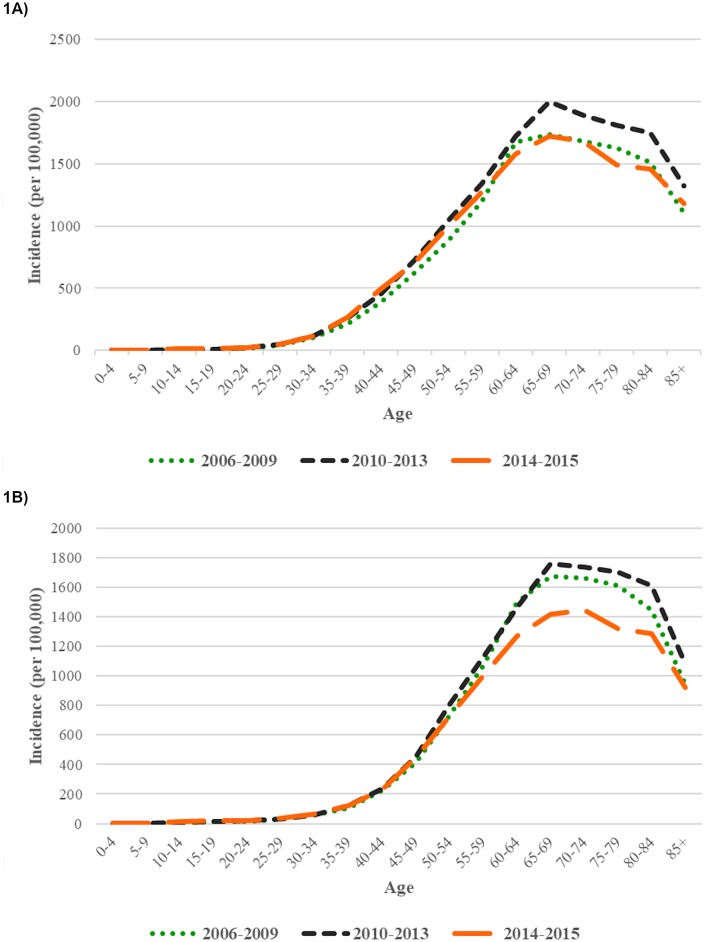
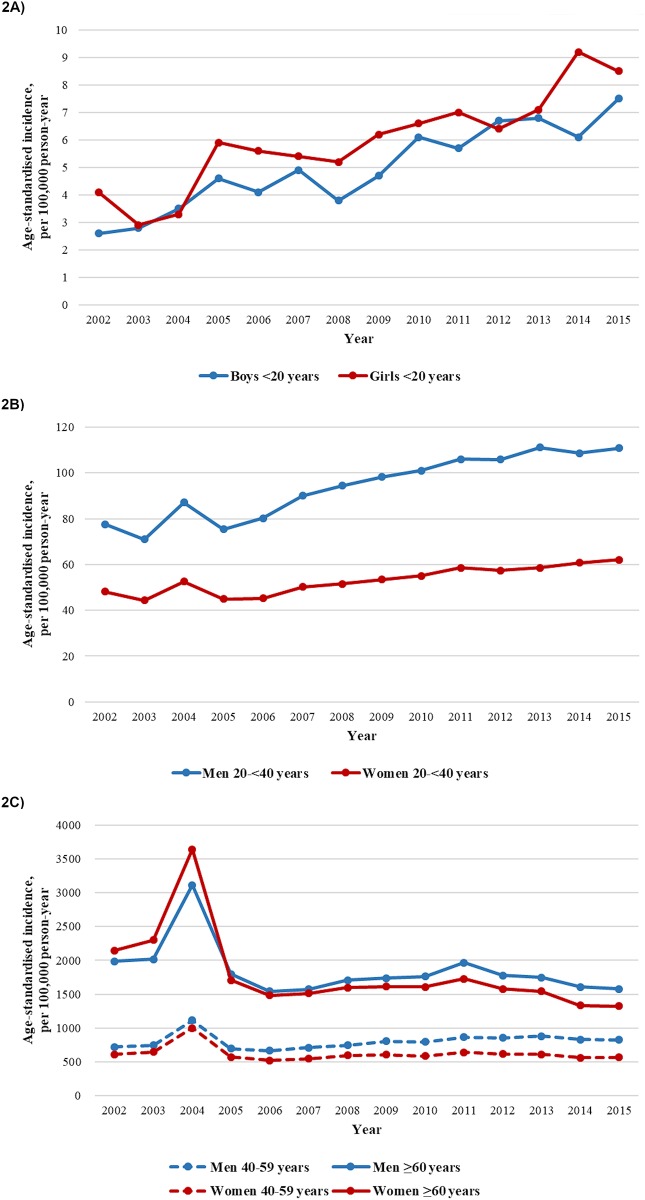
The Hong Kong Diabetes Surveillance Database hosts clinical information on people with diabetes receiving care under the Hong Kong Hospital Authority, a statutory body that governs all public hospitals and clinics. Sex-specific incidence rates were standardised to the age structure of the World Health Organization population. Joinpoint regression analysis was used to describe incidence trends. A total of 562,022 cases of incident diabetes (type 1 diabetes [n = 2,426]: mean age at diagnosis is 32.5 years, 48.4% men; type 2 diabetes [n = 559,596]: mean age at diagnosis is 61.8 years, 51.9% men) were included. Among people aged <20 years, incidence of both type 1 and type 2 diabetes increased. For type 1 diabetes, the incidence increased from 3.5 (95% CI 2.2-4.9) to 5.3 (95% CI 3.4-7.1) per 100,000 person-years (average annual percentage change [AAPC] 3.6% [95% CI 0.2-7.1], p < 0.05) in boys and from 4.3 (95% CI 2.7-5.8) to 6.4 (95% CI 4.3-8.4) per 100,000 person-years (AAPC 4.7% [95% CI 1.7-7.7], p < 0.05] in girls; for type 2 diabetes, the incidence increased from 4.6 (95% CI 3.2-6.0) to 7.5 (95% CI 5.5-9.6) per 100,000 person-years (AAPC 5.9% [95% CI 3.4-8.5], p < 0.05) in boys and from 5.9 (95% CI 4.3-7.6) to 8.5 (95% CI 6.2-10.8) per 100,000 person-years (AAPC 4.8% [95% CI 2.7-7.0], p < 0.05) in girls. In people aged 20 to <40 years, incidence of type 1 diabetes remained stable, but incidence of type 2 diabetes increased over time from 75.4 (95% CI 70.1-80.7) to 110.8 (95% CI 104.1-117.5) per 100,000 person-years (AAPC 4.2% [95% CI 3.1-5.3], p < 0.05) in men and from 45.0 (95% CI 41.4-48.6) to 62.1 (95% CI 57.8-66.3) per 100,000 person-years (AAPC 3.3% [95% CI 2.3-4.2], p < 0.05) in women. In people aged 40 to <60 years, incidence of type 2 diabetes increased until 2011/2012 and then flattened. In people aged ≥60 years, incidence was stable in men and declined in women after 2011. No trend was identified in the incidence of type 1 diabetes in people aged ≥20 years. The present study is limited by its reliance on electronic medical records for identification of people with diabetes, which may result in incomplete capture of diabetes cases. The differentiation of type 1 and type 2 diabetes was based on an algorithm subject to potential misclassification.
There was an increase in incidence of type 2 diabetes in people aged <40 years and stabilisation in people aged ≥40 years. Incidence of type 1 diabetes continued to climb in people aged <20 years but remained constant in other age groups.
亚洲的糖尿病发病率时间趋势数据非常有限。我们利用人群水平的数据,报告了香港在 2002 年至 2015 年间 1 型和 2 型糖尿病的发病趋势。
香港糖尿病监测数据库包含了在香港医管局管辖的所有公立医院和诊所接受治疗的糖尿病患者的临床信息。按世界卫生组织人口结构标准化了性别特异性发病率。采用连接点回归分析描述发病趋势。共纳入 562022 例新发糖尿病病例(1 型糖尿病[例数=2426]:诊断时的平均年龄为 32.5 岁,男性占 48.4%;2 型糖尿病[例数=559596]:诊断时的平均年龄为 61.8 岁,男性占 51.9%)。在年龄<20 岁的人群中,1 型和 2 型糖尿病的发病率均有所上升。对于 1 型糖尿病,男性发病率从每 10 万人年 3.5(95%可信区间 2.2-4.9)增加到 5.3(95%可信区间 3.4-7.1)(平均年百分比变化[AAPC]3.6%[95%可信区间 0.2-7.1],p<0.05),女性发病率从每 10 万人年 4.3(95%可信区间 2.7-5.8)增加到 6.4(95%可信区间 4.3-8.4)(AAPC 4.7%[95%可信区间 1.7-7.7],p<0.05);对于 2 型糖尿病,男性发病率从每 10 万人年 4.6(95%可信区间 3.2-6.0)增加到 7.5(95%可信区间 5.5-9.6)(AAPC 5.9%[95%可信区间 3.4-8.5],p<0.05),女性发病率从每 10 万人年 5.9(95%可信区间 4.3-7.6)增加到 8.5(95%可信区间 6.2-10.8)(AAPC 4.8%[95%可信区间 2.7-7.0],p<0.05)。在年龄 20 至<40 岁的人群中,1 型糖尿病的发病率保持稳定,但 2 型糖尿病的发病率随时间推移而增加,从每 10 万人年 75.4(95%可信区间 70.1-80.7)增加到 110.8(95%可信区间 104.1-117.5)(AAPC 4.2%[95%可信区间 3.1-5.3],p<0.05),男性发病率从每 10 万人年 45.0(95%可信区间 41.4-48.6)增加到 62.1(95%可信区间 57.8-66.3)(AAPC 3.3%[95%可信区间 2.3-4.2],p<0.05),女性发病率从每 10 万人年 45.0(95%可信区间 41.4-48.6)增加到 62.1(95%可信区间 57.8-66.3)(AAPC 3.3%[95%可信区间 2.3-4.2],p<0.05)。在年龄 40 至<60 岁的人群中,2 型糖尿病的发病率在 2011/2012 年达到峰值后趋于平稳。在年龄≥60 岁的人群中,男性的发病率保持稳定,女性的发病率在 2011 年后下降。在年龄≥20 岁的人群中,1 型糖尿病的发病率没有趋势。本研究的局限性在于依赖电子病历来识别糖尿病患者,这可能导致糖尿病病例不完全捕获。1 型和 2 型糖尿病的区分是基于一个潜在的分类错误的算法。
<40 岁人群的 2 型糖尿病发病率增加,≥40 岁人群的发病率稳定。<20 岁人群的 1 型糖尿病发病率继续攀升,而其他年龄组的发病率保持稳定。